TCS on Foreign Remittance Under LRS: Rates and Refunds
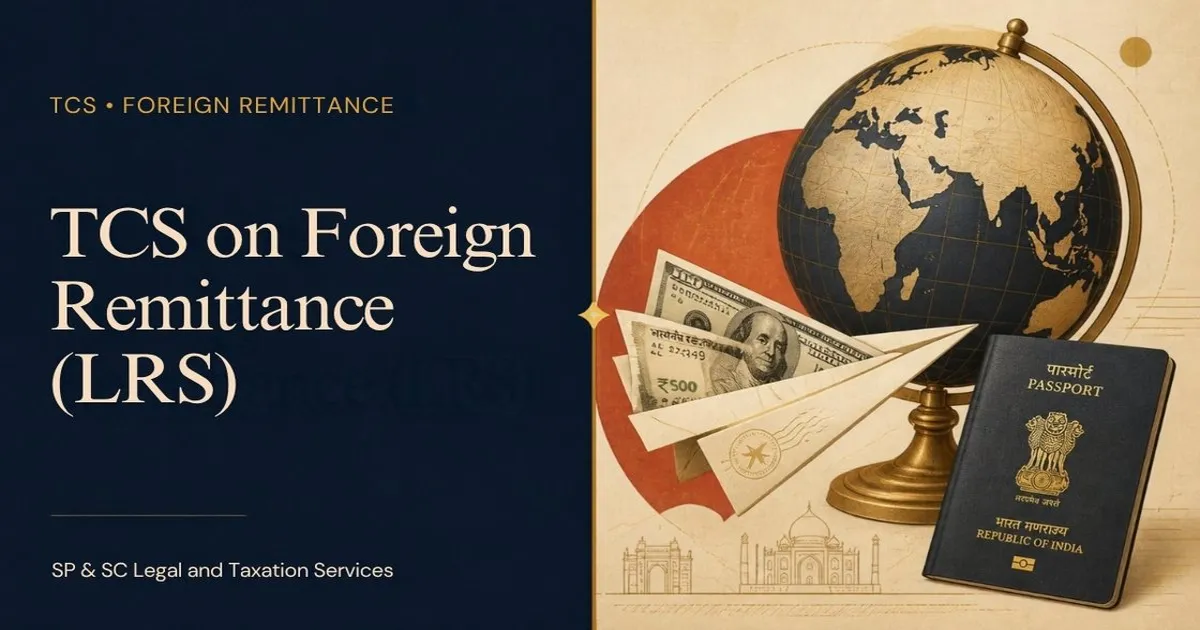
Learn about Tax Collected at Source (TCS) on foreign remittances under the Liberalised Remittance Scheme (LRS), including the latest rates and thresholds.
TCS on Foreign Remittance Under LRS: Rates and Refunds
Short answer: Tax Collected at Source (TCS) on foreign remittances under the Liberalised Remittance Scheme (LRS) is an advance tax collected by your bank as per Section 206C(1G) of the Income-tax Act. Rates vary from 0.5% to 20% based on the purpose and amount. There is generally no TCS on remittances up to ₹7 lakh in a financial year. This amount is creditable against your final tax liability and can be claimed as a refund.
What is the Liberalised Remittance Scheme (LRS)?
The Liberalised Remittance Scheme (LRS) is a framework established by the Reserve Bank of India (RBI) that allows resident individuals, including minors, to freely remit up to USD 250,000 per financial year for any permissible current or capital account transaction. This includes purposes like travelling abroad, education, medical treatment, investing in foreign stocks or property, and sending gifts or maintenance funds to relatives overseas.
What is Tax Collected at Source (TCS) on LRS?
TCS is an income tax collected by the seller (in this case, your bank or authorised foreign exchange dealer) from the buyer (you). Under Section 206C(1G), when you remit money abroad under LRS, your bank is required to collect TCS at the prescribed rate. This is not an additional tax but a prepayment of your income tax, similar to Tax Deducted at Source (TDS). The amount collected is reflected in your Form 26AS and Annual Information Statement (AIS), and you can claim full credit for it when filing your income tax return.
What are the current TCS rates for foreign remittances?
The TCS rate depends on the purpose of your remittance and the total amount sent during the financial year. The general rule is that no TCS is levied on the first ₹7 lakh remitted under LRS in a financial year, with the exception of overseas tour packages.
Here are the applicable rates for FY 2025-26 (AY 2026-27):
| Purpose of Remittance | Threshold for TCS to Apply | TCS Rate on Amount Exceeding Threshold |
|---|---|---|
| Education, financed by a loan qualifying under Section 80E | ₹7 Lakh per financial year | 0.5% |
| Education (self-funded) or Medical Treatment | ₹7 Lakh per financial year | 5% |
| All other LRS purposes (Investments, Gifts, etc.) | ₹7 Lakh per financial year | 20% |
Special Rule for Overseas Tour Packages:
The TCS rules for tour packages are different. The ₹7 lakh threshold is not an exemption but a point where the rate changes. There is no initial tax-free limit.
| Cost of Overseas Tour Package | Applicable TCS Rate |
|---|---|
| On the first ₹7 Lakh | 5% |
| On the amount exceeding ₹7 Lakh | 20% |
How is the ₹7 lakh threshold calculated?
The ₹7 lakh threshold is an aggregate limit for each individual (per PAN) in a single financial year. It covers all remittances made under LRS, regardless of the purpose (excluding tour packages, which are tracked separately for their rate change). If you use multiple banks for remittances, it is your responsibility to declare the total amount already remitted during the year to ensure the bank applies the correct TCS. The government is also improving systems for banks to track this automatically.
Can I claim a refund for the TCS paid?
Yes, absolutely. Since TCS is an advance tax payment, you can claim it as a credit against your total income tax liability for the year. The process is straightforward:
- Verify TCS: The TCS collected by the bank will appear in your Form 26AS and AIS within a few days of the transaction.
- File ITR: When you file your income tax return, declare the total TCS paid during the year.
- Adjust Against Liability: The tax portal will automatically set off the TCS amount (along with any TDS and advance tax paid) against your final tax liability.
- Receive Refund: If your total tax payments (TCS + TDS + Advance Tax) are more than your actual tax liability, the excess amount will be issued to you as an income tax refund.
Worked example
Ms. Priya, a marketing head in Bengaluru, makes several foreign remittances during the financial year 2025-26. Her total taxable income for the year is ₹30 lakh.
- October 2025: Remits ₹9 lakh for her daughter's university tuition in Canada (self-funded).
- December 2025: Remits ₹6 lakh to purchase shares of a US-based tech company.
- January 2026: Books an overseas tour package to Switzerland for ₹10 lakh.
Here’s how her TCS will be calculated:
-
TCS on Education Remittance (₹9 lakh):
- The first ₹7 lakh is the threshold amount. TCS applies on the excess.
- Amount subject to TCS = ₹9,00,000 - ₹7,00,000 = ₹2,00,000.
- TCS rate for self-funded education is 5%.
- TCS Collected = 5% of ₹2,00,000 = ₹10,000.
-
TCS on Investment Remittance (₹6 lakh):
- The ₹7 lakh threshold for the year has already been exhausted.
- The entire amount is subject to TCS.
- TCS rate for investment is 20%.
- TCS Collected = 20% of ₹6,00,000 = ₹1,20,000.
-
TCS on Overseas Tour Package (₹10 lakh):
- TCS on the first ₹7 lakh = 5% of ₹7,00,000 = ₹35,000.
- TCS on the balance amount (₹10 lakh - ₹7 lakh = ₹3 lakh) = 20% of ₹3,00,000 = ₹60,000.
- Total TCS on Tour Package = ₹35,000 + ₹60,000 = ₹95,000.
Total TCS and Final Tax Adjustment:
- Total TCS collected from Priya = ₹10,000 + ₹1,20,000 + ₹95,000 = ₹2,25,000.
- This entire amount of ₹2,25,000 will be available as a credit when she files her ITR for AY 2026-27.
- If her final tax liability is, for instance, ₹6,00,000, she will only need to pay the balance of ₹3,75,000 (assuming no other TDS or advance tax was paid).
Common mistakes
- Treating TCS as an Extra Tax: The most common error is thinking TCS is a final, non-refundable tax. It is merely an advance collection that you can fully claim back.
- Not Declaring Purpose Correctly: Failing to inform your bank that a remittance is for education funded by a loan (under Section 80E) will result in TCS being collected at 5% or 20% instead of the concessional 0.5% rate.
- Ignoring Aggregate Remittances: Forgetting to track total remittances made through different banks in a year can lead to incorrect TCS calculation. You must declare your cumulative remittances to each bank.
- Misunderstanding Tour Package Rules: Applying the general LRS threshold of ₹7 lakh as an exemption for tour packages is incorrect. TCS applies from the first rupee for tour packages.
- Not Providing PAN: If you do not provide your PAN to the bank, they must collect TCS at a much higher rate as per Section 206CC, and you will not be able to claim credit for it.
How SP & SC helps
Navigating TCS on large foreign remittances requires careful planning to manage cash flow and ensure compliance. At SP & SC, we provide expert tax consultation to help you structure your remittances efficiently. We verify that the correct TCS rate is applied, assist in preparing the necessary documentation for your bank, and handle your income tax filing end-to-end to ensure you receive the full credit and any applicable refunds promptly. For professional guidance on tax planning for your foreign transactions, explore our tax consultation services.
Frequently asked questions
H3: Is TCS applicable on international credit card usage?
As of September 2026, international spending on credit cards while overseas is not treated as a remittance under LRS and is therefore not subject to TCS. However, the rules in this area have been subject to change, so it's wise to monitor RBI and Finance Ministry notifications for any updates.
H3: What happens if I do not provide my PAN?
If you fail to furnish your PAN to the authorised dealer, Section 206CC of the Income-tax Act mandates the collection of TCS at a higher rate. Furthermore, you will be unable to claim credit for this TCS amount when filing your tax return, resulting in a direct financial loss.
H3: I am an NRI. Does LRS TCS apply to me?
No. The Liberalised Remittance Scheme (LRS) is exclusively for resident Indians. Since Non-Resident Indians (NRIs) cannot use the LRS facility, the provisions of TCS under Section 206C(1G) do not apply to them.
H3: Do I pay TCS if my income is below the taxable limit?
Yes, the authorised dealer is obligated to collect TCS at the applicable rate if your remittance exceeds the threshold, irrespective of your personal income tax slab. However, if you have no final tax liability, you can file an ITR and claim a full refund of the TCS amount collected.
H3: How does my bank track my total LRS remittances for the year?
The bank primarily relies on a declaration provided by you regarding any remittances made through other financial institutions during the year. It is your legal responsibility to provide accurate information. The government is also developing a more robust system for real-time tracking of LRS utilisation across the banking system.
Get a fixed-fee quote
Planning a large foreign remittance for education, investment, or property? Unsure about the tax implications? Share your documents with us for a confidential review and receive a written fixed-fee quote for our services. We help clients plan their finances, ensure tax compliance, and handle all related filings from start to finish. Contact SP & SC via email or on WhatsApp at +91 90356 74566.
Written by
SP & SC Editorial
Editorial team at SP & SC Legal and Taxation Services — practising advocates, chartered accountants, and company secretaries publishing hands-on guidance from live client files.
Next steps
What to do next
Guides help you decide. If you need an advocate, CA, or CS on your side, the SP & SC team files, drafts, and represents.