Section 80E: Tax Deduction on Education Loan Interest
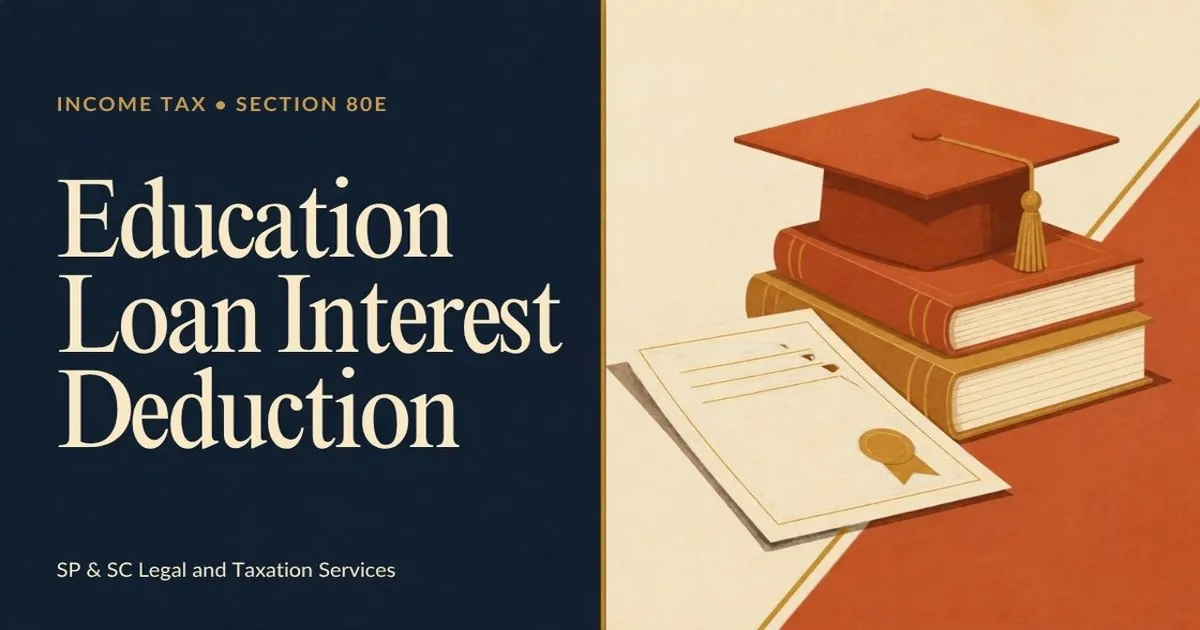
Section 80E lets you deduct the full interest on an education loan for up to 8 years, with no upper limit. Who qualifies, which loans count, and a worked example.
Section 80E: Tax Deduction on Education Loan Interest
Short answer: Under Section 80E of the Income Tax Act, 1961, an individual can deduct the entire interest paid on a loan taken for higher education, with no rupee ceiling. The deduction runs for the year repayment starts and the next 7 years, so 8 years at most. The principal portion gets no deduction. It is available only under the old tax regime.
Who can claim the Section 80E deduction?
Only an individual can claim it, and only for a loan taken for their own higher education or that of their spouse, children, or a student for whom they are the legal guardian. A HUF or company cannot claim it. Siblings do not qualify, so if a brother pays interest on his sister's loan, neither of them gets the deduction unless the sister is the borrower and pays herself.
Which loans qualify?
The loan must come from a bank, a notified financial institution, or an approved charitable institution. Loans from relatives, friends or an employer do not qualify, however genuine they are.
| Point | Qualifies | Does not qualify |
|---|---|---|
| Lender | Bank, notified NBFC, approved charity | Relative, friend, employer |
| Course | Any course after Class 12, India or abroad | School fees |
| Amount claimed | Full interest paid in the year | Principal repayment |
| Regime | Old regime | New regime under Sec. 115BAC |
"Higher education" covers any full-time course after Senior Secondary, including vocational courses, in India or abroad.
How long does the deduction last?
The 8-year clock starts in the financial year you begin repaying, not the year the loan was sanctioned. Interest paid during a moratorium, while the student is still studying, is usually added to the loan and claimed once repayment starts. If you close the loan in 5 years, the deduction simply ends after 5 years.
Worked example
Riya took a ₹18 lakh loan from a public-sector bank for an MS abroad. Repayment began in April 2025. In FY 2025-26 she paid EMIs of ₹2,76,000, of which ₹1,62,000 was interest.
- Deduction under Sec. 80E: ₹1,62,000 (full interest, no cap)
- Her taxable income falls from ₹14,00,000 to ₹12,38,000 under the old regime
- At a 30% slab plus 4% cess, the saving is about ₹50,500
Riya then compared regimes. Her 80E claim plus 80C and HRA made the old regime cheaper that year. Run your own figures in our income tax calculator before choosing.
Is 80E better than choosing the new tax regime?
It depends on how large your interest is. The new regime has lower rates and a rebate up to ₹12 lakh of income, but it disallows 80E. A large education loan in its early years often tips the balance to the old regime. As interest falls, the new regime may win. Check every year, since salaried employees can switch at the time of filing.
Documents you need
- Interest certificate from the bank for the financial year, showing interest and principal separately
- Loan sanction letter showing the student's name and course
- Proof of relationship if the borrower is a parent or spouse
You do not upload these with the return, but keep them for any notice under Sec. 143(1) or scrutiny.
Common mistakes
- Claiming principal along with interest. Only interest counts.
- Claiming a loan from a relative or employer.
- Claiming beyond the 8th year.
- Claiming under the new regime, which triggers a mismatch.
- Two people claiming the same loan.
How SP & SC helps
We check your eligibility, compare both regimes on your actual figures, and file your return with the 80E claim correctly reported. See our income tax filing service.
Frequently asked questions
Is there a maximum limit under Section 80E?
No. The full interest paid during the year is deductible, however large.
Can I claim 80E for a loan taken for my sibling?
No. Only self, spouse, children, or a student you are legal guardian of qualify.
Can a parent and child both claim the same loan?
No. Only the person who is the borrower and actually pays the interest can claim.
Does 80E apply to loans for study abroad?
Yes, as long as the lender is a bank or notified institution.
Can I claim 80E under the new regime?
No. Section 115BAC removes this deduction under the new regime.
Get a fixed-fee quote
Every situation is different, so we do not publish a one-size price. Share your documents with us and a named advisor will send a written, fixed-fee quote before any work starts. Contact SP & SC or message us on WhatsApp at +91 90356 74566. Whatever the problem you bring, we handle it end to end.
Written by
SP & SC Editorial
Editorial team at SP & SC Legal and Taxation Services — practising advocates, chartered accountants, and company secretaries publishing hands-on guidance from live client files.
Next steps
What to do next
Guides help you decide. If you need an advocate, CA, or CS on your side, the SP & SC team files, drafts, and represents.