
Form 26AS vs AIS vs TIS: What Each Shows and How to Fix Mismatches
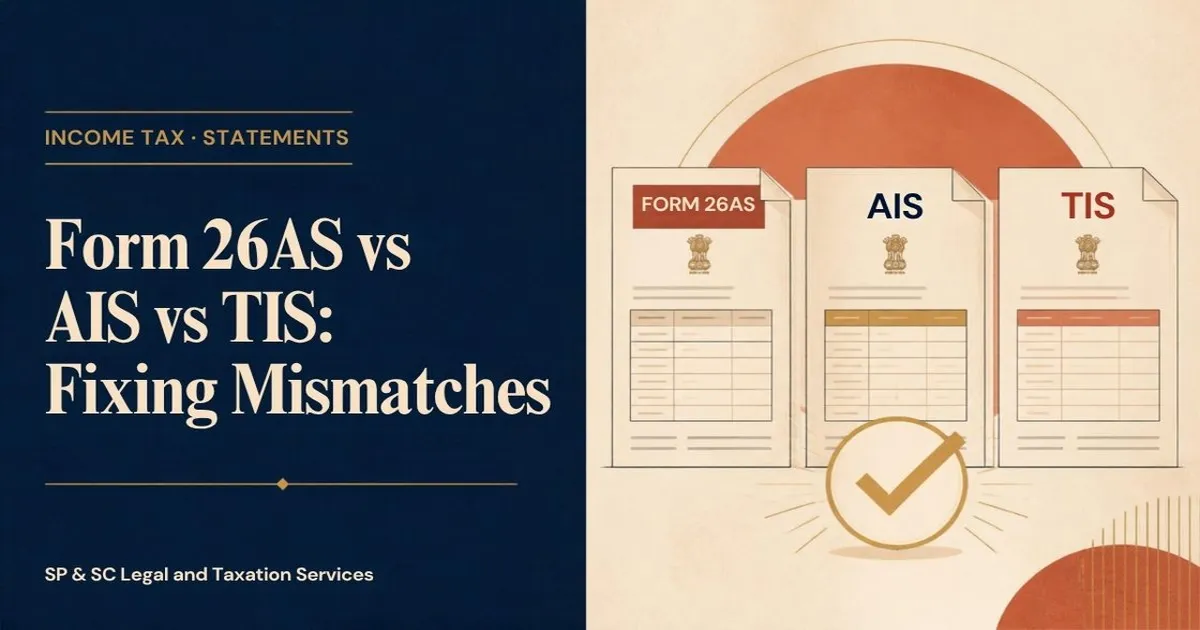
Three statements, one tax record. Learn what Form 26AS, the Annual Information Statement and the Taxpayer Information Summary contain, and how to give feedback before filing.
Form 26AS vs AIS is mainly a distinction between tax-credit records and wider financial information. For FY 2025-26 / AY 2026-27, use Form 26AS to check TDS and TCS, AIS to review reported transactions and tax information, and TIS to understand consolidated figures used for prefilling. Reconcile all three with your records before filing. Incorrect reporting needs feedback or source correction, while missing taxable income must still be declared.
What is the difference between Form 26AS, AIS and TIS?
Form 26AS primarily records tax deducted or collected, AIS provides broader financial information, and TIS summarises information within AIS.
The Income-tax Act, 1961 continues to govern FY 2025-26 / AY 2026-27.
| Feature | Form 26AS | AIS | TIS |
|---|---|---|---|
| Full name | Annual Tax Statement | Annual Information Statement | Taxpayer Information Summary |
| Access | TRACES, through the income-tax e-filing portal | AIS service on the e-filing portal | Within the AIS service |
| Main content | TDS and TCS information from AY 2023-24 onwards | TDS/TCS, reported financial transactions, tax payments, refunds and other available information | Category-wise aggregates of information in AIS |
| Typical use | Checking reported tax credits | Reviewing interest, dividends, securities transactions, property transactions and other reporting | Checking processed and accepted values used for prefilling, where applicable |
| Correction route | Deductor or collector corrects the underlying statement | Submit feedback against relevant information | Derived values update through AIS processing and applicable feedback |
| Important limitation | Not a complete income statement | May contain omissions, duplicates or incorrect reporting | Not an independent calculation of taxable income |
Older descriptions showing advance tax, self-assessment tax and refunds as current Form 26AS content are outdated. From AY 2023-24, these details are available through AIS rather than the revised Form 26AS.
AIS operates within the information-statement framework under Sec. 285BB Income-tax Act and Rule 114-I Income-tax Rules. Its contents depend on information received by the department; it is not necessarily complete.
Does every AIS transaction represent taxable income?
No, AIS reports financial information, which may differ substantially from the income taxable in your return.
Common reconciliation points include:
- Share and mutual-fund sales: Reported sale proceeds are not capital gains. Calculate gains using acquisition cost, eligible expenses and applicable tax provisions.
- Duplicate interest: Check whether apparently repeated entries genuinely duplicate the same deposit interest.
- Joint accounts: Reporting against the first holder’s PAN does not necessarily determine tax ownership. Examine contributions, beneficial ownership and any clubbing provisions.
- Property purchases: A purchase entry may correctly record your investment, but it does not make the purchase price your income. A seller must separately compute any taxable capital gain.
- Foreign remittances: A remittance may represent an investment, expense or transfer, rather than taxable income.
- GST turnover: Differences from income-tax business receipts may require reconciliation for timing, credit notes or reporting treatment.
AIS can also omit income. Savings interest, cash receipts or foreign income do not become exempt merely because they are absent.
For salaried taxpayers and businesses alike, the return must follow the law and underlying evidence, not simply reproduce AIS totals.
Can an AIS mismatch automatically increase your tax?
An AIS mismatch can trigger verification, but it does not by itself authorise every addition through return processing.
Adjustments under Sec. 143(1)(a) Income-tax Act are limited to specified grounds. In particular, the adjustment provision for income appearing in Form 26AS, Form 16 or Form 16A but omitted from the return does not apply from AY 2018-19 onwards. It is therefore incorrect to say that any AIS difference automatically permits CPC to add income under that provision.
The department may nevertheless seek explanations through compliance communications or take other action permitted by law. Where a proposed processing adjustment is legally available, taxpayers ordinarily have 30 days from issue of the communication to respond.
The practical lesson remains: investigate discrepancies before filing, without treating every reported transaction as taxable income.
How much can omitted bank interest cost?
Omitted taxable interest increases your tax according to the applicable regime and slab, even if the bank deducted no TDS.
Suppose Sunita reports ₹18,000 savings-account interest, but AIS shows ₹62,000 total bank interest. The difference is ₹44,000 FD interest on which the bank deducted no TDS after receiving Form 15G.
Form 15G is not a tax exemption. Its validity depends on statutory conditions, including estimated nil tax liability under Sec. 197A Income-tax Act.
Assume Sunita uses the new regime under Sec. 115BAC Income-tax Act and has taxable income of ₹18,00,000 before adding the omitted interest. All her income is taxable at normal slab rates.
| Calculation | Amount |
|---|---|
| Additional FD interest | ₹44,000 |
| Additional income tax at 20%, within the ₹16 lakh to ₹20 lakh slab | ₹8,800 |
| Health and Education Cess at 4% | ₹352 |
| Additional tax including cess | ₹9,152 |
This excludes interest under Sec. 234B Income-tax Act or Sec. 234C Income-tax Act, which depends on advance-tax liability and payment dates. Sunita should also investigate whether her earlier Form 15G declaration was valid.
How do you submit AIS feedback correctly?
Submit transaction-level feedback through AIS and retain documents supporting both the correction and your return position.
- Log in to the income-tax e-filing portal and open AIS.
- Select FY 2025-26 and inspect the relevant information category.
- Open the disputed entry and select the available feedback option.
- Enter the corrected value or explanation where requested.
- Save the acknowledgement and monitor the feedback status.
Depending on the information category, options can include information being correct, not fully correct, duplicated, related to another PAN or year, or denied. Do not assume every category offers identical options.
Where information is not taxable, explain its actual character using the available workflow and supporting records.
Feedback may be shared with the reporting entity for confirmation. A bank or broker may confirm or disagree with it. Feedback does not itself amend your filed return, correct a TDS statement or conclusively settle tax treatment.
What should you do if TDS is missing from Form 26AS?
Ask the deductor to verify payment and reporting, because missing Form 26AS credit usually requires correction at source.
Possible causes include an unfiled TDS statement, an incorrect PAN, an incorrect challan reference or processing delays. Obtain Form 16 or Form 16A and evidence of the deduction, then request a correction statement where necessary.
“You can claim only what appears in Form 26AS” is too absolute. Credit entitlement is governed by Sec. 199 Income-tax Act read with Rule 37BA Income-tax Rules, although missing entries commonly cause processing difficulties.
Sec. 205 Income-tax Act also protects against direct recovery from the taxpayer to the extent tax has actually been deducted. Credit and recovery issues require evidence and appropriate follow-up, not an automatic second payment of the same tax.
For an incorrect processed result, consider rectification under Sec. 154 Income-tax Act or another suitable remedy.
What should you check before filing for AY 2026-27?
Reconcile reported information, actual income and tax payments before submitting the return.
Download all three statements after mid-June 2026, when many fourth-quarter TDS filings and certificates should be available, and refresh them before filing. Reporting corrections can arrive later.
Match salary with Form 16, interest with bank certificates, gains with broker records, and business receipts with books and GST returns. Verify advance tax and self-assessment tax against challans. Submit AIS feedback for errors, pursue missing TDS corrections, and report all taxable income.
How SP & SC helps
SP & SC Legal and Taxation Services, Bengaluru, reconciles Form 26AS, AIS and TIS with supporting records and advises on corrections, filing and mismatch responses.
Our fees are a fixed quote after reviewing the case. Use our secure document-sharing process rather than sending portal passwords. For assistance, contact us.
Frequently asked questions
Is AIS legally binding?
AIS is an information statement, not a final assessment. Investigate differences and support your return with records and applicable law.
Does AIS feedback automatically update TIS?
Relevant processed or accepted values can update through AIS processing. Check the resulting TIS figures rather than assuming every aggregate changes immediately.
Can I correct a return already filed?
A revised return under Sec. 139(5) Income-tax Act may be available. For AY 2026-27, the ordinary deadline is 31 December 2026, or completion of assessment, whichever is earlier.
How long can a processing intimation take?
An intimation under Sec. 143(1) Income-tax Act can be sent within nine months from the end of the financial year in which the return is filed. Other proceedings have different timelines.
What if I have already received a notice?
Check its section, deadline and disputed figures. Read our guide on responding to an income tax notice and submit a documented response.
Written by
SP & SC Editorial
Editorial team at SP & SC Legal and Taxation Services — practising advocates, chartered accountants, and company secretaries publishing hands-on guidance from live client files.
Next steps
What to do next
Guides help you decide. If you need an advocate, CA, or CS on your side, the SP & SC team files, drafts, and represents.