Income Tax Benefits for Senior Citizens in India
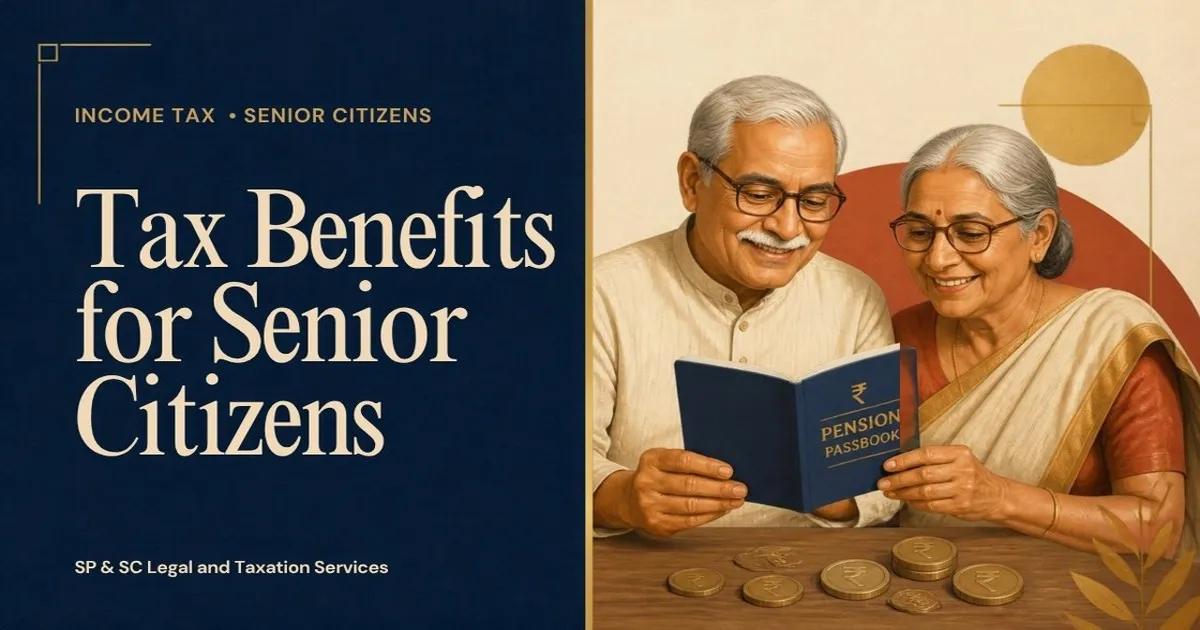
Senior citizens in India get special tax benefits, including a higher basic exemption, deductions up to ₹50,000 for health expenses and interest income.
Income Tax Benefits for Senior Citizens in India
Short answer: As a senior citizen (aged 60+) or super senior citizen (aged 80+), you are entitled to significant income tax benefits. These include a higher basic tax exemption limit under the old regime, a substantial deduction of ₹50,000 for interest income under Section 80TTB, enhanced deductions for health insurance under Section 80D, and an exemption from paying advance tax if you do not have business income. These benefits are designed to reduce your tax burden in your post-retirement years.
What is the basic tax exemption for senior citizens?
The basic tax exemption limit, which is the amount of income up to which no tax is payable, depends on your age and the tax regime you choose. For the financial year 2025-26 (Assessment Year 2026-27), the new tax regime is the default option. However, you can opt for the old regime if it is more beneficial.
- Under the New Tax Regime (Default): The basic exemption limit is ₹3,00,000 for all individuals, including senior and super senior citizens. However, a rebate under Section 87A makes income up to ₹12,00,000 effectively tax-free for many.
- Under the Old Tax Regime:
- Senior Citizens (60 to 79 years): The basic exemption limit is ₹3,00,000.
- Super Senior Citizens (80 years and above): The basic exemption limit is ₹5,00,000.
Choosing the right regime requires careful calculation. You can learn more about the latest slabs in our guide to income tax slabs for AY 2026-27.
Are senior citizens exempt from paying advance tax?
Yes, resident senior citizens are exempt from the requirement to pay advance tax under Section 207 of the Income-tax Act, 1961. This exemption applies provided the senior citizen does not have any income chargeable under the head "Profits and gains of business or profession". If you only have income from sources like pension, interest, rent, or capital gains, you do not need to pay tax in installments during the year. You can pay your entire tax liability (if any) as self-assessment tax before filing your return. Read our guide on advance tax installments for more details.
What are the health insurance benefits under Section 80D?
Senior citizens receive a higher deduction for health-related expenses under Section 80D, which is available only if you opt for the old tax regime. You can claim a deduction of up to ₹50,000 for health insurance premiums paid for yourself and your spouse. If you do not have health insurance, you can claim a deduction of up to ₹50,000 for medical expenditure incurred during the year. This provides significant relief, acknowledging the higher healthcare costs associated with age. Explore the nuances in our detailed guide on deductions under Section 80D.
Can senior citizens claim deductions for medical treatment?
Yes, under the old tax regime, senior citizens can claim two primary deductions for medical treatment.
- Section 80D: As mentioned above, if a senior citizen does not have any health insurance coverage, they can claim a deduction for medical expenses incurred up to a limit of ₹50,000.
- Section 80DDB: For medical treatment of specified diseases and ailments (like cancer, chronic renal failure, etc.) for self or a dependent, senior citizens can claim a deduction of up to ₹1,00,000. This is a significant increase from the ₹40,000 limit available to non-senior citizens. This deduction is based on the actual amount spent.
What is the tax benefit on interest income for seniors?
Section 80TTB provides a special benefit for senior citizens, available only under the old tax regime. Under this section, you can claim a deduction of up to ₹50,000 on interest income earned from deposits held in savings bank accounts, fixed deposits (FDs), or post office deposit schemes. This is a substantial benefit compared to Section 80TTA (available to non-seniors), which only allows a deduction of up to ₹10,000 and that too only on savings account interest. This provision directly reduces the tax on one of the most common sources of income for retirees. Consequently, TDS on interest is also triggered only if interest income from a bank exceeds ₹50,000 per financial year, as per Section 194A.
Comparison of Tax Benefits: Senior vs. Non-Senior Citizen
| Benefit Feature | Non-Senior Citizen (<60) | Senior Citizen (60-79) | Super Senior Citizen (80+) |
|---|---|---|---|
| Basic Exemption (Old Regime) | ₹2,50,000 | ₹3,00,000 | ₹5,00,000 |
| Basic Exemption (New Regime) | ₹3,00,000 | ₹3,00,000 | ₹3,00,000 |
| Standard Deduction (Pension) | ₹50,000 (Old), ₹75,000 (New) | ₹50,000 (Old), ₹75,000 (New) | ₹50,000 (Old), ₹75,000 (New) |
| Health Insurance (Sec 80D) | Up to ₹25,000 (+₹25,000 for parents) | Up to ₹50,000 | Up to ₹50,000 |
| Interest Deduction | Sec 80TTA: Up to ₹10,000 (Savings A/c) | Sec 80TTB: Up to ₹50,000 (Savings + Deposits) | Sec 80TTB: Up to ₹50,000 (Savings + Deposits) |
| Advance Tax Payment | Mandatory if tax > ₹10,000 | Not required (if no business income) | Not required (if no business income) |
| Form for no TDS on Interest | Form 15G | Form 15H | Form 15H |
Note: Deductions under Chapter VI-A (like 80D, 80TTB) are generally not available under the New Tax Regime. A detailed analysis is available in our New vs. Old Tax Regime guide.
Worked example
Ms. Sharma, a 68-year-old resident of Bengaluru, has the following income and expenses for FY 2025-26:
- Pension Income: ₹8,00,000
- Interest from Bank FDs: ₹1,20,000
- Health Insurance Premium paid for self: ₹55,000
Let's calculate her tax liability under both regimes to see which is more beneficial.
1. Calculation under Old Tax Regime
- Gross Pension: ₹8,00,000
- Less: Standard Deduction: ₹50,000
- Income from Salary (Pension): ₹7,50,000
- Income from Other Sources (Interest): ₹1,20,000
- Gross Total Income (GTI): ₹8,70,000
- Deductions under Chapter VI-A:
- Section 80D (Health Insurance): ₹50,000 (capped at max limit)
- Section 80TTB (Interest Income): ₹50,000 (as interest income is ₹1.2L)
- Total Deductions: ₹1,00,000
- Net Taxable Income: ₹8,70,000 - ₹1,00,000 = ₹7,70,000
- Tax Calculation (Senior Citizen Slabs):
- Up to ₹3,00,000: Nil
- ₹3,00,001 to ₹5,00,000: 5% on ₹2,00,000 = ₹10,000
- ₹5,00,001 to ₹7,70,000: 20% on ₹2,70,000 = ₹54,000
- Total Income Tax: ₹64,000
- Add: Health & Education Cess @ 4%: ₹2,560
- Total Tax Payable (Old Regime): ₹66,560
2. Calculation under New Tax Regime (Default)
- Gross Pension: ₹8,00,000
- Less: Standard Deduction: ₹75,000 (as per the hypothetical Finance Act 2025)
- Income from Salary (Pension): ₹7,25,000
- Income from Other Sources (Interest): ₹1,20,000
- Gross Total Income (GTI): ₹8,45,000
- Deductions: None (80D, 80TTB not allowed).
- Net Taxable Income: ₹8,45,000
- Tax Calculation (New Slabs):
- Up to ₹3,00,000: Nil
- ₹3,00,001 to ₹6,00,000: 5% on ₹3,00,000 = ₹15,000
- ₹6,00,001 to ₹8,45,000: 10% on ₹2,45,000 = ₹24,500
- Total Income Tax before rebate: ₹39,500
- Rebate u/s 87A: Since her taxable income (₹8,45,000) is below the ₹12 lakh threshold, she is eligible for a rebate. Assuming the rebate is capped at ₹25,000.
- Tax after Rebate: ₹39,500 - ₹25,000 = ₹14,500
- Add: Health & Education Cess @ 4%: ₹580
- Total Tax Payable (New Regime): ₹15,080
Conclusion: For Ms. Sharma, the New Tax Regime is significantly more beneficial, with a tax saving of ₹51,480.
Common mistakes
- Forgetting to claim Section 80TTB: Many senior citizens claim only the ₹10,000 deduction under 80TTA or forget to claim any deduction on interest income altogether when using the old regime.
- Assuming No ITR Filing Required: Even if your final tax liability is zero due to deductions or rebates, you must file an ITR if your Gross Total Income (before Chapter VI-A deductions) exceeds your applicable basic exemption limit (e.g., ₹3 lakh or ₹5 lakh).
- Paying Advance Tax Unnecessarily: Senior citizens without business income are not required to pay advance tax. Many continue to pay it out of habit, which is not necessary.
- Not Submitting Form 15H: To prevent TDS deduction on interest income over ₹50,000, you must submit Form 15H to your bank(s) at the start of the financial year, provided your final tax liability is nil. You can use our Form 15G/15H guide for help.
- Not Comparing Regimes: Sticking to the old regime by default can be costly. As shown in the example, the new regime with its higher standard deduction and enhanced rebate can be more advantageous.
How SP & SC helps
Navigating tax laws can be complex, especially with annual changes. SP & SC Legal and Taxation Services provides end-to-end tax support for senior citizens. We help you choose the most beneficial tax regime, ensure all eligible deductions and rebates are claimed, prepare and file your income tax return accurately, and handle any communication from the Income Tax Department. Our goal is to make tax compliance a stress-free experience for you. For personalized tax planning and filing, check our income tax filing services.
Frequently asked questions
Who is a senior and super senior citizen for tax purposes?
A resident individual who is 60 years or older at any time during the financial year is considered a senior citizen. A resident individual who is 80 years or older is a super senior citizen.
Can I use Form 15H to avoid TDS on interest?
Yes. If you are a senior citizen and your estimated total tax for the year is nil, you can submit Form 15H to your bank and other financial institutions. This instructs them not to deduct TDS on your interest income, even if it exceeds the ₹50,000 threshold.
Is there any special tax benefit for reverse mortgage schemes?
Yes. The Reverse Mortgage Scheme is designed to help senior citizens get a regular stream of income by mortgaging their house property. The lump sum amount or periodic payments received under a reverse mortgage scheme are exempt from income tax.
Do I need to file an ITR if my income is below the exemption limit?
If your Gross Total Income (your total income before any deductions like 80D, 80TTB, etc.) is below the basic exemption limit for your age category (e.g., ₹3 lakh for seniors under the old regime), you are not required to file an income tax return.
Are pension and interest income treated differently for tax?
Pension is taxed under the head "Income from Salaries," making it eligible for the standard deduction. Interest income is taxed under "Income from Other Sources." While both are added to your total income, specific deductions like 80TTB are available only against interest income under the old regime.
Get a fixed-fee quote
Let our experts handle your tax planning and filing. Share your documents with us for a transparent, written fixed-fee quote. Contact SP & SC or WhatsApp us at +91 90356 74566. We take care of your compliance needs from start to finish.
Written by
SP & SC Editorial
Editorial team at SP & SC Legal and Taxation Services — practising advocates, chartered accountants, and company secretaries publishing hands-on guidance from live client files.
Next steps
What to do next
Guides help you decide. If you need an advocate, CA, or CS on your side, the SP & SC team files, drafts, and represents.