New vs Old Tax Regime FY 2025-26: Which Saves You More?
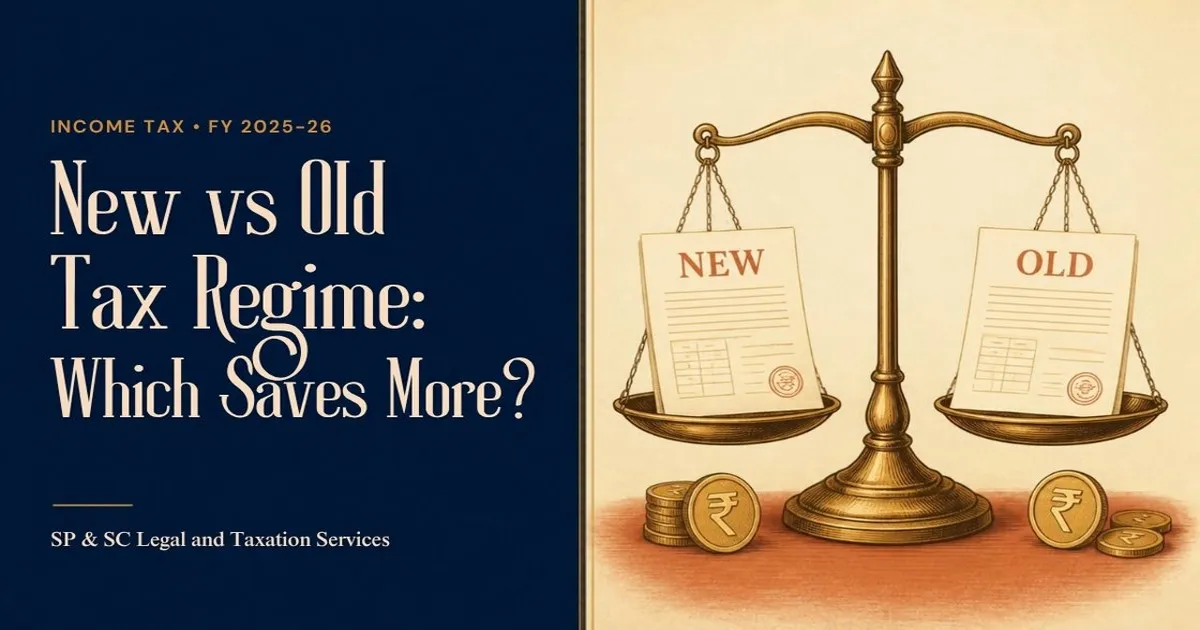
A side-by-side comparison of the new and old income tax regimes for FY 2025-26, with break-even deduction levels and worked salary examples.
For FY 2025-26, the new vs old tax regime choice usually favours the new regime unless you have substantial eligible deductions and exemptions. A resident salaried individual with only normal-rate salary income can pay zero tax on gross salary up to ₹12.75 lakh, after the ₹75,000 standard deduction and rebate. The old regime can still save more where HRA, housing-loan interest and other deductions are sufficiently large.
What changed for FY 2025-26?
The new regime offers revised slabs and a rebate covering normal-rate tax on taxable income up to ₹12 lakh for eligible resident individuals.
These rules apply to income earned from 1 April 2025 to 31 March 2026, assessed in AY 2026-27. The Income-tax Act, 1961 continues to govern this financial year.
Under Sec. 115BAC Income-tax Act, the new regime is the default. However, eligible taxpayers can choose the old regime, subject to the applicable procedure and deadlines.
The ₹12 lakh figure is a rebate threshold, not the basic exemption limit. The new regime’s nil-rate slab ends at ₹4 lakh. Tax is calculated on income above that level, then the rebate under Sec. 87A Income-tax Act may eliminate it.
The rebate is available only to resident individuals, not to non-residents or Hindu undivided families.
What are the new and old regime tax slabs?
The new regime has seven slab bands, while the standard old-regime schedule has four bands for individuals below 60.
The following rates apply to ordinary slab-rate income, before rebate, surcharge and cess:
| New regime taxable income | Rate | Old regime taxable income, below 60 | Rate |
|---|---|---|---|
| Up to ₹4 lakh | Nil | Up to ₹2.5 lakh | Nil |
| Above ₹4 lakh to ₹8 lakh | 5% | Above ₹2.5 lakh to ₹5 lakh | 5% |
| Above ₹8 lakh to ₹12 lakh | 10% | Above ₹5 lakh to ₹10 lakh | 20% |
| Above ₹12 lakh to ₹16 lakh | 15% | Above ₹10 lakh | 30% |
| Above ₹16 lakh to ₹20 lakh | 20% | Not applicable | Not applicable |
| Above ₹20 lakh to ₹24 lakh | 25% | Not applicable | Not applicable |
| Above ₹24 lakh | 30% | Not applicable | Not applicable |
Under the old regime, resident senior citizens aged 60 to 79 have a ₹3 lakh basic exemption limit. Resident individuals aged 80 or above have a ₹5 lakh basic exemption limit. The new regime’s slabs do not change with age.
Health and Education Cess is 4% of income tax plus applicable surcharge. Surcharge may apply when total income exceeds ₹50 lakh.
Does salary up to ₹12.75 lakh always mean zero tax?
No, the zero-tax outcome assumes an eligible resident individual whose taxable income, after permitted deductions, does not exceed ₹12 lakh and is taxed at ordinary slab rates.
Under Sec. 16(ia) Income-tax Act, salaried taxpayers receive a standard deduction of:
- ₹75,000 under the new regime.
- ₹50,000 under the old regime.
Each deduction is capped at the salary amount.
For gross salary of ₹12.75 lakh, subtracting ₹75,000 leaves ₹12 lakh taxable income. New-regime slab tax is ₹60,000, which the rebate under Sec. 87A Income-tax Act eliminates.
However, ₹12.75 lakh of CTC is not necessarily ₹12.75 lakh of taxable gross salary. Employer contributions and salary components need separate examination.
Interest, rent or other income can push total taxable income above ₹12 lakh. Also, the new-regime rebate does not eliminate tax charged at special rates, such as tax on certain capital gains or lottery winnings.
Marginal relief is available under Sec. 87A Income-tax Act for eligible new-regime taxpayers whose income slightly exceeds ₹12 lakh. Its calculation needs care where special-rate income is involved.
Under the old regime, the rebate remains capped at ₹12,500 where an eligible resident individual’s total income does not exceed ₹5 lakh.
Which deductions and exemptions make the old regime attractive?
The old regime allows several common deductions and exemptions that are generally unavailable under the new regime.
| Claim | Old regime | New regime |
|---|---|---|
| Sec. 80C Income-tax Act | Up to ₹1.5 lakh within the combined statutory limit | Not available |
| Sec. 80D Income-tax Act | Eligible health-insurance premiums and specified medical expenditure, subject to limits | Not available |
| HRA under Sec. 10(13A) Income-tax Act | Available subject to conditions | Not available |
| LTA under Sec. 10(5) Income-tax Act | Available for qualifying domestic travel | Not available |
| Self-occupied housing-loan interest under Sec. 24(b) Income-tax Act | Up to ₹2 lakh where conditions are met | Not available |
| Additional personal NPS contribution under Sec. 80CCD(1B) Income-tax Act | Up to ₹50,000 | Not available |
| Employer NPS contribution under Sec. 80CCD(2) Income-tax Act | Available within applicable limits | Available within applicable limits |
HRA exemption is not automatically equal to rent paid. It depends on actual HRA, qualifying salary, rent and location under Rule 2A Income-tax Rules. For Bengaluru, the relevant salary ceiling is 40%, not the 50% applicable to Delhi, Mumbai, Kolkata and Chennai.
Let-out property interest has separate rules. Do not apply the self-occupied ₹2 lakh rule mechanically to rental property, and check the new regime’s restrictions on setting off house-property losses.
How much tax is payable on an ₹18 lakh salary?
On the stated deductions, the new regime saves ₹83,200, including cess, compared with the old regime.
Assume a resident employee below 60 has ₹18 lakh gross taxable salary before standard deduction, no other income and these eligible old-regime claims:
- ₹1,50,000 under Sec. 80C Income-tax Act.
- ₹25,000 under Sec. 80D Income-tax Act.
- ₹2,00,000 self-occupied housing-loan interest under Sec. 24(b) Income-tax Act.
| Calculation | New regime | Old regime |
|---|---|---|
| Gross salary | ₹18,00,000 | ₹18,00,000 |
| Standard deduction | ₹75,000 | ₹50,000 |
| Other stated deductions | Nil | ₹3,75,000 |
| Taxable income | ₹17,25,000 | ₹13,75,000 |
| Income tax before cess | ₹1,45,000 | ₹2,25,000 |
| Cess at 4% | ₹5,800 | ₹9,000 |
| Total tax | ₹1,50,800 | ₹2,34,000 |
The new-regime calculation is ₹20,000 + ₹40,000 + ₹60,000 + ₹25,000 = ₹1,45,000 before cess, not ₹1,64,500.
If the employee also qualifies for ₹3 lakh HRA exemption, old-regime taxable income falls to ₹10.75 lakh. Tax becomes ₹1,35,000 plus ₹5,400 cess, totalling ₹1,40,400. The old regime then saves ₹10,400.
How should you decide which regime saves more?
Compare your complete annual tax liability under both regimes rather than relying on a universal deduction threshold.
- Total salary, interest, rent, business income and capital gains.
- Separate ordinary slab-rate income from special-rate income.
- Verify deductions and exemptions using supporting documents.
- Apply each regime’s standard deduction, rebate and loss-set-off rules.
- Compare the final liability, including cess and any surcharge.
Use our Income Tax Calculator, with professional review where your income includes complex items.
The suggestion that ₹4–5 lakh of deductions always makes the old regime preferable is unreliable. In the ₹18 lakh example, the break-even point is approximately ₹6.42 lakh of old-regime deductions and exemptions beyond the ₹50,000 standard deduction.
Avoid buying unsuitable insurance or locking away money merely to claim a deduction.
Can you switch regimes every year?
Taxpayers without business or professional income can generally choose annually, while those with such income face stricter switching rules.
For employees without business income, the regime declared to the employer determines payroll TDS but is not the final choice. Make the appropriate selection in the return filed within the applicable deadline under Sec. 139(1) Income-tax Act.
Taxpayers with business or professional income generally need Form 10-IEA, under Rule 21AGA Income-tax Rules, to opt out of the default new regime by that deadline. The old-regime option continues into later years.
They can generally withdraw that option once to return to the new regime. After withdrawal, they cannot ordinarily choose the old regime again while business or professional income continues.
How SP & SC helps
SP & SC Legal and Taxation Services, Bengaluru, compares both regimes and reviews the claims supporting your return.
We assist salaried individuals and business clients with computation, documentation, regime selection and filing. Explore our Income Tax Filing service. Fees are a fixed quote after reviewing the case.
Frequently asked questions
Is the new regime compulsory?
No. It is the default, but eligible taxpayers can choose the old regime using the prescribed procedure.
Can I claim both HRA and housing-loan interest?
Yes, under the old regime, if the separate eligibility conditions and actual circumstances support both claims.
Is ₹12 lakh income completely exempt?
No. It is a rebate threshold for eligible resident individuals, not the new regime’s basic exemption limit.
Does employer TDS determine my final tax?
No. TDS is a tax credit. Your return determines the final liability and any refund or balance payable.
Can freelancers switch as freely as employees?
No. Freelancers earning professional income must consider Form 10-IEA and the restrictions applicable to business or professional income.
Written by
SP & SC Editorial
Editorial team at SP & SC Legal and Taxation Services — practising advocates, chartered accountants, and company secretaries publishing hands-on guidance from live client files.
Next steps
What to do next
Guides help you decide. If you need an advocate, CA, or CS on your side, the SP & SC team files, drafts, and represents.