Form 15G and 15H: Who Can Submit Them and the New TDS Thresholds
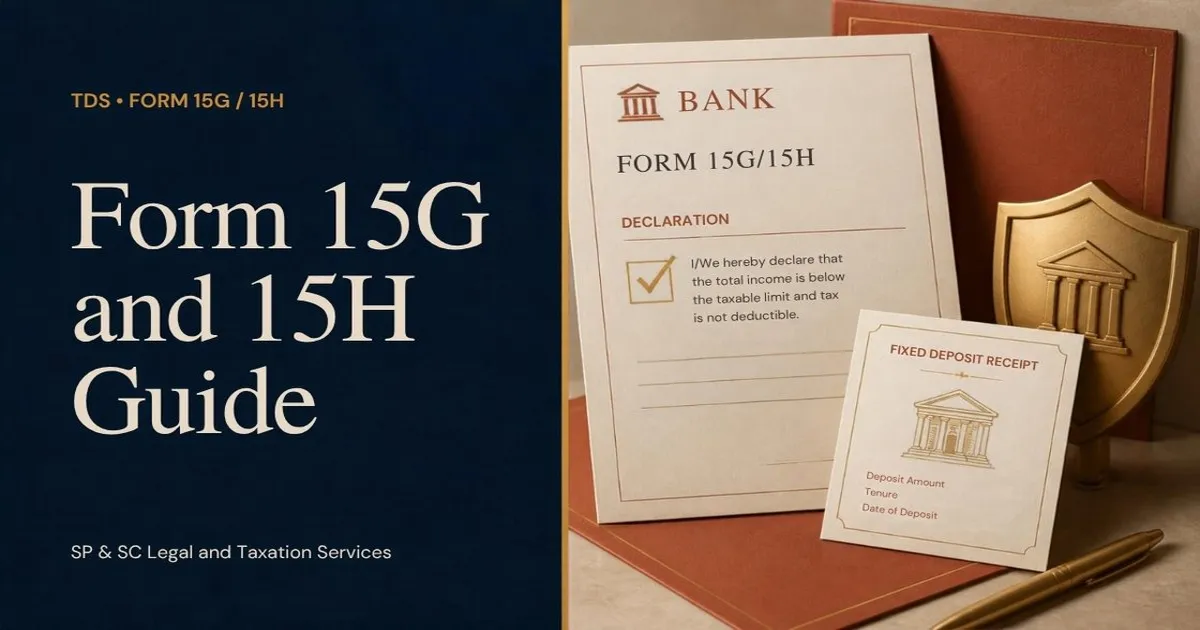
Stop TDS on FD interest the legal way. Eligibility for Form 15G (under 60) and 15H (60+), updated interest thresholds from April 2025, and the penalty for false declarations.
Form 15G and Form 15H let eligible residents request payment of specified income without TDS, but they do not make that income tax-free. For FY 2025-26 / AY 2026-27, bank-interest TDS thresholds are ₹50,000 for non-seniors and ₹1,00,000 for resident senior citizens. Form 15G has both a nil-tax test and a specified-income ceiling; Form 15H requires nil estimated tax but has no equivalent income ceiling.
What are the new interest TDS thresholds?
From 1 April 2025, Sec. 194A Income-tax Act raises the annual interest thresholds for banks, co-operative banks, specified post-office deposits and other payers.
The Income-tax Act, 1961 continues to govern FY 2025-26 / AY 2026-27.
| Payer or interest category | Non-senior | Resident senior citizen, aged 60+ |
|---|---|---|
| Bank or co-operative bank | ₹50,000 | ₹1,00,000 |
| Notified post-office deposits | ₹50,000 | ₹1,00,000 |
| Other payers, including company deposits | ₹10,000 | ₹10,000 |
If interest does not exceed the applicable threshold, no TDS is required under this provision and a declaration is unnecessary. Once it exceeds the threshold, TDS ordinarily applies to the whole interest amount, not merely the excess.
For banks using core banking, the threshold applies across branches of the same bank, not separately to each FD or branch. Separate banks apply their own thresholds.
These are TDS thresholds, not tax exemptions. Interest can remain taxable even when no tax is deducted.
Who can submit Form 15G?
Form 15G is generally used by resident individuals below 60 and eligible HUFs where estimated tax is nil and the aggregate specified income stays within the basic exemption limit.
Companies and firms cannot use it. Eligibility arises under Sec. 197A Income-tax Act, with declarations governed by Rule 29C Income-tax Rules.
Two separate conditions must be met:
- Tax on estimated total income for the financial year must be nil, after applicable deductions and rebate.
- The aggregate income covered by the relevant declaration provisions must not exceed the maximum amount not chargeable to tax.
The second test is frequently misunderstood. It concerns the aggregate specified income, such as eligible interest, not necessarily your entire total income.
For FY 2025-26, the basic exemption limit is ₹4,00,000 under the new regime. Under the old regime, it is ₹2,50,000 for individuals below 60 and HUFs. HUFs cannot claim the resident-individual rebate under Sec. 87A Income-tax Act.
A 45-year-old receiving ₹6,00,000 entirely as FD interest may owe no tax under the new regime because of that rebate. However, she cannot submit Form 15G: the interest exceeds ₹4,00,000. Applicable TDS can instead be claimed as credit or refunded through her ITR.
Conversely, total income exceeding ₹4,00,000 does not automatically disqualify someone if the aggregate specified income remains within the ceiling and estimated tax is nil.
Who can submit Form 15H?
Form 15H is available to a resident individual aged 60 or more at any time during the financial year whose estimated tax liability is nil.
Unlike Form 15G, Form 15H has no separate basic-exemption ceiling on the interest or other eligible income.
A 68-year-old pensioner with taxable total income of ₹9,00,000 consisting of ordinary slab-rate income can therefore submit Form 15H under the new regime if the rebate eliminates the tax liability.
For AY 2026-27, Sec. 87A Income-tax Act provides a new-regime rebate of up to ₹60,000 for resident individuals with total income not exceeding ₹12,00,000. However, the rebate does not eliminate tax charged at special rates, such as tax on certain capital gains. Calculate the actual liability rather than relying only on the ₹12,00,000 figure.
| Eligibility point | Form 15G | Form 15H |
|---|---|---|
| Typical applicant | Resident individual below 60 or eligible HUF | Resident individual aged 60+ |
| Estimated tax must be nil | Yes | Yes |
| Separate ceiling on aggregate specified income | Yes | No |
| Available to NRIs | No | No |
| Available to companies or firms | No | No |
How does Form 15H work in a rupee example?
An eligible senior citizen can avoid interest TDS where the final tax calculation is nil.
Mr Rao, aged 66, receives an employment pension of ₹4,20,000 and FD interest of ₹3,10,000 during FY 2025-26. He chooses the new regime and has no other income.
| Calculation | Amount |
|---|---|
| Employment pension | ₹4,20,000 |
| FD interest | ₹3,10,000 |
| Total receipts | ₹7,30,000 |
| Less: pension standard deduction under Sec. 16(ia) Income-tax Act | ₹75,000 |
| Taxable total income | ₹6,55,000 |
| Tax: nil up to ₹4,00,000; 5% on ₹2,55,000 | ₹12,750 |
| Less: rebate under Sec. 87A Income-tax Act | ₹12,750 |
| Final tax, including cess | ₹0 |
Assuming one bank pays all the interest and has his valid PAN, ordinary TDS at 10% would be ₹31,000 without a valid declaration. Form 15H prevents this deduction, avoiding the wait for a refund.
If several banks pay the interest, he submits the declaration wherever required. The ₹75,000 deduction applies to employment pension, not family pension.
How should you submit Form 15G or Form 15H?
Submit a fresh, accurate declaration for each financial year to each relevant payer, preferably before the first interest credit or payment that could trigger TDS.
Most banks accept declarations through net banking, mobile banking or branches.
- Estimate all income: Include interest across banks, pension, rent, dividends and other taxable receipts.
- Select the correct regime: Deductions, exemption limits and rebates differ.
- Provide a valid PAN: Under Sec. 206AA Income-tax Act, a declaration without PAN is invalid. For ordinary bank interest, TDS generally becomes 20%.
- Disclose earlier declarations: Include the required details of other declarations and aggregate amounts.
- Check account coverage: Confirm which accounts and branches the bank’s process covers.
- Retain acknowledgement: Keep the submission record and supporting tax estimate.
The payer reports declaration details to the Income Tax Department. Interest may still appear in AIS despite nil TDS; check AIS and Form 26AS before filing.
What mistakes and penalties should you watch for?
The main risks are an incorrect income estimate, misuse of the rebate and knowingly making a false declaration.
Common mistakes include:
- Comparing Form 15G eligibility only with total income instead of applying both statutory tests.
- Ignoring interest from other banks or cumulative deposits.
- Treating the declaration as a tax exemption: report taxable interest in your ITR.
- Assuming a January submission reverses earlier TDS: it ordinarily affects future deductions, not completed ones.
- Failing to inform the payer when circumstances change and eligibility is lost.
Sec. 277 Income-tax Act addresses statements that a person knows or believes are false, or does not believe to be true.
| Circumstance under Sec. 277 Income-tax Act | Punishment |
|---|---|
| Tax that would have been evaded exceeds ₹25 lakh | Rigorous imprisonment from six months to seven years, plus fine |
| Other cases | Rigorous imprisonment from three months to two years, plus fine |
An honest estimation error is not automatically a criminal offence. Nevertheless, declarations can be checked against AIS and other records, so supporting calculations matter.
How SP & SC helps
SP & SC Legal and Taxation Services, Bengaluru, checks eligibility, compares regimes and reconciles income across payers before recommending a declaration or refund claim.
Our fees are a fixed quote after reviewing the case, agreed before work begins. Contact us, or use the income tax calculator for an initial estimate.
Frequently asked questions
Can an NRI submit Form 15G or Form 15H?
No. These declarations are available only to eligible residents. NRI interest follows the applicable tax and withholding provisions.
Can Form 15G stop TDS on an EPF withdrawal?
Yes, if the declaration conditions are met. Sec. 192A Income-tax Act can require TDS on taxable withdrawals of ₹50,000 or more. Service below five years is relevant, but statutory exceptions and transferred service must also be checked.
Can these forms cover dividends, rent or insurance commission?
Yes, for eligible payments under provisions including Sec. 194, Sec. 194-I and Sec. 194D Income-tax Act. They are not universal TDS waivers; ordinary insurance commission should not be confused with lottery commission.
Can I recover TDS already deducted?
A later declaration does not ordinarily reverse earlier deductions. Claim the TDS credit in your ITR and obtain a refund if it exceeds your final tax liability.
Must I submit the form every year?
Yes. A declaration covers the specified financial year, not the entire FD tenure. Recheck eligibility annually and whenever your income changes.
Written by
SP & SC Editorial
Editorial team at SP & SC Legal and Taxation Services — practising advocates, chartered accountants, and company secretaries publishing hands-on guidance from live client files.
Next steps
What to do next
Guides help you decide. If you need an advocate, CA, or CS on your side, the SP & SC team files, drafts, and represents.