Section 80TTA and 80TTB: Deduction on Interest Income
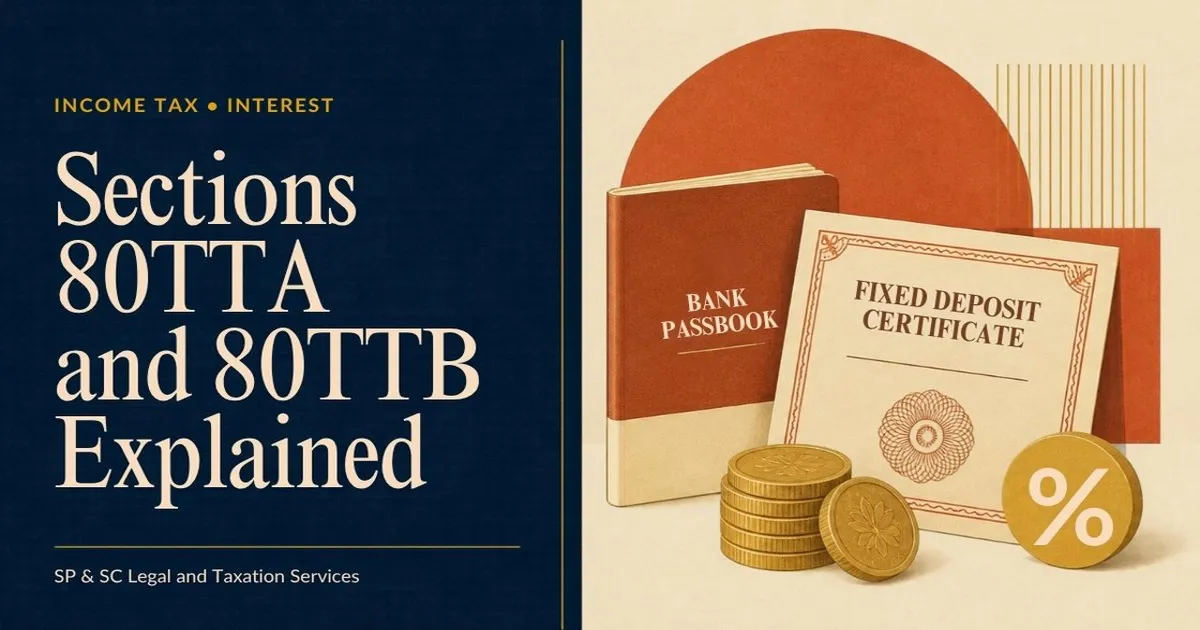
Section 80TTA allows a tax deduction of up to ₹10,000 on savings interest, while Section 80TTB offers up to ₹50,000 for senior citizens on savings and deposit interest.
Section 80TTA and 80TTB: Deduction on Interest Income
Short answer: Section 80TTA of the Income-tax Act, 1961, provides a deduction of up to ₹10,000 on interest earned from savings bank accounts for individuals (below 60 years) and HUFs. Section 80TTB offers a higher deduction of up to ₹50,000 for resident senior citizens (60 years and above) on interest from both savings accounts and deposits. Crucially, these deductions are available only if you opt for the old tax regime.
What is Section 80TTA Deduction?
Section 80TTA offers a tax deduction on interest income earned from savings accounts held in a bank, co-operative society, or post office. This deduction is available to individuals (other than senior citizens) and Hindu Undivided Families (HUFs). The maximum deduction allowed under this section is ₹10,000 per financial year. It is a straightforward way to reduce your taxable income if you have earned interest on your savings bank balance. Remember, this does not apply to interest from fixed deposits (FDs) or recurring deposits (RDs).
What is Section 80TTB Deduction?
Section 80TTB is a special provision designed for resident senior citizens, defined as individuals aged 60 years or more at any time during the financial year. It allows for a significantly higher deduction of up to ₹50,000 on interest income. Unlike 80TTA, this deduction covers interest from a wider range of sources, including savings accounts, fixed deposits (FDs), recurring deposits (RDs), and other deposits held with banks, co-operative banks, or post offices. If a senior citizen claims a deduction under 80TTB, they cannot claim a deduction under 80TTA.
Can I claim 80TTA and 80TTB in the New Tax Regime?
No, you cannot claim deductions under either Section 80TTA or Section 80TTB if you choose to file your income tax return under the new tax regime. The new regime, which is the default option from FY 2023-24 onwards, offers lower tax rates but disallows most of the common deductions and exemptions available under Chapter VI-A of the Income-tax Act, including 80TTA and 80TTB. Therefore, to avail of these benefits, you must explicitly opt for the old tax regime when filing your return.
Who is eligible for Section 80TTA?
Eligibility for Section 80TTA is specific to certain types of taxpayers. You can claim this deduction if you are an Individual (who is not a senior citizen) or a Hindu Undivided Family (HUF). This means that entities like partnership firms, LLPs, companies, or Associations of Persons (AOPs) are not eligible for the 80TTA deduction. The deduction is applicable to both residents and non-residents, as long as they fall into the eligible categories.
Who is eligible for Section 80TTB?
Eligibility for Section 80TTB is more restricted and is a benefit exclusively for senior citizens. To claim this deduction, you must be an individual who is a resident of India and is 60 years of age or older at any point during the relevant financial year. Hindu Undivided Families (HUFs) and non-resident senior citizens are not eligible to claim the deduction under Section 80TTB. This provision acknowledges the reliance of many senior citizens on interest income for their regular expenses.
Section 80TTA vs. Section 80TTB: A Comparison
Understanding the key differences between these two sections is vital for correct tax planning and filing. The primary distinction lies in the eligible assessee, the quantum of deduction, and the types of interest income covered.
| Feature | Section 80TTA | Section 80TTB |
|---|---|---|
| Eligible Taxpayer | Individuals (below 60) & HUF | Resident Senior Citizens (60+) |
| Maximum Deduction | ₹10,000 per year | ₹50,000 per year |
| Eligible Interest | Interest from savings accounts only | Interest from savings accounts and deposits (FDs, RDs etc.) |
| Applicable Tax Regime | Old Tax Regime Only | Old Tax Regime Only |
| Mutual Exclusivity | Cannot be claimed if 80TTB is claimed | Cannot be claimed alongside 80TTA |
| Consequence of 80TTB | No TDS on interest up to ₹50,000 for senior citizens (Sec 194A) | No TDS on interest up to ₹50,000 for senior citizens (Sec 194A) |
Worked example
Let's consider two scenarios to understand the practical application of these sections.
Scenario 1: Non-Senior Citizen
Ms. Anjali, aged 40, is a resident of Bengaluru. For the financial year 2025-26, her interest income is as follows:
- Interest from savings bank account: ₹18,000
- Interest from company fixed deposits: ₹40,000
- Total Interest Income: ₹58,000
She decides to file her return under the old tax regime.
- Report Total Income: First, Ms. Anjali must declare her entire interest income of ₹58,000 under the head "Income from Other Sources".
- Claim Deduction under 80TTA: She can claim a deduction on her savings account interest. The deduction is limited to a maximum of ₹10,000.
- Calculate Taxable Interest:
- Total Interest Income: ₹58,000
- Less: Deduction under Sec 80TTA: ₹10,000
- Taxable Interest Income: ₹48,000
Scenario 2: Senior Citizen
Mr. Sharma, aged 68, is a resident of Bengaluru. For the financial year 2025-26, his interest income is as follows:
- Interest from Post Office savings account: ₹12,000
- Interest from Bank Fixed Deposits (FDs): ₹60,000
- Total Interest Income: ₹72,000
He also chooses the old tax regime.
- Report Total Income: Mr. Sharma declares his total interest income of ₹72,000 under "Income from Other Sources".
- Claim Deduction under 80TTB: As a resident senior citizen, he is eligible for the higher deduction under Section 80TTB, which covers both savings and FD interest.
- Calculate Taxable Interest:
- Total Interest Income: ₹72,000
- Less: Deduction under Sec 80TTB (capped at ₹50,000): ₹50,000
- Taxable Interest Income: ₹22,000
Common mistakes
- Claiming in the New Regime: The most frequent error is attempting to claim 80TTA or 80TTB deductions while filing under the new tax regime. These deductions are exclusively for those who opt for the old regime.
- Including FD Interest for 80TTA: Non-senior citizens often mistakenly include interest from fixed deposits or recurring deposits while calculating the 80TTA deduction. This section only applies to savings account interest.
- Forgetting to Report Income First: You cannot simply reduce your interest income by the deduction amount. You must first report the gross interest income in your ITR under "Income from Other Sources" and then claim the deduction separately under Chapter VI-A.
- Senior Citizens Claiming 80TTA: A senior citizen should always claim the more beneficial Section 80TTB deduction. Claiming 80TTA instead would mean a lower deduction limit and exclusion of FD interest.
- Incorrectly Calculating TDS: For senior citizens, banks are instructed not to deduct TDS on interest income up to ₹50,000 per financial year per bank, thanks to the alignment with Section 80TTB. However, you must still report this income and claim the deduction. Also check your Form 26AS/AIS to confirm the TDS status.
How SP & SC helps
Navigating tax deductions can be complex, and choosing the right tax regime is a critical decision that impacts your overall tax liability. At SP & SC, our team of Chartered Accountants provides expert guidance on income tax planning and filing. We analyse your complete financial profile to determine whether the old or new regime is more beneficial for you, ensure all eligible deductions like Section 80TTA/TTB are correctly claimed, and manage the end-to-end income tax filing process. We help you accurately report income, claim deductions, and file your return correctly, minimising your tax outgo and ensuring full compliance.
Frequently asked questions
H3: Can an HUF claim a deduction under Section 80TTB?
No, a Hindu Undivided Family (HUF) cannot claim a deduction under Section 80TTB. This deduction is available only to resident senior citizen individuals. However, an HUF is eligible to claim the deduction up to ₹10,000 under Section 80TTA for interest earned on its savings bank accounts.
H3: Is interest from a Post Office Savings Account eligible for 80TTA?
Yes, interest earned from a savings account maintained with a Post Office is eligible for deduction under Section 80TTA, subject to the overall limit of ₹10,000.
H3: What happens if my savings interest income is less than ₹10,000?
If your total interest income from savings accounts is, for example, ₹7,000 for the financial year, you can claim a deduction for the entire amount of ₹7,000 under Section 80TTA. The deduction is limited to the actual interest earned or ₹10,000, whichever is lower.
H3: Can I claim both 80TTA and 80TTB in the same year?
No, you cannot. The sections are mutually exclusive. A resident senior citizen who is eligible for the Section 80TTB deduction of up to ₹50,000 is not permitted to claim the deduction under Section 80TTA.
H3: Is this deduction over and above the Section 80C limit?
Yes, the deductions under Section 80TTA and Section 80TTB are independent of and over and above the ₹1,50,000 limit available under Section 80C. They fall under the overall limit of deductions under Chapter VI-A but have their own specific sub-limits.
Get a fixed-fee quote
Planning your taxes and filing your return accurately requires careful attention to detail. Share your financial documents with us, and we will provide a written, fixed-fee quote for handling your tax compliance from end to end. Contact SP & SC today via our website or on WhatsApp at +91 90356 74566 to ensure your tax affairs are in expert hands.
Written by
SP & SC Editorial
Editorial team at SP & SC Legal and Taxation Services — practising advocates, chartered accountants, and company secretaries publishing hands-on guidance from live client files.
Next steps
What to do next
Guides help you decide. If you need an advocate, CA, or CS on your side, the SP & SC team files, drafts, and represents.