Standard Deduction for Salaried Employees: ₹75,000 Explained
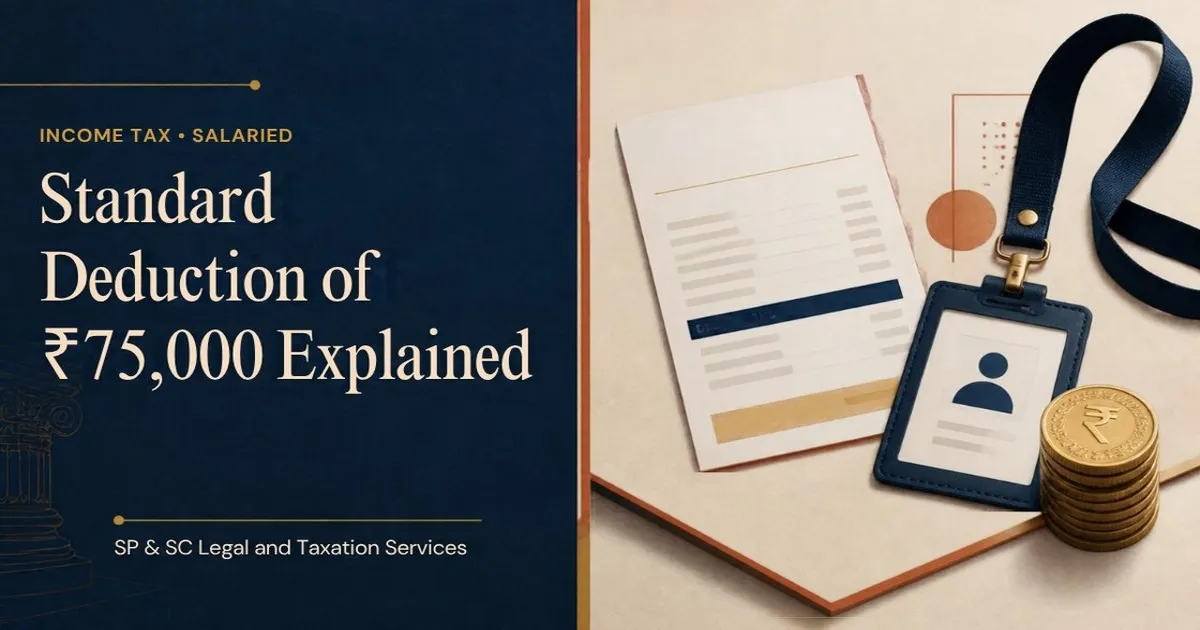
For FY 2025-26, salaried individuals and pensioners can claim a flat ₹75,000 standard deduction under the new tax regime, reducing their taxable income.
Standard Deduction for Salaried Employees: ₹75,000 Explained
Short answer: The standard deduction for the financial year 2025-26 (Assessment Year 2026-27) is a flat ₹75,000 available to salaried individuals and pensioners under the new tax regime. This is a straight deduction from your gross salary income, reducing your taxable income without the need for any proof of expense. The new tax regime is the default option for all taxpayers.
What is the standard deduction for salary income?
The standard deduction is a fixed amount that can be subtracted from your salary income before calculating income tax. Governed by Section 16(ia) of the Income-tax Act, 1961, its purpose is to provide a standard relief for expenses an employee typically incurs for their employment, such as transport, daily allowances, and maintaining professional attire. This deduction simplifies the tax filing process by eliminating the need to track and claim numerous small employment-related expenses like the erstwhile transport allowance and medical reimbursement.
Who is eligible for the ₹75,000 standard deduction?
Any individual earning an income under the head 'Salaries' is eligible. This includes:
- Salaried Employees: Anyone working in the private or public sector.
- Pensioners: Individuals receiving a pension from their former employer. This pension is taxed as salary income, making pensioners eligible for this deduction.
To claim the full ₹75,000 deduction, you must be under the new tax regime. If you choose to opt for the old tax regime, the standard deduction is limited to ₹50,000.
How is the standard deduction different in the old vs. new tax regime?
The availability and amount of the standard deduction are key differentiators between the two tax regimes. As of FY 2025-26, the new regime is the default choice, and you must consciously opt out if you wish to follow the old one.
| Feature | New Tax Regime (Default) | Old Tax Regime |
|---|---|---|
| Standard Deduction | ₹75,000 | ₹50,000 |
| Tax Rebate (Sec 87A) | No tax on income up to ₹12 lakh | No tax on income up to ₹5 lakh |
| Chapter VI-A Deductions | Not available (e.g., 80C, 80D, 80E) | Available |
| HRA & LTA Exemptions | Not available | Available |
| Tax Slabs | Lower tax rates, more slabs | Higher tax rates, fewer slabs |
Choosing a regime depends on your ability to claim other deductions. For most salaried individuals without significant investments or home loan interest, the new tax regime with its higher standard deduction and generous tax rebate is more beneficial.
Do I need to submit any documents to claim the standard deduction?
No, you do not need to submit any investment proofs or expense bills. The standard deduction is a flat, unconditional deduction from your gross salary. Your employer will automatically factor this in while calculating your Tax Deducted at Source (TDS) on salary, and it will be pre-filled in your ITR form if you file using details from your Form 16.
Can pensioners claim the standard deduction?
Yes, pensioners can claim the standard deduction. Pension received from a former employer is treated as 'Income from Salaries' for tax purposes. Therefore, a pensioner can claim a flat deduction of ₹75,000 (under the new regime) or ₹50,000 (under the old regime) from their total pension income, just like a salaried employee.
Is the standard deduction available for family pension?
No, the standard deduction under Section 16(ia) is not available for family pension. Family pension is taxed under the head 'Income from Other Sources'. However, the recipient of a family pension can claim a separate deduction under Section 57(iia). This deduction is the lower of:
- ₹15,000
- One-third of the family pension received.
This is a different provision and should not be confused with the standard deduction for salary income.
Worked example
Anjali is a 32-year-old software engineer working in Bengaluru. Her gross salary for FY 2025-26 is ₹12,75,000. She has no other income and stays in the default new tax regime.
Here is her tax calculation:
- Gross Salary: ₹12,75,000
- Less: Standard Deduction (Sec 16ia): ₹75,000
- Net Taxable Income: ₹12,75,000 - ₹75,000 = ₹12,00,000
Now, let's calculate the tax on this income using the new regime slabs:
- ₹0 to ₹3,00,000: ₹0
- ₹3,00,001 to ₹6,00,000 (at 5%): ₹15,000
- ₹6,00,001 to ₹9,00,000 (at 10%): ₹30,000
- ₹9,00,001 to ₹12,00,000 (at 15%): ₹45,000
- Total Tax Liability Before Rebate: ₹15,000 + ₹30,000 + ₹45,000 = ₹90,000
- Less: Rebate under Section 87A: As her taxable income is exactly ₹12 lakh, she is eligible for a full tax rebate under the enhanced Section 87A. The rebate will be equal to the tax payable, i.e., ₹90,000.
- Final Tax Payable: ₹90,000 - ₹90,000 = ₹0
Because of the ₹75,000 standard deduction, Anjali's income fell to the ₹12 lakh threshold, making her total tax liability zero.
Common mistakes
- Claiming for Business Income: The standard deduction is only for income under the head 'Salaries'. It cannot be claimed against income from business or profession.
- Assuming it's Over and Above HRA/LTA: Under the old tax regime, people could claim HRA, LTA, and other allowances along with a ₹50,000 standard deduction. Under the new regime, you only get the ₹75,000 standard deduction; you cannot claim HRA or LTA.
- Forgetting to Opt for the Best Regime: Many taxpayers fail to compare the tax liability under both regimes. For some, especially those with high home loan interest and 80C investments, the old regime might still be better despite the lower standard deduction. Use our income tax calculator to compare.
- Confusing it with Family Pension Deduction: As explained above, the deduction on family pension is different (capped at ₹15,000 under Section 57) and should not be mistaken for the salary standard deduction.
How SP & SC helps
Navigating tax laws can be complex, especially with annual changes to rates and deductions. SP & SC Legal's team of Chartered Accountants provides end-to-end income tax filing services. We help you choose the most beneficial tax regime, ensure all eligible deductions and exemptions are claimed correctly, and file your return accurately and on time. Our goal is to ensure you remain compliant while legally minimizing your tax outgo.
Frequently asked questions
H3: Can I claim standard deduction if my salary is below the taxable limit?
Yes, the standard deduction is applied to your gross salary regardless of the final taxable amount. However, if your income is already below the basic exemption limit, the deduction has no practical tax-saving effect.
H3: I am a freelancer. Can I claim the standard deduction?
No. Freelancers earn income from 'Business or Profession', not 'Salary'. You cannot claim the standard deduction. However, you can claim actual business expenses or opt for the presumptive taxation scheme under Section 44ADA.
H3: My employer has already given the standard deduction in Form 16. Do I need to claim it again?
No. If your employer has correctly factored it into your Form 16, the benefit has already been passed on through lower TDS. The ITR form will auto-populate this deduction. You just need to verify that it has been correctly applied.
H3: Is standard deduction available on arrears of salary?
Yes. Arrears of salary are taxed in the year of receipt. The total salary, including arrears, is eligible for the standard deduction for that financial year.
H3: Can both husband and wife claim the standard deduction?
Yes. If both spouses are salaried employees, they can each claim the standard deduction of ₹75,000 (under the new regime) against their respective salary incomes in their individual tax returns.
Get a fixed-fee quote
Before you file your income tax return, let our experts review your financial documents to ensure you are maximising your tax savings. Share your documents with us, and we will provide a written fixed-fee quote for our comprehensive tax filing services. We handle everything from tax planning to filing and responding to notices. Connect with us on WhatsApp at +91 90356 74566 or contact SP & SC to get started.
Written by
SP & SC Editorial
Editorial team at SP & SC Legal and Taxation Services — practising advocates, chartered accountants, and company secretaries publishing hands-on guidance from live client files.
Next steps
What to do next
Guides help you decide. If you need an advocate, CA, or CS on your side, the SP & SC team files, drafts, and represents.