Section 80U and 80DD: Tax Deductions for Disability
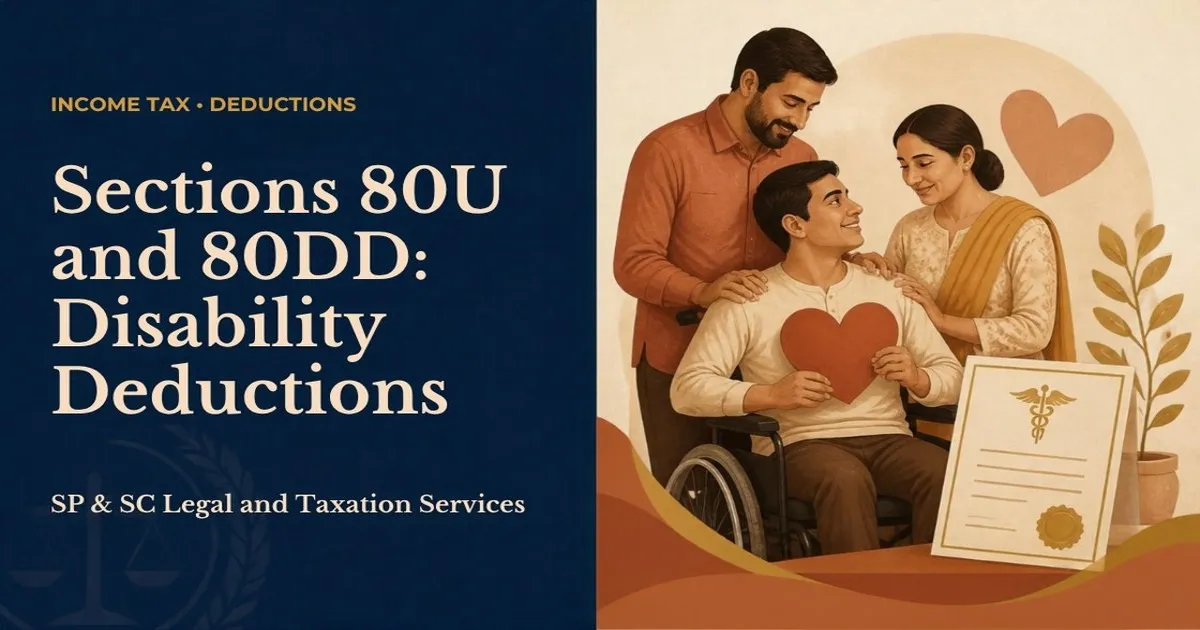
Claim flat tax deductions up to ₹1,25,000 for disability under Section 80U (self) or 80DD (dependent). This guide covers eligibility, amounts, and required documents.
Section 80U and 80DD: Tax Deductions for Disability
Short answer: Section 80U allows an individual with a disability to claim a tax deduction for themselves, while Section 80DD allows a deduction for maintaining a disabled dependent. The flat deduction is ₹75,000 for disability and ₹1,25,000 for severe disability. Crucially, these deductions can only be claimed if you opt for the old tax regime; they are not available under the default new tax regime as of FY 2025-26.
What is the difference between Section 80U and Section 80DD?
The primary difference lies in who is claiming the deduction and for whom. Section 80U is a deduction claimed by a resident individual who is certified as a person with a disability, for themselves. Section 80DD, on the other hand, is a deduction claimed by a resident individual or HUF for the expenses incurred on the medical treatment, training, and rehabilitation of a dependent with a disability.
| Feature | Section 80U | Section 80DD |
|---|---|---|
| Claimant | The individual with the disability themselves. | An individual or HUF supporting a disabled dependent. |
| Beneficiary | The taxpayer. | The taxpayer's dependent (spouse, child, parent, sibling) or HUF member. |
| Basis of Claim | Based on the taxpayer's own certified disability. | Based on the certified disability of a dependent person. |
| Key Condition | Claimant must be a resident individual certified with a disability of 40% or more. | Claimant must be a resident and must have incurred expenses for the dependent. |
Who is considered a person with a disability under Section 80U?
A person with a disability is an individual certified by a medical authority to be suffering from not less than 40% of any disability as defined under the Rights of Persons with Disabilities Act, 2016. These include conditions like blindness, low vision, leprosy-cured persons, hearing impairment, locomotor disability, mental retardation, and mental illness. To claim the deduction, the individual must obtain a certificate in the prescribed Form 10-IA from a recognised medical authority.
Who qualifies as a dependent with a disability under Section 80DD?
A dependent is a close relative of the taxpayer who is wholly or mainly dependent on the taxpayer for support and maintenance. Under Section 80DD, dependents can be your spouse, children, parents, or siblings. For a Hindu Undivided Family (HUF), any member of the HUF can be a dependent. The dependent must not have separately claimed a deduction under Section 80U for themselves for the same financial year.
What are the deduction amounts under 80U and 80DD?
The deduction is a flat amount and does not depend on the actual expenditure incurred. The amount is determined by the severity of the disability.
- Disability (40% or more, but less than 80%): A flat deduction of ₹75,000.
- Severe Disability (80% or more): A flat deduction of ₹1,25,000.
This flat deduction simplifies the process, as you do not need to collect and produce every single medical bill to claim it. The claim is substantiated by the disability certificate itself.
What documents are required to claim these deductions?
You do not need to attach any documents when you e-file your income tax return. However, you must have the following documents ready to be produced if your case is selected for scrutiny by the Income Tax Department:
- Medical Certificate (Form 10-IA): A copy of the certificate issued by a medical authority. This is the most crucial document. The medical authority generally consists of a neurologist, a civil surgeon, or a Chief Medical Officer of a government hospital.
- Self-Declaration Certificate: For Section 80DD, a self-declaration from the taxpayer certifying the expenditure incurred on the medical treatment, nursing, training, and rehabilitation of the disabled dependent.
- Receipts (for 80DD insurance schemes): If the deduction is claimed for payment to an insurance scheme for the maintenance of the dependent, you must have the receipts for the deposit or payment.
If the disability is temporary, the certificate will have a validity period, and it must be renewed to continue claiming the deduction in subsequent years.
Can these deductions be claimed under the new tax regime?
No, deductions under both Section 80U and Section 80DD are not available under the new tax regime (governed by Section 115BAC). The new tax regime, which is the default option for taxpayers from FY 2023-24 onwards, offers lower slab rates in exchange for forgoing most major deductions and exemptions. If you or your dependent are eligible for these deductions, you must carefully compare your tax liability under both regimes before deciding which one is more beneficial. To claim the 80U or 80DD deduction, you must explicitly opt for the old tax regime when filing your return.
Read more about the New vs. Old Tax Regime
Worked example
Ms. Priya is a software engineer in Bengaluru with a gross salary of ₹13,00,000 for FY 2025-26. Her father, who is wholly dependent on her, has a severe disability (certified at 85%). She has also invested ₹1,50,000 in PPF (eligible for Section 80C). Let's calculate her tax liability under both regimes.
1. Calculation under the Old Tax Regime
- Gross Salary: ₹13,00,000
- Less: Standard Deduction: ₹50,000
- Gross Total Income: ₹12,50,000
- Less: Section 80C Deduction: ₹1,50,000
- Less: Section 80DD Deduction (Severe Disability): ₹1,25,000
- Net Taxable Income: ₹9,75,000
- Tax Calculation (Old Slabs):
- Up to ₹2,50,000: ₹0
- ₹2,50,001 to ₹5,00,000: ₹12,500
- ₹5,00,001 to ₹9,75,000 (on ₹4,75,000 @ 20%): ₹95,000
- Total Tax: ₹1,07,500
- Add: Health & Education Cess @ 4%: ₹4,300
- Total Tax Payable (Old Regime): ₹1,11,800
2. Calculation under the New Tax Regime (Default)
- Gross Salary: ₹13,00,000
- Less: Standard Deduction: ₹75,000
- Net Taxable Income: ₹12,25,000
- (Note: Deductions under Section 80C and 80DD are not allowed)
- Tax Calculation (New Slabs as per Finance Act 2025):
- Up to ₹3,00,000: ₹0
- ₹3,00,001 to ₹6,00,000: ₹15,000
- ₹6,00,001 to ₹9,00,000: ₹30,000
- ₹9,00,001 to ₹12,00,000: ₹45,000
- ₹12,00,001 to ₹12,25,000 (on ₹25,000 @ 20%): ₹5,000
- Total Tax: ₹95,000
- Add: Health & Education Cess @ 4%: ₹3,800
- Total Tax Payable (New Regime): ₹98,800
Conclusion: In this specific case, despite forgoing deductions of ₹2,75,000, Ms. Priya saves ₹13,000 in tax by staying with the default new tax regime. This highlights the importance of calculating tax under both regimes before making a choice.
Common mistakes
- Claiming under the New Regime: The most frequent error is attempting to claim 80U or 80DD deductions while filing under the new tax regime. These are disallowed and can lead to a tax demand notice.
- Relying on Actual Expenses: Claiming an amount based on actual medical spending. The deduction is a fixed sum (₹75,000 or ₹1,25,000) irrespective of the amount spent.
- No Valid Medical Certificate: Claiming the deduction without having a valid Form 10-IA certificate. The certificate is mandatory proof.
- Dependent Claims 80U: A taxpayer claims a deduction under 80DD for a dependent, and the dependent also claims a deduction under 80U in their own tax return. This is not allowed.
- Expired Certificate: Forgetting to renew a temporary disability certificate and continuing to claim the deduction, which is invalid.
How SP & SC helps
Navigating the nuances of tax deductions and choosing the right tax regime can be complex. The team at SP & SC Legal and Taxation Services specialises in comprehensive tax planning and income tax filing. We help you evaluate your financial situation, ensure all eligible deductions are correctly claimed, and assist in choosing the most tax-efficient regime. From collating documents to filing your return and responding to any departmental queries, we manage the entire process for you.
Frequently asked questions
H3: What is considered 'severe disability'?
A 'severe disability' is defined under the Income-tax Act as a disability certified to be 80% or more by a recognised medical authority. This includes conditions like autism spectrum disorder and specified disabilities listed in the Rights of Persons with Disabilities Act, 2016.
H3: Can a Non-Resident Indian (NRI) claim 80U or 80DD?
No. The benefit of deductions under Section 80U and Section 80DD is available only to a person who is a resident in India during the financial year.
H3: Do I need to submit the medical certificate with my ITR?
No, you are not required to upload or submit the medical certificate (Form 10-IA) along with your income tax return. However, you must keep it in your records as the assessing officer can ask for it during an assessment or scrutiny.
H3: Can I claim 80DD for my disabled brother?
Yes, you can claim a deduction under Section 80DD for your brother, provided he is wholly or mainly dependent on you for his support and maintenance, and he has not claimed a deduction under Section 80U himself.
H3: What if the person with a disability passes away during the year?
If you have paid or deposited an amount in an approved insurance scheme for the maintenance of the disabled dependent and they pass away, the amount paid or deposited is taxed as your income in the year of receipt.
Get a fixed-fee quote
Making the right tax choices requires careful analysis. Share your financial documents with us, and we will provide a written fixed-fee quote for our tax planning and filing services. At SP & SC, we handle your tax compliance end-to-end, ensuring accuracy and peace of mind. Contact SP & SC via our website or on WhatsApp at +91 90356 74566 to get started.
Written by
SP & SC Editorial
Editorial team at SP & SC Legal and Taxation Services — practising advocates, chartered accountants, and company secretaries publishing hands-on guidance from live client files.
Next steps
What to do next
Guides help you decide. If you need an advocate, CA, or CS on your side, the SP & SC team files, drafts, and represents.