Leave Travel Allowance (LTA) Exemption Rules
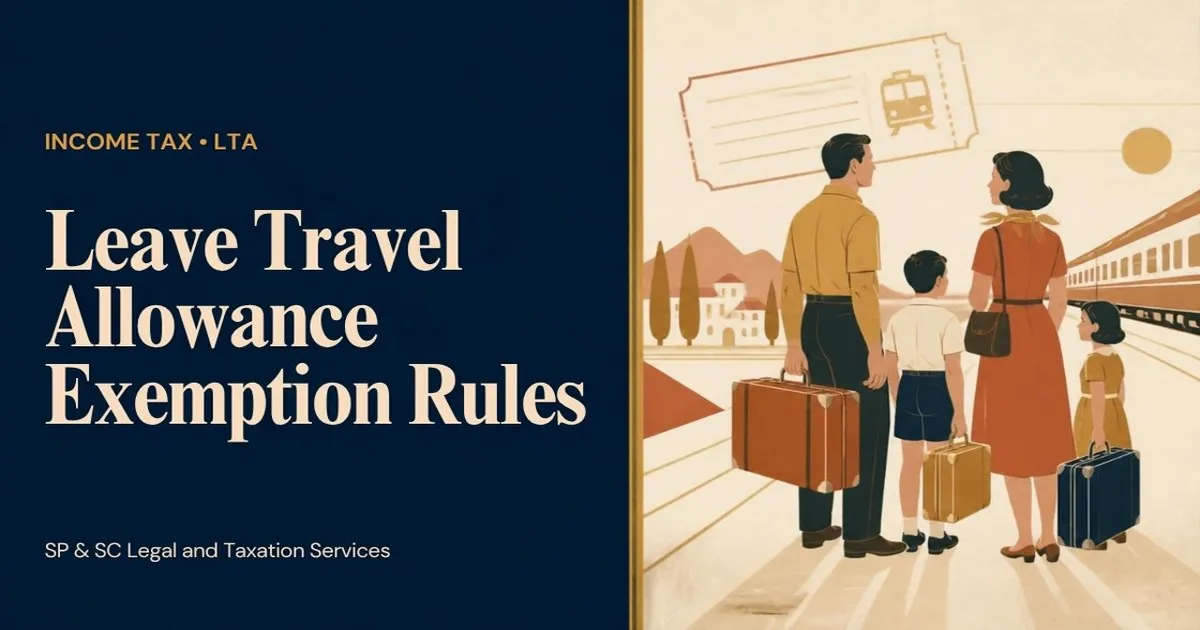
A guide to Leave Travel Allowance (LTA) exemption rules in India. Learn who can claim it, the conditions, the four-year block system, and eligible expenses.
Leave Travel Allowance (LTA) Exemption Rules
Short answer: Leave Travel Allowance (LTA) or Leave Travel Concession (LTC) is a tax exemption under Section 10(5) of the Income-tax Act for salaried employees. It covers domestic travel expenses for the employee and their family. You can claim this exemption for two journeys in a block of four calendar years. Crucially, this benefit is only available if you opt for the old tax regime; it is not available under the default new tax regime.
Is LTA exemption available in the new tax regime?
No, the LTA exemption is not available under the new tax regime (governed by Section 115BAC). The new tax regime, which is the default option for salaried individuals from FY 2023-24 onwards, offers lower tax rates but disallows most common exemptions and deductions, including LTA. To claim LTA, you must consciously opt out of the new regime and choose the old tax regime when filing your income tax return. You can read more about this choice in our guide on the new vs. old tax regime for FY 2025-26.
What are the conditions for claiming LTA exemption?
To claim the LTA tax exemption, you must meet several conditions stipulated under Section 10(5) of the Income-tax Act, 1961, read with Rule 2B.
- Employment Status: You must be a salaried employee.
- Salary Component: LTA must be a part of your CTC or salary structure.
- Actual Travel: You must have actually undertaken the journey. You cannot claim the exemption without travelling.
- Domestic Travel: The travel must be within the geographical boundaries of India. Foreign travel is not covered.
- Leave Taken: You must be on leave from your employer for the duration of the journey.
- Tax Regime: You must have opted for the old tax regime for the relevant financial year.
How does the four-year block system work for LTA?
The LTA exemption can be claimed for two journeys within a designated block of four calendar years.
The blocks are defined by the government and are fixed. The current block is 2026-2029 (1st January 2026 to 31st December 2029). The previous block was 2022-2025.
- Two Journeys: An employee can claim exemption for a maximum of two journeys during this four-year period.
- Carry-Forward Rule: If you fail to claim LTA for one or both of the two permitted journeys within a block, you can carry forward a maximum of one journey to the next block. However, this carried-forward journey must be claimed in the very first calendar year of the next block. For example, an unused journey from the 2022-2025 block could have been claimed by 31st December 2026.
What travel expenses are covered under LTA?
The exemption is strictly limited to the cost of travel (i.e., the fare) and does not cover any other expenses like accommodation, food, local conveyance, or sightseeing.
The amount of exemption is the lower of:
- The LTA amount provided by the employer.
- The actual travel expenses incurred.
- The prescribed limits based on the mode of transport.
Eligible Travel Costs for LTA Exemption
| Mode of Travel | Maximum Exemption Allowed | Notes |
|---|---|---|
| Air Travel | Economy class airfare of a national carrier via the shortest route. | Even if you travel by business class, the exemption is capped at the economy fare. |
| Rail Travel | AC First Class rail fare via the shortest route. | Applies if the journey's origin and destination are connected by rail. |
| Other Recognised Transport | First class or deluxe class bus fare via the shortest route. | Applicable where the origin/destination are not rail-connected but a recognised public transport system exists. |
| Other Non-Recognised Transport | An amount equivalent to the AC First Class rail fare for that distance. | Applicable where no recognised public transport exists. This is often used for travel by own car or private taxi. |
Who is considered 'family' for LTA exemption?
The LTA exemption can be claimed for travel undertaken by you (the employee) alone or with your family. The term 'family' for this purpose includes:
- Your spouse.
- Your children (up to two children born on or after 1st October 1998). This restriction does not apply to children born before this date, or in cases of multiple births (twins, triplets) after the first child.
- Your parents, brothers, and sisters, provided they are wholly or mainly dependent on you.
It's important to note that you can claim the exemption for your dependent family members even if they travel without you, but you cannot claim an exemption if you do not travel at all during the journey.
Worked example
Ms. Priya is a Marketing Manager in Bengaluru. Her employer provides an LTA of ₹90,000 for the financial year 2025-26. In December 2026, she travels with her husband and dependent father from Bengaluru to Goa for a holiday. She opts for the old tax regime to claim the LTA benefit.
- LTA in Salary: ₹90,000
- Journey: Bengaluru to Goa and back.
- Travellers: 3 adults (Priya, spouse, dependent father).
Expenses Incurred:
- Flight Tickets (Economy): ₹12,000 per person for the round trip. Total = ₹36,000.
- Hotel Stay: ₹40,000.
- Food and Local Taxis: ₹25,000.
Calculation of LTA Exemption:
- Identify Eligible Expenses: Only the flight tickets are eligible for exemption. Hotel and food costs are not considered.
- Actual Eligible Cost: The actual cost of travel is ₹36,000.
- LTA Provided by Employer: ₹90,000.
- Calculate Exemption: The exemption is the lower of the LTA provided (₹90,000) and the actual eligible travel cost (₹36,000).
- Exempt LTA: ₹36,000
- Calculate Taxable Portion: The remaining part of the LTA received becomes taxable.
- Taxable LTA: LTA Received - Exempt LTA = ₹90,000 - ₹36,000 = ₹54,000.
This taxable amount of ₹54,000 will be added to her gross salary and taxed as per her applicable slab rate under the old regime.
Common mistakes
- Claiming under the New Tax Regime: The most common error today is assuming LTA is available under the default new tax regime. It is not.
- Claiming Non-Fare Expenses: Submitting bills for hotel stays, meals, or local sightseeing. Only travel fare is exempt.
- No Proof of Travel: Failing to retain boarding passes, flight/train tickets, or other proof of journey. The employer and tax authorities can disallow the claim without proof.
- Assuming Full LTA is Exempt: Believing the entire LTA amount mentioned in the payslip is tax-free. The exemption is always limited to the actual travel cost incurred, subject to prescribed limits.
- Exceeding the Two-Journey Limit: Claiming LTA more than twice in a four-year block.
- Forgetting the Carry-Forward Deadline: Failing to claim a carried-forward journey within the first calendar year of the new block.
How SP & SC helps
Navigating salary components and tax exemptions can be complex. The team at SP & SC Legal and Taxation Services helps you make informed decisions. We can review your compensation structure, help you decide between the old and new tax regimes, verify your LTA claim documents for compliance, and ensure your income tax return filing is accurate and optimised. We handle the entire process, from documentation to filing, ensuring you claim every deduction you are legally entitled to.
Frequently asked questions
H3: Can I claim LTA if I don't take leave?
No. A mandatory condition for claiming LTA is that the journey must be undertaken while you are on leave from work. Your employer will likely ask for your leave application as part of the proof.
H3: What happens to LTA if I don't travel or claim it?
If you do not travel or fail to submit the required proofs to your employer within the stipulated time, the LTA amount paid to you becomes fully taxable. It will be added to your 'Income from Salary' and taxed at your applicable slab rate.
H3: What proof do I need to submit for an LTA claim?
You need to submit proof of travel to your employer. This typically includes original flight tickets, boarding passes (for air travel), or train tickets. For travel by car, you may need to provide a declaration along with proofs like toll receipts or fuel bills, though the exemption will be limited to the rail/bus fare equivalent.
H3: Can both my spouse and I claim LTA exemption?
Yes. If both you and your spouse are employed and receive LTA from your respective employers, you can both claim the exemption. However, you cannot claim it for the same journey. You can claim for two different journeys within the same block.
H3: Can I claim LTA for foreign travel?
No, the exemption is only for travel within India. If your journey includes a foreign leg, the exemption will be restricted to the cost of travel to the last Indian port/airport and from the first Indian port/airport on your return, via the shortest route.
Get a fixed-fee quote
Are you unsure about your LTA claim or need assistance with your tax filing? Share your documents with us for a confidential review. SP & SC provides a written fixed-fee quote for all tax planning and filing services, ensuring clarity and no surprises. We handle everything end-to-end, so you can be confident your taxes are filed correctly. Contact SP & SC or message us on WhatsApp at +91 90356 74566.
Written by
SP & SC Editorial
Editorial team at SP & SC Legal and Taxation Services — practising advocates, chartered accountants, and company secretaries publishing hands-on guidance from live client files.
Next steps
What to do next
Guides help you decide. If you need an advocate, CA, or CS on your side, the SP & SC team files, drafts, and represents.