Slump Sale Taxation Under Section 50B
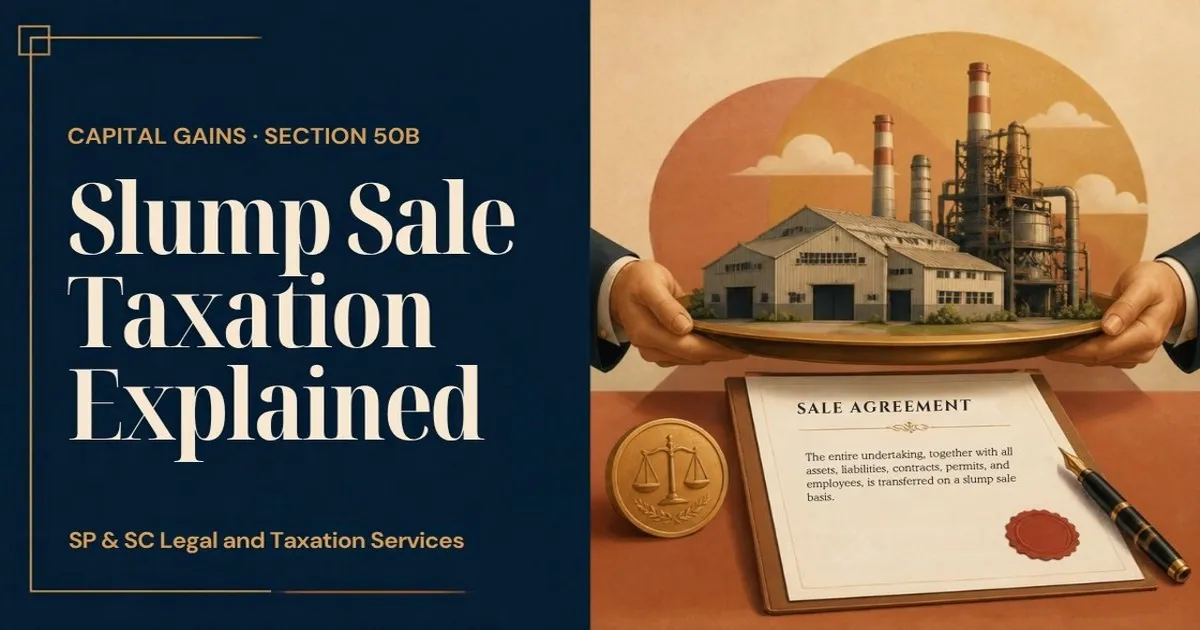
Learn how a slump sale is taxed under Section 50B. This guide covers capital gains calculation, net worth determination, and compliance for AY 2026-27.
Slump Sale Taxation Under Section 50B
Short answer: A slump sale is the transfer of a business undertaking as a going concern for a single lump-sum price, without assigning values to individual assets. Under Section 50B of the Income Tax Act, the profit from a slump sale is taxed as capital gains. The gain is calculated as the total sale consideration minus the net worth of the transferred undertaking. Indexation benefits are not available for this calculation.
What is a slump sale under the Income Tax Act?
A slump sale is the transfer of one or more business units as a whole for a lump-sum consideration. Section 2(42C) of the Income Tax Act defines it as the transfer of an "undertaking" without values being assigned to individual assets and liabilities. An undertaking can be a whole company, a division, or a distinct business activity. The key elements are the transfer of a business as a going concern and a single, unitemised payment for it.
How is capital gain calculated in a slump sale?
The capital gain or loss from a slump sale is computed as per the mechanism laid out in Section 50B. It is a straightforward formula:
Capital Gain = Full Value of Consideration - Net Worth of the Undertaking
If the result is positive, it's a capital gain. If negative, it is treated as a capital loss. The "Full Value of Consideration" is the lump-sum price received or receivable for the transfer. No indexation benefit is allowed on the cost of acquisition (net worth).
How is the 'net worth' of the undertaking determined?
The 'net worth' is the cornerstone of the slump sale calculation and must be computed precisely as per the formula in Section 50B. It is the aggregate value of total assets of the undertaking minus the value of its liabilities as appearing in the books of account.
Here's how asset values are determined:
- Depreciable Assets: The Written Down Value (WDV) as per the Income Tax Act.
- Assets eligible for 100% deduction (e.g., under Section 35AD): Nil.
- Other Assets (e.g., land, inventory, receivables): Their book value.
It is crucial to note that any revaluation of assets must be ignored when calculating net worth. The calculation must be certified by a Chartered Accountant in Form 3CEB, which is mandatory to be furnished along with the income tax return.
Is the capital gain from a slump sale short-term or long-term?
The nature of the capital gain depends on the holding period of the undertaking itself, not the individual assets within it. The holding period is calculated from the date the undertaking was set up by the seller.
- Long-Term Capital Gain (LTCG): If the undertaking was owned and held for more than 36 months before the sale.
- Short-Term Capital Gain (STCG): If the undertaking was owned and held for 36 months or less before the sale.
This distinction is vital as it determines the applicable tax rate.
What is the tax rate on slump sale gains?
The tax rate applied depends on whether the gain is short-term or long-term.
- Short-Term Capital Gains (STCG): These are added to your total income and taxed at the applicable slab rates for the financial year. You can refer to the latest income tax slabs for AY 2026-27.
- Long-Term Capital Gains (LTCG): These are taxed at a flat rate of 20%, plus applicable surcharge and a 4% health and education cess. Note that the 12.5% LTCG rate applies only to specific listed securities and does not apply to slump sales.
How can I save tax on slump sale gains?
Tax planning options are available, particularly for Long-Term Capital Gains (LTCG) arising from a slump sale. The most common route is to claim an exemption under Section 54EC of the Income Tax Act. To avail this:
- The gain must be a Long-Term Capital Gain.
- You must invest the capital gains (up to a maximum of ₹50 lakh) in specified bonds within six months from the date of the slump sale.
- These specified bonds are typically issued by entities like the National Highways Authority of India (NHAI) or Rural Electrification Corporation (REC).
- The investment must be held for a lock-in period of 5 years.
This can significantly reduce your tax outgo. For more details, read our guide on Section 54EC bonds.
Slump Sale vs. Itemised Asset Sale
Businesses often weigh a slump sale against selling assets individually. Here is a comparison:
| Feature | Slump Sale (Section 50B) | Itemised Asset Sale |
|---|---|---|
| Consideration | A single lump-sum price for the entire undertaking. | Separate prices are agreed upon for each asset. |
| Valuation | No individual asset valuation is required for the deal. | Each asset must be valued and sold separately. |
| Capital Gains | A single capital gain (LTCG/STCG) is calculated. | Capital gains are calculated for each asset individually. |
| Indexation Benefit | Not available. | Available for long-term assets like land and buildings. |
| Depreciation | The buyer can claim depreciation on the WDV of assets. | The buyer claims depreciation on the actual purchase price. |
| GST | Generally exempt as a transfer of a going concern. | GST is applicable on the sale of individual movable assets. |
| Stamp Duty | Lower stamp duty may apply, depending on state laws. | Higher stamp duty is usually payable on immovable property. |
Worked example
Let's assume 'Zenith Software Pvt. Ltd.' in Bengaluru decides to sell its 'HR Tech' division through a slump sale on 1st October 2026. The division was started on 1st April 2021.
- Sale Consideration: ₹8 Crore (lump-sum)
- Holding Period: Over 36 months (from April 2021 to Oct 2026), so the gain will be LTCG.
Step 1: Calculate the Net Worth of the HR Tech Division
| Asset / Liability | Value in Books of Account (₹) |
|---|---|
| Assets | |
| Office Premises (non-depreciable asset) | 2,00,00,000 |
| Computers & Servers (WDV as per Income Tax Rules) | 75,00,000 |
| Trade Receivables | 50,00,000 |
| Total Value of Assets (A) | ₹3,25,00,000 |
| Liabilities | |
| Bank Loan (specific to the division) | 1,00,00,000 |
| Sundry Creditors | 25,00,000 |
| Total Value of Liabilities (B) | ₹1,25,00,000 |
Net Worth = Total Assets (A) - Total Liabilities (B) = ₹3,25,00,000 - ₹1,25,00,000 = ₹2,00,00,000
Step 2: Calculate the Long-Term Capital Gain (LTCG)
LTCG = Sale Consideration - Net Worth = ₹8,00,00,000 - ₹2,00,00,000 = ₹6,00,00,000
Step 3: Calculate the Tax Liability
- Base Tax on LTCG @ 20%: 20% of ₹6 Crore = ₹1,20,00,000
- Add: Applicable Surcharge: The gain is over ₹5 Crore, so a 15% surcharge applies on the tax amount. (15% of ₹1.2 Crore) = ₹18,00,000
- Add: Health & Education Cess @ 4%: 4% on (₹1,20,00,000 + ₹18,00,000) = 4% of ₹1.38 Crore = ₹5,52,000
Total Tax Payable = ₹1,20,00,000 + ₹18,00,000 + ₹5,52,000 = ₹1,43,52,000
Zenith Software Pvt. Ltd. would have a tax liability of ₹1.43 Crore on this slump sale, which must be paid and reported in their income tax return for AY 2027-28.
Common mistakes
- Itemising Assets in the Agreement: Mentioning individual asset values in the Business Transfer Agreement (BTA) can disqualify the transaction from being a slump sale, leading tax authorities to treat it as an itemised sale.
- Not Obtaining Form 3CEB: Failing to obtain and furnish the Chartered Accountant's certificate in Form 3CEB reporting the net worth calculation is a critical compliance failure.
- Incorrect Net Worth Calculation: Using market values for assets instead of book values (or WDV for depreciable assets) is a common error that leads to incorrect tax computation.
- Claiming Indexation: The cost of acquisition (net worth) in a slump sale is not eligible for indexation benefit. Claiming it will lead to notices and demands from the tax department.
- Forgetting GST Implications: While a slump sale as a 'transfer of a going concern' is exempt from GST, the documentation must clearly support this position to avoid future litigation.
How SP & SC helps
Navigating a slump sale involves complex legal and financial considerations. SP & SC provides end-to-end assistance, from structuring the deal to ensuring full tax compliance. We help draft and vet the Business Transfer Agreement, conduct financial due diligence, work with our empanelled CAs for the precise net worth calculation and certification in Form 3CEB, and manage the final tax filing and reporting. Our goal is to ensure your business transfer is seamless, tax-efficient, and legally sound. For comprehensive support, explore our tax consultation services.
Frequently asked questions
Q1. What is an 'undertaking' for a slump sale?
An undertaking refers to a part of a business that can function independently. This could be a manufacturing plant, a business division, a product line, or a distinct service vertical that is capable of being run as a standalone business after the transfer.
Q2. Does GST apply to a slump sale?
Generally, no. The transfer of a business as a going concern is considered a supply of service and is specifically exempted from GST. However, it's crucial that the BTA and transaction documents clearly establish that the business is being transferred with all assets and liabilities required to continue its operations without interruption.
Q3. What happens if the calculated net worth is negative?
As per Explanation 2 to Section 50B, if the net worth of the undertaking is negative, its value shall be deemed to be zero for the purpose of calculating capital gains. This means the entire sale consideration will become a capital gain.
Q4. Is a Business Transfer Agreement (BTA) mandatory?
While the law doesn't explicitly name the document, a well-drafted BTA is practically mandatory. It is the primary legal document that defines the terms, consideration, assets and liabilities being transferred, and serves as crucial evidence that the transaction is a slump sale.
Q5. Can a sole proprietorship undergo a slump sale?
Yes. Any business entity, including a sole proprietorship, partnership firm, LLP, or company, can transfer an undertaking via a slump sale. The tax treatment under Section 50B applies to all taxpayers.
Get a fixed-fee quote
Planning a business sale or acquisition? The tax implications can be significant. Share your transaction documents with us for a confidential review, and we will provide a written fixed-fee quote for handling the entire process, end to end. Contact SP & SC or WhatsApp us at +91 90356 74566.
Written by
SP & SC Editorial
Editorial team at SP & SC Legal and Taxation Services — practising advocates, chartered accountants, and company secretaries publishing hands-on guidance from live client files.
Next steps
What to do next
Guides help you decide. If you need an advocate, CA, or CS on your side, the SP & SC team files, drafts, and represents.