Is Selling Agricultural Land Taxable? Rural vs Urban
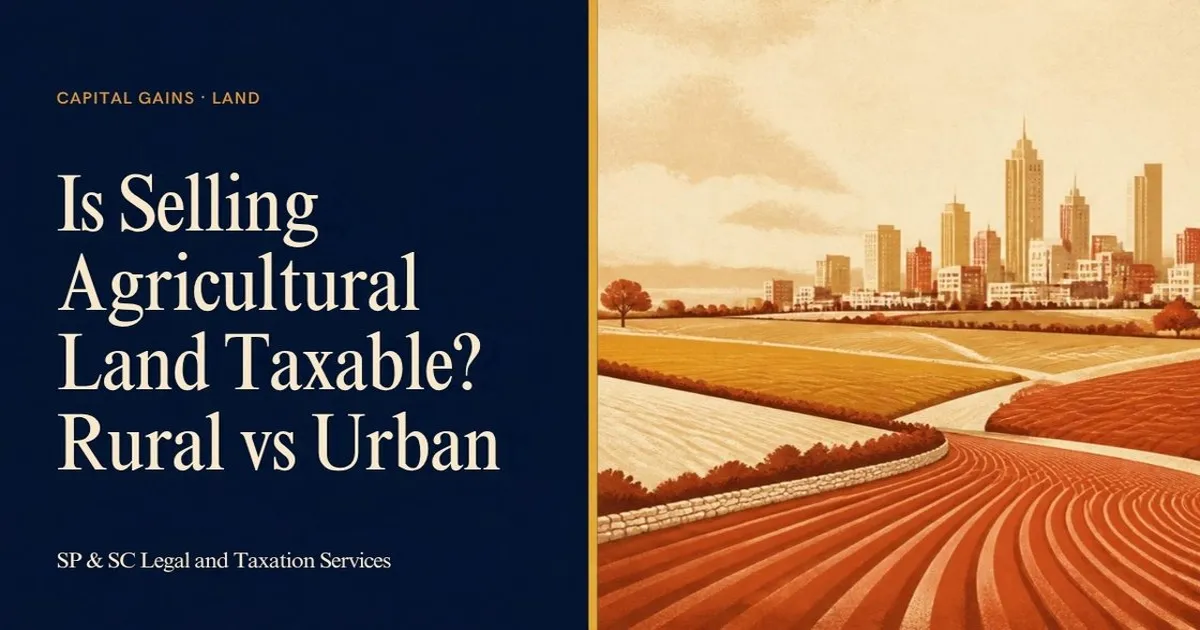
The taxability of selling agricultural land in India depends entirely on its location. Rural agricultural land is not a capital asset and its sale is tax-free.
Is Selling Agricultural Land Taxable? Rural vs Urban
Short answer: The sale of agricultural land is taxable only if it qualifies as a 'capital asset' under the Income-tax Act, 1961. Land classified as rural agricultural land is not a capital asset, making its sale completely tax-free. However, the sale of urban agricultural land is treated as a capital gain and is subject to tax. The key is understanding the precise definition of 'rural' based on municipal limits and population.
What defines rural agricultural land?
Rural agricultural land is specifically excluded from the definition of a 'capital asset' under Section 2(14) of the Income-tax Act, making its sale non-taxable. For a property to be classified as rural agricultural land, it must be situated outside certain defined urban areas. Any agricultural land is considered rural if it is NOT located:
- Within the jurisdiction of a municipality or cantonment board having a population of 10,000 or more according to the last preceding census.
- Within the following aerial distances (shortest straight-line distance, not road distance) from the local limits of such a municipality or cantonment board:
- Up to 2 kilometres, if the population is more than 10,000 but not more than 1,00,000.
- Up to 6 kilometres, if the population is more than 1,00,000 but not more than 10,00,000.
- Up to 8 kilometres, if the population is more than 10,00,000.
If your land falls outside these specified zones, it is rural agricultural land, and you pay zero capital gains tax on its sale.
When is the sale of urban agricultural land taxable?
Any agricultural land that does not meet the criteria for 'rural' agricultural land is automatically classified as 'urban' agricultural land. Urban agricultural land is considered a capital asset under the Income-tax Act, 1961. Therefore, any profit or gain arising from its sale is taxable as capital gains. The tax treatment depends on the holding period. If held for more than 24 months, it is a Long-Term Capital Gain (LTCG); if held for 24 months or less, it is a Short-Term Capital Gain (STCG).
How is tax calculated on the sale of urban agricultural land?
Tax is calculated on the capital gain, which is the sale price minus the cost. For long-term gains, you get the benefit of 'indexation' to account for inflation.
-
Long-Term Capital Gain (LTCG): This applies if you held the land for more than 24 months. The gain is taxed at a flat rate of 20% (plus applicable surcharge and 4% cess). Formula:
LTCG = Full Value of Consideration - (Indexed Cost of Acquisition + Indexed Cost of Improvement + Expenses on Transfer) -
Short-Term Capital Gain (STCG): This applies if you held the land for 24 months or less. The gain is added to your total income and taxed at your applicable income tax slab rates. Formula:
STCG = Full Value of Consideration - (Cost of Acquisition + Cost of Improvement + Expenses on Transfer)
For a detailed breakdown of property gains, see our guide on /blog/capital-gains-on-property.
Can I save tax on the sale of urban agricultural land?
Yes, the Income-tax Act provides specific exemptions to save tax on capital gains from the sale of urban agricultural land. The most important exemption is under Section 54B, which allows you to claim a deduction if you reinvest the proceeds in new agricultural land. Other general exemptions like investing in capital gain bonds under Section 54EC are also available. It's crucial to meet the specific conditions of these sections to claim the benefit.
What is the Section 54B exemption?
Section 54B provides tax relief specifically for gains arising from the sale of urban agricultural land. To claim this exemption, you must satisfy the following conditions:
- Eligible Assessee: The seller must be an individual or a Hindu Undivided Family (HUF).
- Asset Usage: The land sold must have been used for agricultural purposes by the individual (or their parents) for at least two years immediately before the date of sale.
- Reinvestment: You must purchase another plot of agricultural land (which can be rural or urban) within two years from the date of the sale.
Exemption Amount: The amount of exemption will be the lower of the capital gain or the cost of the new agricultural land. If you do not reinvest the entire capital gain before filing your income tax return, you must deposit the unutilised amount in a Capital Gains Account Scheme (CGAS) to claim the exemption.
Is TDS applicable on the sale of agricultural land?
Yes, but only for urban agricultural land. As per Section 194-IA of the Income-tax Act, a buyer of any immovable property (other than rural agricultural land) is required to deduct Tax at Source (TDS) at 1% if the sale consideration is ₹50 lakh or more.
- Rural Agricultural Land: No TDS is applicable as it is specifically excluded from the purview of Section 194-IA.
- Urban Agricultural Land: TDS at 1% is mandatory if the sale price is ₹50 lakh or more. The buyer is responsible for deducting this amount and depositing it with the government.
Learn more about this compliance in our guide on /blog/tds-on-property-purchase-194ia.
What happens if agricultural land is compulsorily acquired?
If the government compulsorily acquires your urban agricultural land, any capital gain arising from the compensation received is completely exempt from tax under Section 10(37) of the Income-tax Act. The conditions for this exemption are:
- The land must be urban agricultural land.
- It must have been used for agricultural purposes by the individual or their parents for at least two years before the acquisition.
- The compensation must have been received on or after 1st April 2004.
This is a direct exemption and does not require any reinvestment, unlike Section 54B.
| Feature | Rural Agricultural Land | Urban Agricultural Land |
|---|---|---|
| Is it a 'Capital Asset'? | No, as per Section 2(14) | Yes |
| Tax on Sale | Not taxable (No capital gains arise) | Taxable as Short-Term or Long-Term Capital Gains |
| TDS u/s 194-IA | Not applicable | Applicable @ 1% if sale value is ₹50 Lakh or more |
| Section 54B Exemption | Not applicable (as sale is already tax-free) | Available upon reinvestment in new agricultural land |
| Compulsory Acquisition | Not taxable (as sale itself is tax-free) | Exempt u/s 10(37) if conditions are met |
| Reporting in ITR | Recommended to report under 'Exempt Income' schedule | Mandatory to report under 'Capital Gains' schedule |
Worked example
Ms. Priya, a resident of Bengaluru, sold a piece of agricultural land in September 2026. She had purchased it in May 2011 (FY 2011-12).
Scenario 1: Sale of Rural Land
The land is located in a village 15 km away from a town with a population of 50,000. This qualifies as rural agricultural land.
- Sale Price: ₹80,00,000
- Is it a capital asset? No.
- Capital Gain: Not applicable.
- Tax Payable: ₹0. The entire proceeds are tax-free.
Scenario 2: Sale of Urban Land with Tax Saving
The land is located in a suburb just 5 km from Bengaluru's municipal limits (population well over 10,00,000). This is urban agricultural land.
-
Calculate Long-Term Capital Gain (LTCG):
- Sale Consideration: ₹1,20,00,000
- Brokerage Paid (Expense): ₹1,20,000
- Net Consideration: ₹1,18,80,000
- Purchase Price (in FY 2011-12): ₹20,00,000
- Cost Inflation Index (CII) for FY 2011-12: 184
- Assumed CII for FY 2026-27 (Year of Sale): 450
- Indexed Cost of Acquisition: (
₹20,00,000 / 184) * 450 = ₹48,91,304 - LTCG: ₹1,18,80,000 - ₹48,91,304 = ₹69,88,696
-
Calculate Tax Liability (without exemption):
- Tax on LTCG @ 20%: ₹13,97,739
- Health & Education Cess @ 4%: ₹55,910
- Total Tax Payable: ₹14,53,649
-
Applying Section 54B Exemption:
- Priya purchases another agricultural land in February 2027 for ₹75,00,000.
- Exemption under Section 54B is the lower of the capital gain (₹69.88 lakh) or the new investment (₹75 lakh).
- Exemption Amount: ₹69,88,696
- Final Tax Payable: ₹0
Common mistakes
- Ignoring Location Rules: Assuming any land used for agriculture is 'rural'. The distance and population criteria under Section 2(14) are strict and must be verified.
- Using Road Distance: Calculating the proximity to a municipality using road maps. The law specifies 'aerial distance', which is the shortest straight-line distance.
- Forgetting Indexation Benefit: Calculating tax on the sale of urban land without applying the Cost Inflation Index, which leads to a significantly higher tax liability.
- Failing the Usage Condition for 54B: Claiming Section 54B exemption without ensuring the land sold was used for agricultural purposes by the individual or their parents for at least two years prior to sale.
- Buyer's TDS Failure: The buyer of urban agricultural land (value > ₹50 lakh) forgetting to deduct TDS u/s 194-IA. This can lead to penalties for the buyer.
How SP & SC helps
Navigating the tax implications of property transactions can be complex. SP & SC Legal and Taxation Services provides end-to-end guidance. We help you correctly classify your agricultural land as rural or urban based on official records, accurately compute capital gains with all eligible deductions and indexation, and structure the transaction to legally minimize your tax liability using exemptions like Section 54B. We ensure all TDS and ITR filing compliances are handled flawlessly. For expert advice on your property sale, check out our tax consultation services.
Frequently asked questions
Do I need to show the sale of rural agricultural land in my ITR?
Yes. While the gain is not taxable, it is a best practice to disclose the sale proceeds in the 'Exempt Income' (EI) schedule of your Income Tax Return. This maintains a clear financial record and can pre-empt questions from the tax department about the source of funds.
Can I claim Section 54B exemption if I buy new agricultural land in my spouse's name?
No. To claim the exemption under Section 54B, the new agricultural land must be purchased in the name of the original seller (the assessee who had the capital gain). Investment in any other person's name is not eligible.
What if I don't use the new land for agriculture after buying it for Section 54B?
The primary purpose of Section 54B is to encourage continued investment in agriculture. While the law does not specify a mandatory period for which the new land must be used for agriculture, the intention at the time of purchase must be for agricultural purposes. It should not be purchased with an immediate intent to convert it for commercial use.
Is agricultural income from this land also tax-free?
Yes, income earned from carrying out agricultural operations is exempt from income tax under Section 10(1) of the Act, regardless of whether the land is classified as rural or urban. You can read more in our guide on /blog/agricultural-income-tax-india.
What is the holding period to classify agricultural land as a long-term asset?
The holding period for any immovable property, including urban agricultural land, is 24 months. If you sell the land after holding it for more than 24 months, the resulting gain or loss is considered long-term. If held for 24 months or less, it is short-term.
Get a fixed-fee quote
Selling property involves significant tax and legal considerations. Don't risk costly errors. Share your land documents and transaction details with us, and we will provide a clear, written fixed-fee quote for handling the entire process, from tax calculation to ITR filing. Contact SP & SC or WhatsApp us at +91 90356 74566. We handle all tax and compliance matters end to end.
Written by
SP & SC Editorial
Editorial team at SP & SC Legal and Taxation Services — practising advocates, chartered accountants, and company secretaries publishing hands-on guidance from live client files.
Next steps
What to do next
Guides help you decide. If you need an advocate, CA, or CS on your side, the SP & SC team files, drafts, and represents.