Section 50C: When Stamp Duty Value Overrides Sale Price
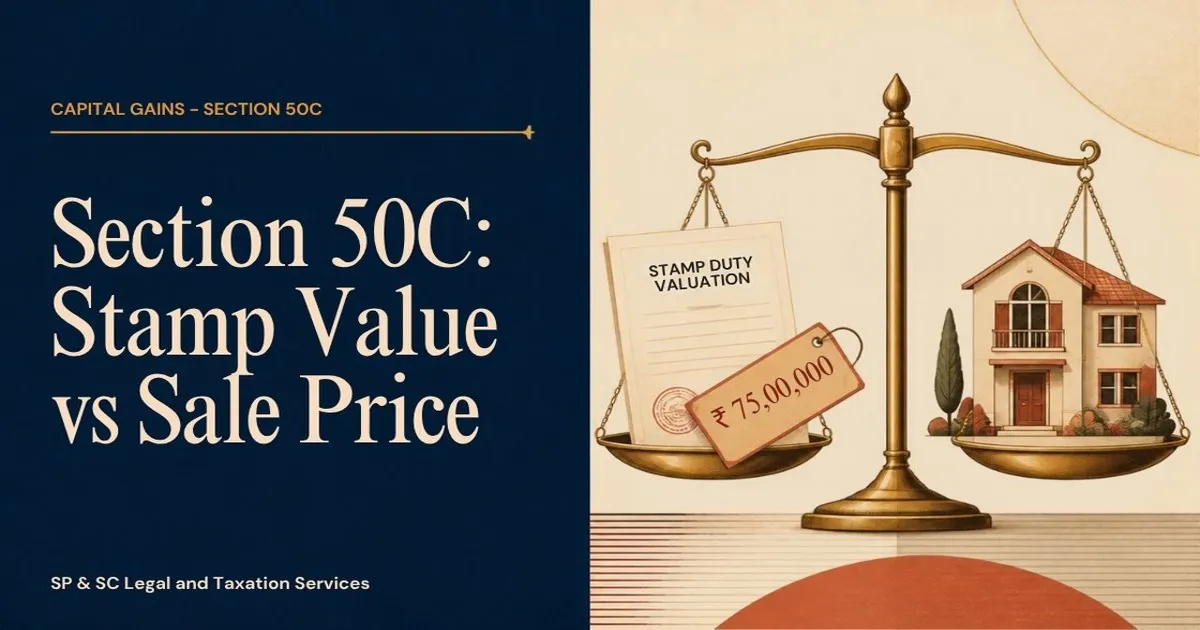
Section 50C is a deeming provision in the Income-tax Act where the Stamp Duty Value (SDV) of a property is considered its sale price for capital gains calculation if it exceeds the actual price.
Section 50C: When Stamp Duty Value Overrides Sale Price
Short answer: Section 50C of the Income-tax Act, 1961 is a provision that prevents tax evasion on property transactions. If you sell a property (land or building) for a price lower than its stamp duty value (SDV), the SDV is treated as the sale price for calculating your capital gains tax. A 10% safe harbour is available, meaning if the SDV is up to 110% of your sale price, the actual price is accepted.
What is Section 50C of the Income-tax Act?
Section 50C is a deeming provision designed to curb the use of unaccounted money in real estate transactions. It states that when a person transfers a capital asset, being land or a building or both, the value adopted by the stamp valuation authority (the 'stamp duty value' or 'guidance value') for the purpose of paying stamp duty shall be deemed to be the full value of consideration for calculating capital gains under Section 48, if it is higher than the declared sale consideration.
How does the 10% safe harbour rule work?
The law provides a tolerance band to account for minor variations between the market price and the stamp duty value. If the stamp duty value exceeds the sale consideration by not more than 10%, then the actual sale consideration is accepted for capital gains calculation. However, if the stamp duty value is more than 110% of the sale consideration, then the stamp duty value becomes the deemed sale price, significantly increasing your potential capital gains tax liability.
What happens if the seller disputes the Stamp Duty Value?
A seller can contest the stamp duty value if they believe it is higher than the property's fair market value. Under Section 50C(2), the seller can make a claim before the Assessing Officer (AO). If the claim is made, the AO is required to refer the valuation of the property to a Valuation Officer (VO) of the income tax department. If the value determined by the VO is lower than the stamp duty value, the VO's valuation will be adopted. If the VO's valuation is higher than the stamp duty value, the stamp duty value is retained as the sale consideration.
What are the implications for the buyer under Section 56(2)(x)?
Section 50C affects the seller, while the corresponding Section 56(2)(x) impacts the buyer. If a buyer purchases an immovable property for a price that is less than its stamp duty value, and the difference is more than the higher of ₹50,000 or 10% of the consideration, then the difference is taxed as 'Income from Other Sources' in the hands of the buyer. This creates a double impact, as the seller pays capital gains on a deemed higher value, and the buyer pays income tax on the deemed benefit.
| Particulars | Scenario A (No Section 50C) | Scenario B (Section 50C Applies) |
|---|---|---|
| Sale Consideration | ₹1,00,00,000 | ₹1,00,00,000 |
| Stamp Duty Value (SDV) | ₹1,08,00,000 | ₹1,20,00,000 |
| SDV vs. Sale Price | SDV is 108% of sale price (within 110% safe harbour) | SDV is 120% of sale price (exceeds 110% safe harbour) |
| Deemed Sale Consideration | ₹1,00,00,000 (Actual price is taken) | ₹1,20,00,000 (SDV is taken) |
| Indexed Cost of Acquisition | ₹60,00,000 | ₹60,00,000 |
| Long-Term Capital Gain (LTCG) | ₹40,00,000 | ₹60,00,000 |
| Tax on LTCG (at 12.5%) | ₹5,00,000 | ₹7,50,000 |
| Buyer's Tax (Sec 56(2)(x)) | Nil (Difference is within limits) | ₹20,00,000 taxed as 'Income from Other Sources' |
Can I claim exemptions under Section 54 if 50C is applied?
Yes, even when Section 50C is triggered and a higher deemed sale consideration is used, you can still claim capital gains exemptions. You can invest the capital gains amount (calculated using the deemed sale consideration) in specified assets under sections like Section 54 (new residential house), Section 54EC (specified bonds), or Section 54F (any asset other than a residential house) to reduce or nullify your tax liability. In fact, to claim full exemption, you will need to invest based on the higher capital gain computed under Section 50C.
Worked example
Ms. Anjali, a Bengaluru resident, decides to sell her apartment in Indiranagar in the Financial Year 2025-26.
- Agreement to Sell Date: 10 May 2025. She received ₹5,00,000 via a bank transfer as an advance on this date.
- Sale Deed Registration Date: 20 August 2025.
- Actual Sale Consideration: ₹2,00,00,000 (₹2 Crore).
- Indexed Cost of Acquisition: ₹1,10,00,000 (₹1.1 Crore).
- Stamp Duty Value on 10 May 2025: ₹2,15,00,000 (₹2.15 Crore).
- Stamp Duty Value on 20 August 2025: ₹2,25,00,000 (₹2.25 Crore).
Step 1: Determine the applicable Stamp Duty Value Since Ms. Anjali received part of the consideration via a banking channel on the date of the agreement, she is eligible to consider the SDV as on the agreement date.
Step 2: Check the Safe Harbour Rule
- Sale Consideration: ₹2,00,00,000
- 110% of Sale Consideration: ₹2,00,00,000 * 1.10 = ₹2,20,00,000
- Applicable SDV (as on agreement date): ₹2,15,00,000
- Since the SDV (₹2.15 Crore) is less than 110% of the sale consideration (₹2.20 Crore), the safe harbour rule applies. Section 50C is not triggered.
Step 3: Calculate Capital Gains
- Full Value of Consideration (Actual Sale Price): ₹2,00,00,000
- Less: Indexed Cost of Acquisition: ₹1,10,00,000
- Long-Term Capital Gain: ₹90,00,000
What if no advance was paid? If no advance was paid on the agreement date, the SDV as on the registration date (₹2.25 Crore) would be applicable. Since this is more than 110% of the sale price (₹2.20 Crore), Section 50C would apply.
- Deemed Sale Consideration: ₹2,25,00,000
- Less: Indexed Cost of Acquisition: ₹1,10,00,000
- Long-Term Capital Gain: ₹1,15,00,000
This simple act of documenting a token advance via a banking channel saves Ms. Anjali from having an additional ₹25,00,000 added to her capital gains.
Common mistakes
- Ignoring the Buyer's Tax: Sellers often focus only on their capital gains, forgetting that an under-valued transaction creates a tax liability for the buyer under Section 56(2)(x).
- Not Using the Agreement Date: Failing to take a token advance through a non-cash mode on the date of the agreement to sell can lead to using a potentially higher SDV of the registration date.
- Accepting Inflated SDV: Many sellers are unaware they can challenge an unusually high stamp duty value by requesting the Assessing Officer to refer the case to a Valuation Officer.
- Incorrect Exemption Planning: When Section 50C applies, failing to invest the higher deemed capital gain amount to claim full exemption under Section 54 or 54F, leading to a partial tax liability.
- Forgetting TDS Implications: The buyer is required to deduct TDS under Section 194-IA on the actual sale consideration or the SDV, whichever is higher. This is often overlooked.
How SP & SC helps
Navigating the complexities of property transactions and deeming provisions like Section 50C requires expert guidance. At SP & SC, we provide end-to-end tax consultation for property sales. We review your draft sale agreement and sale deed, advise on the implications of stamp duty value, structure the transaction to be tax-efficient, assist in proceedings before the Valuation Officer if required, and ensure accurate calculation and reporting of capital gains in your income tax return.
Frequently asked questions
What if the stamp duty value is less than the sale price?
If the stamp duty value is lower than your actual sale consideration, Section 50C does not apply. Your actual sale price will be taken as the full value of consideration for calculating capital gains.
Does Section 50C apply to agricultural land?
Section 50C applies to the transfer of 'land or building or both' which are capital assets. As per Section 2(14), agricultural land in rural areas in India is not considered a capital asset. Therefore, the sale of such rural agricultural land is not subject to capital gains tax, and Section 50C would not apply.
Is the 10% safe harbour limit always available?
Yes, the Finance Act, 2020 increased this safe harbour limit from 5% to 10%, and it has been a standard provision since. If the stamp duty value does not exceed 110% of the actual sale consideration, Section 50C is not triggered.
What proof is needed to use the stamp duty value of the agreement date?
The primary condition is that some amount of consideration must have been received on or before the date of the agreement. This payment must be made through any mode other than cash, such as an account payee cheque, a bank draft, or an electronic clearing system (ECS) like NEFT/RTGS/UPI. The agreement itself and bank statements serve as proof.
Get a fixed-fee quote
Before you sign a sale agreement, understand your tax liability. Share your property documents with us for a comprehensive review and a written fixed-fee quote. Contact SP & SC or WhatsApp us at +91 90356 74566. We handle everything from tax planning to ITR filing, ensuring you are fully compliant and tax-efficient, end to end.
Written by
SP & SC Editorial
Editorial team at SP & SC Legal and Taxation Services — practising advocates, chartered accountants, and company secretaries publishing hands-on guidance from live client files.
Next steps
What to do next
Guides help you decide. If you need an advocate, CA, or CS on your side, the SP & SC team files, drafts, and represents.