Corporate Tax Rates: Section 115BAA and 115BAB Explained
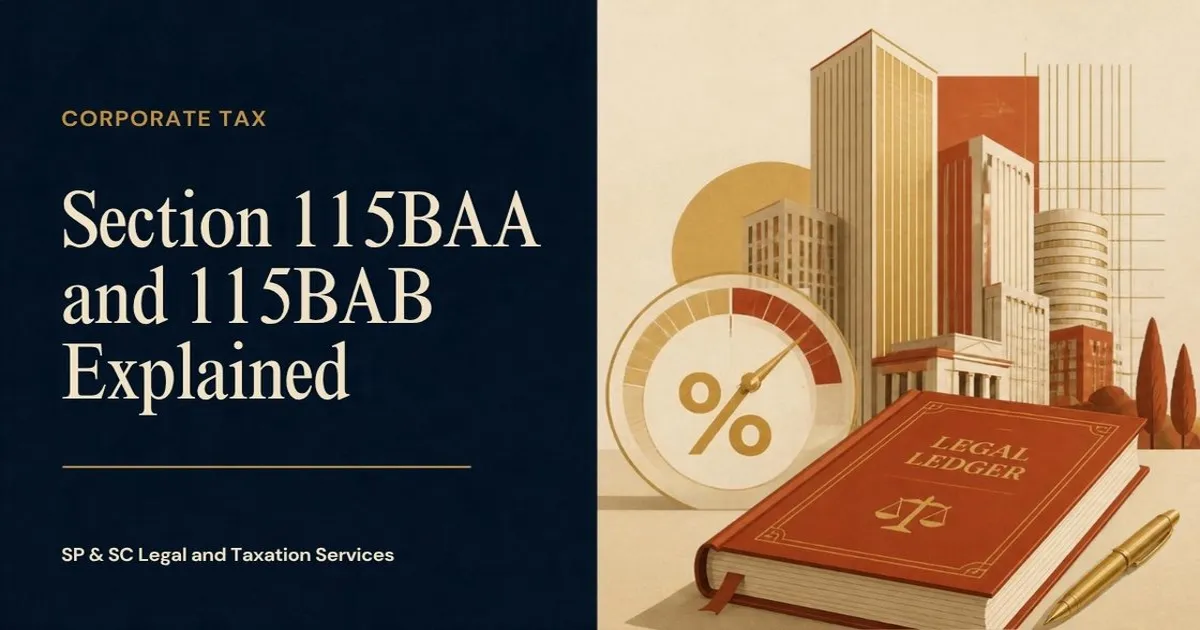
Understand the concessional corporate tax rates under Section 115BAA at 22% for existing companies and Section 115BAB at 15% for new manufacturing companies, and the conditions to avail them.
Corporate Tax Rates: Section 115BAA and 115BAB Explained
Short answer: Section 115BAA of the Income-tax Act, 1961, offers a concessional tax rate of 22% (plus surcharge and cess) to existing domestic companies. Section 115BAB provides an even lower rate of 15% (plus surcharge and cess) for new domestic manufacturing companies set up after October 1, 2019. Both options are voluntary and require the company to forgo certain specified deductions and exemptions, most notably additional depreciation and SEZ benefits.
What is Section 115BAA?
Section 115BAA allows any domestic company to pay income tax at a reduced rate of 22%, plus a mandatory surcharge of 10% and cess of 4%. This results in an effective tax rate of 25.168%. This option provides a flat, lower tax rate without the company having to worry about its turnover threshold, as is the case under the regular tax regime. However, to avail this benefit, the company cannot claim a list of specified deductions, including those for Special Economic Zone units and additional depreciation.
What is Section 115BAB?
Section 115BAB offers a highly attractive tax rate of 15% (plus 10% surcharge and 4% cess, for an effective rate of 17.16%) to newly incorporated domestic manufacturing companies. To be eligible, the company must have been set up and registered on or after October 1, 2019, and must commence manufacturing or production on or before March 31, 2024. This section was introduced to boost domestic manufacturing and attract fresh investment into the sector. Like Section 115BAA, it is conditional upon forgoing various tax deductions.
Which deductions and exemptions must be given up?
A company opting for either Section 115BAA or 115BAB must forego several key tax incentives. The decision to switch requires careful financial analysis, as the benefit of a lower rate might be offset by the loss of these deductions. The primary claims that must be relinquished are:
- Deduction for units in Special Economic Zones (SEZ) under Section 10AA.
- Additional depreciation under Section 32(1)(iia).
- Deduction for investment in new plant or machinery in notified backward areas under Section 32AD.
- Deductions for scientific research expenditure under Section 35(1)(ii), (iia), (iii), 35(2AA), or 35(2AB).
- Deduction for expenditure on specified businesses under Section 35AD.
- Various deductions under Chapter VI-A (e.g., Sections 80-IA, 80-IB, 80-IC, etc.), except for the deduction under Section 80JJAA (for new employment) and Section 80M (for inter-corporate dividends).
- Any brought-forward losses or unabsorbed depreciation from previous years, if such loss is attributable to any of the above-mentioned deductions.
What are the conditions for opting for Section 115BAB?
This section has more stringent conditions aimed specifically at new manufacturing ventures. A company must satisfy all the following:
- Incorporation Date: Must be set up and registered on or after 1 October 2019.
- Commencement of Business: Must commence manufacturing or production by 31 March 2024.
- Nature of Business: Must not be formed by splitting up or reconstructing an existing business (certain exceptions apply).
- Asset Usage: Must not use any plant or machinery previously used for any purpose in India (with an allowance for up to 20% of total machinery value).
- Building Usage: Must not use a building previously used as a hotel or a convention centre.
- Primary Activity: The company must be engaged solely in the business of manufacturing or production of an article or thing, and research or distribution related to it. Businesses like software development, mining, and printing of books are specifically excluded from the definition of 'manufacturing' for this section.
How does a company opt for these special tax rates?
A company must file a specific form electronically to inform the Income Tax Department of its choice to be taxed under these concessional regimes. The choice must be made before the due date for filing the income tax return (ITR-6 for companies) for the financial year in which it wants to claim the benefit.
- For Section 115BAA: File Form 10-IC.
- For Section 115BAB: File Form 10-ID.
Once a company opts for Section 115BAA, the option is irreversible for subsequent years. For Section 115BAB, if the company fails to satisfy the conditions in any year, it can no longer avail the 15% rate but can opt for the 22% rate under Section 115BAA.
Should my company choose Section 115BAA/BAB or the regular rate?
The decision depends entirely on your company's financial structure and future plans. A company benefiting significantly from deductions like additional depreciation or SEZ benefits might find the regular tax regime more advantageous, despite its higher base rate. Conversely, a profitable service-based company with limited fixed assets and no special deductions may find the 25.168% effective rate under Section 115BAA highly beneficial. A detailed comparison is essential.
| Feature | Regular Tax Regime | Section 115BAA | Section 115BAB |
|---|---|---|---|
| Applicability | All domestic companies | Optional for any domestic company | Optional for new domestic manufacturing companies |
| Base Tax Rate | 25% (Turnover ≤ ₹400 Cr) or 30% (Turnover > ₹400 Cr) | 22% | 15% |
| Surcharge | 7% (>₹1 Cr), 12% (>₹10 Cr) | 10% (Mandatory) | 10% (Mandatory) |
| Health & Edu Cess | 4% | 4% | 4% |
| Effective Tax Rate | Varies (26% - 34.94%) | 25.168% | 17.16% |
| MAT Applicability | Yes, under Sec 115JB (15%) | No | No |
| Key Deductions | Allowed (Additional Depreciation, SEZ benefits, etc.) | Not allowed | Not allowed |
Worked example
Let's consider Zenith Software Solutions Pvt. Ltd., a Bengaluru-based IT services company, for the financial year 2025-26. Its turnover for FY 2023-24 was ₹20 crore.
- Profit before tax and depreciation: ₹50,00,000
- Normal Depreciation claim: ₹3,00,000
- Additional Depreciation on new computers: ₹5,00,000
- Deduction for scientific research (Sec 35): ₹2,00,000
Scenario 1: Tax calculation under the Regular Regime Since turnover is below ₹400 crore, the applicable rate is 25%.
- Profit before tax: ₹50,00,000
- Less: Normal Depreciation: ₹3,00,000
- Less: Additional Depreciation: ₹5,00,000
- Less: Section 35 Deduction: ₹2,00,000
- Taxable Income: ₹40,00,000
- Base Tax @ 25%: ₹10,00,000
- Surcharge: Nil (as income is below ₹1 crore)
- Add: Health & Education Cess @ 4%: ₹40,000
- Total Tax Liability (Regular): ₹10,40,000
Scenario 2: Tax calculation under Section 115BAA The company must forgo additional depreciation and the Section 35 deduction.
- Profit before tax: ₹50,00,000
- Less: Normal Depreciation: ₹3,00,000
- Taxable Income: ₹47,00,000
- Base Tax @ 22%: ₹10,34,000
- Add: Mandatory Surcharge @ 10%: ₹1,03,400
- Tax plus Surcharge: ₹11,37,400
- Add: Health & Education Cess @ 4%: ₹45,496
- Total Tax Liability (115BAA): ₹11,82,896
Conclusion: In this case, Zenith Software Solutions Pvt. Ltd. would save ₹1,42,896 by staying in the regular tax regime and claiming its deductions. This illustrates why a blanket switch to the lower rate is not always advisable.
Common mistakes
- Forgetting Surcharge: The 10% surcharge under Sections 115BAA and 115BAB is mandatory, irrespective of the income level, unlike the regular regime. Many calculations erroneously omit this.
- Claiming Prohibited Deductions: After opting for the new regime, some companies continue to claim deductions like additional depreciation out of habit, leading to incorrect returns and potential tax notices.
- Missing the Filing Deadline for Form 10-IC/10-ID: The option must be exercised before the ITR due date. Failing to file the form in time makes the company ineligible for the concessional rate for that year.
- Ignoring MAT Exemption: A key benefit of these sections is that Minimum Alternate Tax (MAT) under Section 115JB is not applicable. Companies often forget to factor this significant advantage into their decision-making, especially if they have high book profits but low taxable income.
- Misunderstanding the Irreversibility: For Section 115BAA, the choice is final. A company cannot flip-flop between regimes based on annual profitability. This requires long-term strategic tax planning.
How SP & SC helps
Choosing the right corporate tax regime is a critical decision with long-term financial implications. SP & SC Legal and Taxation Services provides expert guidance to make this choice clear and beneficial. We analyse your company's financials, project future profits and capex, and prepare a comparative analysis of tax outgo under different regimes. Our team handles the entire compliance process, from advising on eligibility to filing Form 10-IC or 10-ID and preparing and filing the corporate income tax return. For a comprehensive review and strategic tax advice, explore our tax consultation services.
Frequently asked questions
Can a company switch back to the normal tax regime from 115BAA?
No. Once a company exercises its option to be taxed under Section 115BAA by filing Form 10-IC, the decision is binding for all subsequent assessment years. It cannot revert to the regular tax regime.
Is Minimum Alternate Tax (MAT) applicable if a company opts for 115BAA or 115BAB?
No. One of the major advantages of opting for Section 115BAA or 115BAB is that the provisions of Minimum Alternate Tax (MAT) under Section 115JB do not apply.
What is the effective tax rate under Section 115BAA and 115BAB?
The effective tax rate includes the base rate, a mandatory 10% surcharge, and a 4% health and education cess. For Section 115BAA, this comes to 25.168% (22% + 2.2% + 0.968%). For Section 115BAB, it is 17.16% (15% + 1.5% + 0.66%).
What happens to brought-forward losses if a company opts for 115BAA?
Any brought-forward losses that are attributable to the deductions which are disallowed under Section 115BAA (like additional depreciation) cannot be set off. However, brought-forward losses from normal business operations or unabsorbed normal depreciation can still be set off against future income.
Do these sections apply to LLPs or Partnership Firms?
No. Sections 115BAA and 115BAB are specifically for domestic companies, which includes private limited and public limited companies. Limited Liability Partnerships (LLPs) and partnership firms are taxed at a flat rate of 30% plus cess and are not eligible for these concessional rates.
Get a fixed-fee quote
Navigating corporate tax laws requires precision and strategic foresight. To ensure your company is compliant and tax-efficient, share your financial documents with us for a detailed review and a written fixed-fee quote. Contact SP & SC via our website, or WhatsApp us at +91 90356 74566. Our team of Chartered Accountants and advocates is equipped to handle your tax planning and compliance needs from end to end.
Written by
SP & SC Editorial
Editorial team at SP & SC Legal and Taxation Services — practising advocates, chartered accountants, and company secretaries publishing hands-on guidance from live client files.
Next steps
What to do next
Guides help you decide. If you need an advocate, CA, or CS on your side, the SP & SC team files, drafts, and represents.