
Clubbing of Income: When Spouse or Child Income Is Added to Yours
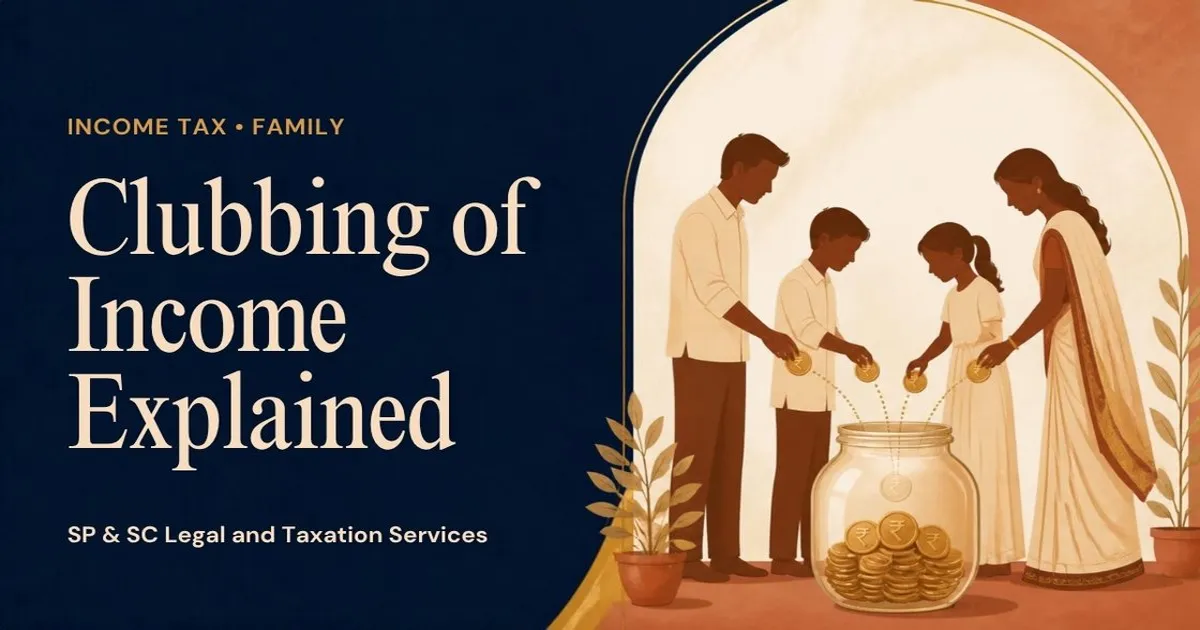
Clubbing of income means adding the income of your spouse or minor child to your total income for tax calculation, a rule designed to prevent tax avoidance on gifted assets.
Clubbing of Income: When Spouse or Child Income Is Added to Yours
Short answer: Clubbing of income is a provision in the Income Tax Act where an individual's income is legally combined with the income of their spouse or minor child for tax computation. This typically happens when you transfer an asset to them without receiving adequate payment, or when your spouse earns a salary from your business without professional qualifications. The purpose is to prevent high-income earners from splitting their income to avoid higher tax brackets.
What is clubbing of income under the Income Tax Act?
It is the process of including another person's income in your 'Total Income' for the purpose of calculating income tax. Sections 60 to 65 of the Income-tax Act, 1961, contain these provisions, which are designed as an anti-avoidance measure. If you try to divert your income to a close relative (like a spouse or minor child) who is in a lower or nil tax bracket, these provisions are triggered, and that diverted income is added back to your own for taxation.
When is a spouse's income clubbed with yours?
Your spouse's income is clubbed with yours in two primary situations. First, under Section 64(1)(ii), if your spouse receives a salary, commission, or fee from a business or company in which you have a "substantial interest" (holding 20% or more of shares or profits), that remuneration is added to your income. This rule does not apply if your spouse possesses technical or professional qualifications for the job. Second, under Section 64(1)(iv), if you transfer any asset (other than a house property) to your spouse without adequate consideration, any income generated from that asset is clubbed with your income.
Is income from an asset gifted to a spouse always clubbed?
No, it is not always clubbed. The clubbing provision does not apply if the asset was transferred for adequate consideration (i.e., sold at fair market value) or as part of an agreement to live apart. Furthermore, the clubbing applies only to the direct income from the gifted asset. Any further income earned by investing the initial income (often called 'income on income' or accretion) is not clubbed and is taxed in the hands of the spouse who received the gift.
For example, if you gift shares to your spouse and they earn dividend income, the dividend is clubbed. If they then use that dividend money to buy bonds and earn interest, that interest income is not clubbed.
Under what circumstances is a minor child's income clubbed?
A minor child's income is clubbed with the income of their parent whose total income (before including the minor's income) is higher, as per Section 64(1A). An exemption of ₹1,500 per minor child is available under Section 10(32). However, there are exceptions. Clubbing provisions do not apply if the minor child has earned the income through their own manual work, or by applying their specialised skill, talent, or knowledge. Additionally, income of a minor child suffering from a disability specified in Section 80U is not clubbed.
What about income from assets transferred to a daughter-in-law?
Yes, these provisions extend to your son's wife as well. According to Section 64(1)(vi), if you transfer an asset to your son's wife after May 31, 1973, without adequate consideration, the income arising from that asset will be clubbed with your income. The same logic applies: it is intended to prevent you from diverting your income to your daughter-in-law to reduce your tax liability. The income from the accretion of such income, however, will not be clubbed.
| Scenario of Income Generation | Is the income clubbed? | Governing Section | Key Condition |
|---|---|---|---|
| Salary to spouse from a firm where you have substantial interest | Yes | Sec 64(1)(ii) | Spouse lacks the professional/technical qualifications for the role. |
| Asset transferred to spouse without adequate consideration | Yes | Sec 64(1)(iv) | Transfer is not in connection with an agreement to live apart. |
| Asset transferred to son's wife without adequate consideration | Yes | Sec 64(1)(vi) | Transfer occurred after May 31, 1973. |
| Income of a minor child | Yes (clubbed with parent whose income is higher) | Sec 64(1A) | Exemption of ₹1,500 available. Not applicable for skilled work income. |
| Income from an asset transferred under a revocable transfer | Yes | Sec 61 | The transferor can reassume control over the asset or income. |
| Asset transferred for the benefit of spouse or son's wife | Yes | Sec 64(1)(vii/viii) | The transfer is to a third person/AOP for their indirect benefit. |
| Income from an asset gifted to a major child (18+ years) | No | N/A | Clubbing provisions do not apply to major children. |
Worked example
Let's consider the case of Priya, a marketing head at a tech startup in Bengaluru, for the Financial Year 2025-26 (Assessment Year 2026-27). She follows the new tax regime.
- Priya's Salary Income: ₹30,00,000
- Her Husband's Income (from his own business): ₹15,00,000
Transactions during the year:
- Priya gifts her husband, Rohan, a Fixed Deposit worth ₹20,00,000. Rohan earns interest of ₹1,40,000 from this FD during the year.
- Priya also opened a mutual fund SIP in the name of her 12-year-old daughter, Myra. The capital gains from this fund during the year were ₹40,000.
Clubbing Calculation:
- Spouse's Income: Since Priya transferred the FD to her husband without adequate consideration, the interest income of ₹1,40,000 will be clubbed with Priya's income under Section 64(1)(iv).
- Minor's Income: Since Priya's income (₹30 Lakhs) is higher than her husband's (₹15 Lakhs), their daughter's income will be clubbed with Priya's. The amount to be clubbed is ₹40,000.
Priya's Total Taxable Income:
- Salary: ₹30,00,000
- Less: Standard Deduction (New Regime): ₹75,000
- Net Salary: ₹29,25,000
- Add: Clubbed Income from Husband's FD: ₹1,40,000
- Add: Clubbed Income from Daughter's MF: ₹40,000
- Less: Exemption for Minor's Income (Sec 10(32)): ₹1,500
- Net Clubbed Income: ₹1,40,000 + ₹38,500 = ₹1,78,500
- Gross Total Income: ₹29,25,000 + ₹1,78,500 = ₹31,03,500
Priya must declare this clubbed income in 'Schedule SPI' of her Income Tax Return and pay tax on a total income of ₹31,03,500.
Common mistakes
- Ignoring Asset Transfers: Many people believe that simply gifting money or assets to a non-working spouse makes the subsequent income tax-free. This is incorrect; the income from such gifted assets is clubbed.
- Forgetting Minor's Income: Overlooking small amounts of income, like interest on a savings account opened for a minor child. Even small amounts must be clubbed with the higher-earning parent's income.
- Misunderstanding 'Income from Income': Failing to distinguish between direct income from a gifted asset (which is clubbed) and income earned on that income (which is not). This can lead to over-reporting of clubbed income.
- Incorrect Parent for Clubbing: Clubbing a minor's income with the lower-earning parent's income instead of the higher-earning one, which is incorrect and can lead to scrutiny.
- Remuneration to Spouse: Paying a salary to a spouse from a proprietary concern or a company where you hold substantial interest, without the spouse having the requisite professional qualifications, and not clubbing this income.
How SP & SC helps
Navigating tax laws requires careful planning to ensure compliance while remaining tax-efficient. At SP & SC, our tax experts provide comprehensive advisory on structuring your finances and investments. We analyse your transactions, determine the applicability of clubbing provisions, and ensure your Income Tax Return is filed accurately, saving you from potential notices and penalties from the Income Tax Department. For more personalised guidance, explore our tax consultation services.
Frequently asked questions
H3: What happens to clubbed income if the marriage ends?
Once the relationship of husband and wife ceases to exist (due to divorce or death), the clubbing provisions under Section 64 are no longer applicable from the assessment year following the end of the relationship. Any income from assets previously transferred will then be taxed in the hands of the person who owns the asset.
H3: Is income earned by my major child clubbed with mine?
No. The clubbing provisions of Section 64(1A) apply only to a minor child (below 18 years of age). Once your child turns 18, they are treated as a separate assessee. Their income, regardless of the source, is taxed in their own hands, and they must file their own tax return if their income exceeds the basic exemption limit.
H3: Do clubbing provisions apply to losses as well?
Yes. The principle of clubbing applies to losses in the same way it applies to income. If income from a particular source is subject to clubbing, any loss from that same source will also be clubbed in the hands of the same individual and can be set off against their other income as per tax rules.
H3: What is 'substantial interest' for clubbing a spouse's salary?
An individual is deemed to have a "substantial interest" in a concern if they, either individually or along with their relatives, beneficially own at least 20% of the equity shares (in case of a company) or are entitled to at least 20% of the profits (in case of any other concern) at any time during the financial year.
H3: Is the ₹1,500 exemption for a minor's income available for each child?
Yes. The exemption of up to ₹1,500 under Section 10(32) is available per minor child whose income is being clubbed with the parent's income. So, if you have two minor children whose incomes are being clubbed, you can claim a total exemption of up to ₹3,000 (₹1,500 for each child).
Get a fixed-fee quote
To ensure you are compliant with India's complex tax laws, it's best to seek professional guidance. Share your documents with us, and we will provide a written, fixed-fee quote for our services. We handle all aspects of tax planning, ITR filing, and responding to department queries, end to end. Contact SP & SC or message us on WhatsApp at +91 90356 74566 for a consultation.
Written by
SP & SC Editorial
Editorial team at SP & SC Legal and Taxation Services — practising advocates, chartered accountants, and company secretaries publishing hands-on guidance from live client files.
Next steps
What to do next
Guides help you decide. If you need an advocate, CA, or CS on your side, the SP & SC team files, drafts, and represents.