Section 8 Company vs Trust vs Society for NGOs
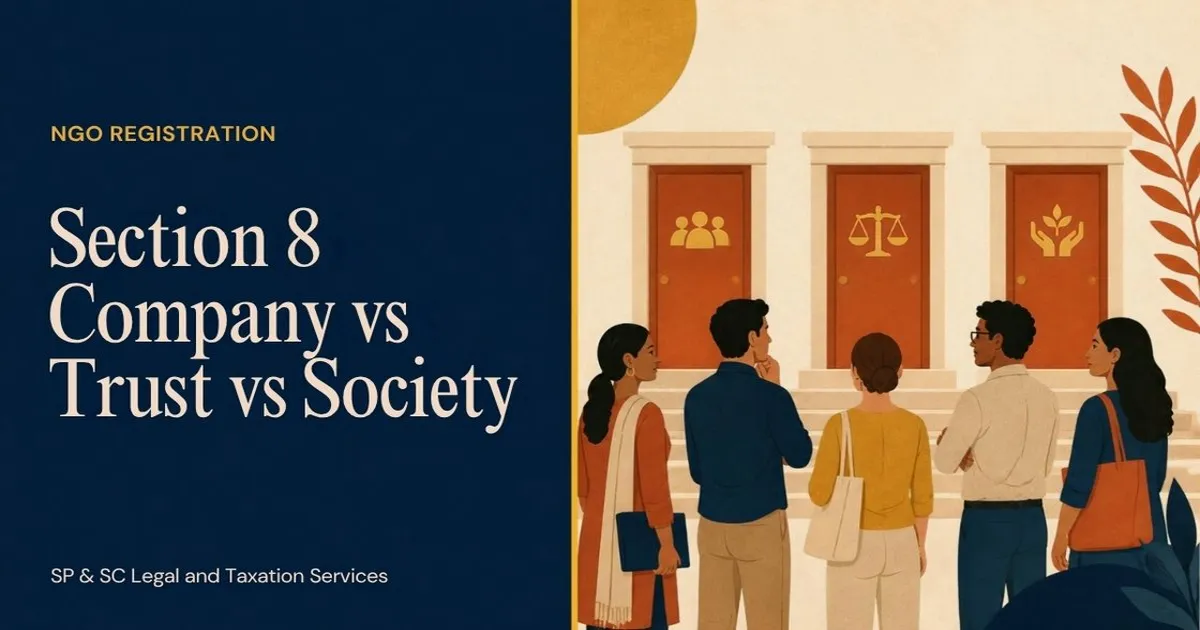
Deciding between a Section 8 Company, Trust, or Society? This guide compares them on governance, compliance, and suitability for your charitable goals.
Section 8 Company vs Trust vs Society: Which NGO Structure is Right for You?
Short answer: Choose a Section 8 Company for a corporate-style structure with high credibility, ideal for seeking CSR funds and scaling operations nationwide. Opt for a Trust for simpler asset management, especially property, with tight control by trustees. A Society is best for member-driven, democratic organisations with a local or state-level focus. The right choice depends entirely on your organisation's scale, governance model, and long-term objectives.
What is the main difference between a Section 8 Company, Trust, and Society?
The primary difference lies in their governing law, registration authority, and management structure. A Section 8 Company is regulated by the Companies Act, 2013 and the Ministry of Corporate Affairs, offering a robust corporate governance framework. A Public Charitable Trust is governed by the Indian Trusts Act, 1882 (or state-specific acts) and registered with the local Sub-Registrar, managed by a board of trustees. A Society is governed by the Societies Registration Act, 1860, managed democratically by a governing body elected by its members, and registered with the state Registrar of Societies.
Which structure is easiest and cheapest to register?
A Public Charitable Trust is generally the simplest and most cost-effective entity to register. The process primarily involves drafting a Trust Deed and registering it with the local Sub-Registrar of the district where the trust's registered office is located. A Society is moderately complex, requiring a minimum of seven members to subscribe to a Memorandum of Association. A Section 8 Company involves the most detailed registration process, similar to a private limited company, requiring director appointments, name approval (RUN), and filing with the Registrar of Companies (ROC), making it the most complex and expensive option initially.
Which NGO structure offers the best legal protection and credibility?
A Section 8 Company provides the highest degree of legal protection and credibility. It is recognised as a separate legal entity, distinct from its members, and offers limited liability, protecting members' personal assets from the company's debts. This corporate structure is preferred by government bodies, foreign donors, and companies providing CSR funds, as it implies a higher standard of governance and transparency. Trusts and Societies, while legally sound, do not always carry the same perception of corporate professionalism.
Can a Section 8 Company, Trust, or Society receive foreign donations (FCRA)?
Yes, all three types of organisations can apply for registration under the Foreign Contribution (Regulation) Act, 2010 (FCRA) to receive foreign donations. To be eligible, the NGO must have a proven track record of charitable activities for at least three years and have spent a minimum prescribed amount on its core objectives during that period. New organisations can seek prior permission from the Ministry of Home Affairs for a specific project and grant before they become eligible for full FCRA registration.
How are these entities taxed?
All three entities can be exempt from income tax on their surplus income if they meet certain conditions. The primary requirement is to obtain registration under Section 12AB of the Income-tax Act, 1961. Once registered, the NGO's income is exempt provided it is applied towards its charitable objects. Furthermore, to provide a tax deduction to its donors, the organisation must also secure registration under Section 80G of the Act. Without these registrations, the surplus income of the NGO would be taxable at the maximum marginal rate.
| Feature | Section 8 Company | Public Charitable Trust | Society |
|---|---|---|---|
| Governing Law | Companies Act, 2013 | Indian Trusts Act, 1882 & State Acts | Societies Registration Act, 1860 |
| Regulator | Ministry of Corporate Affairs (MCA) / Registrar of Companies (ROC) | Sub-Registrar of Assurances / Charity Commissioner | Registrar of Societies |
| Minimum Members | 2 Directors & 2 Members | 2 Trustees (Settlor + Trustees) | 7 Members in the Governing Body |
| Legal Status | Separate Legal Entity | Not a separate legal entity from trustees | Separate Legal Entity (in most states) |
| Liability | Limited Liability for members | Trustees can have personal liability | Limited (but can extend to governing body) |
| Management | Board of Directors | Board of Trustees | Governing Body / Managing Committee |
| Annual Compliance | High (ROC filings like AOC-4, MGT-7, DIR-3 KYC, Auditor Appointment) | Low (Primarily Income Tax filings) | Moderate (Annual list of governing body to Registrar of Societies) |
| Credibility | High, preferred for CSR and foreign grants | Moderate, depends on trustees' reputation | Moderate, good for community projects |
| Ease of Registration | Complex and time-consuming | Simple and quick | Moderately complex |
| Geographic Scope | All over India | Typically state-specific unless deed states otherwise | Typically state-specific operation |
Worked example
Let's consider a scenario in Bengaluru. Ms. Priya and Mr. Rohan want to start an NGO to provide free coding education to girls from low-income families. They have secured initial seed funding of ₹10 lakh from an angel investor and plan to approach major IT companies in Bengaluru for CSR funding.
-
Objective Analysis: Their goal is to create a scalable, professionally run organisation that can attract corporate funding. They need a structure that inspires confidence and ensures transparent management of funds.
-
Evaluating Options:
- Society: Requires 7 members. The democratic process might be slow for their fast-paced ed-tech model. It might not look as appealing to a large corporate CSR committee compared to a company structure.
- Trust: Simple to start with just the two of them as trustees. However, the structure vests significant power in the trustees, and corporate donors may prefer a more distributed governance model with a formal board.
- Section 8 Company: This is the ideal choice. They can be the initial two directors and members. The structure provides:
- Credibility: A "company" registered with the MCA is highly credible for CSR committees.
- Limited Liability: Their personal assets are protected.
- Governance: The Companies Act mandates clear rules for board meetings, financial reporting, and audits, ensuring transparency.
- Scalability: It's easy to add more directors or members and operate across India as they grow.
-
Decision & Next Steps: They decide to form a Section 8 Company. They will need to draft a Memorandum of Association (MOA) and Articles of Association (AOA) with clear charitable objects related to education. After incorporation, they will immediately apply for Section 12AB and Section 80G registrations to ensure tax exemption and offer tax benefits to donors.
Common mistakes
- Choosing Based on Initial Cost: Opting for a trust just because it's cheaper to set up can lead to governance and scalability issues later. The initial setup cost is minor compared to the long-term operational framework.
- Vague Object Clauses: Writing generic or overly broad objects in the Trust Deed or MOA. This is a common reason for rejection of 12AB, 80G, and FCRA applications, which require specific, well-defined charitable purposes.
- Assuming Automatic Tax Benefits: Incorporation/registration does not grant tax exemption. You must separately apply for and obtain registration under Section 12AB of the Income-tax Act.
- Failing to Maintain Separation: The NGO is a separate entity. Its bank account, assets, and liabilities must be kept strictly separate from the personal finances of the founders, trustees, or directors.
- Ignoring Annual Compliances: Section 8 Companies and Societies have mandatory annual filing requirements with their respective registrars. Failure to comply can lead to heavy penalties and even the entity being struck off.
How SP & SC helps
Choosing the right structure is the first critical step in your journey to make an impact. At SP & SC, our experts guide you through the pros and cons of each option based on your specific vision and funding strategy. We handle the entire registration process end-to-end, whether it's a Section 8 Company, Trust, or Society. This includes drafting the necessary legal documents like the Trust Deed or MOA/AOA, filing applications with the appropriate authorities, and managing post-incorporation essentials like obtaining Section 12AB and 80G registrations to make your organisation fully compliant and ready to receive donations.
Frequently asked questions
Can an NGO make a profit?
Yes, an NGO can generate a surplus (profit) from its activities. However, under Section 8 of the Companies Act and general charitable principles, this profit cannot be distributed to its members as dividends. It must be reinvested and applied towards promoting its charitable objects.
How many people are needed to start a Section 8 Company?
A minimum of two directors and two members are required. The directors and members can be the same individuals. There is no maximum limit on the number of members.
Is GST applicable to NGOs?
Yes, GST registration is mandatory for an NGO if its aggregate turnover from the supply of commercial goods or services exceeds the threshold limit (currently ₹20 lakh in most states, ₹10 lakh in special category states). Many services provided by charitable entities are exempt from GST, but this must be evaluated on a case-by-case basis.
Can directors of a Section 8 Company receive a salary?
Yes, a director can receive reasonable remuneration for professional or technical services rendered to the company. This should be explicitly permitted by the Articles of Association and must be a fair market value for the service to avoid conflicts of interest. Sitting fees for attending board meetings are also permissible.
How do I close down an NGO?
Closing an NGO is a formal legal process. A Section 8 Company can be wound up voluntarily or by a tribunal. A Society can be dissolved as per the procedure laid out in the Societies Registration Act. A Trust can be extinguished under the conditions specified in the Indian Trusts Act. In all cases, the remaining assets must be transferred to another charitable organisation with similar objects.
Get a fixed-fee quote
Starting an NGO involves critical legal and financial decisions. Let our experienced team handle the complexities so you can focus on your mission. Share your documents with us for an initial consultation and receive a written, fixed-fee quote for our services. Contact SP & SC or message us on WhatsApp at +91 90356 74566. We provide comprehensive, end-to-end support for all your registration and compliance needs.
Written by
SP & SC Editorial
Editorial team at SP & SC Legal and Taxation Services — practising advocates, chartered accountants, and company secretaries publishing hands-on guidance from live client files.
Next steps
What to do next
Guides help you decide. If you need an advocate, CA, or CS on your side, the SP & SC team files, drafts, and represents.