GSTR-2B Reconciliation: How to Match Your Input Tax Credit
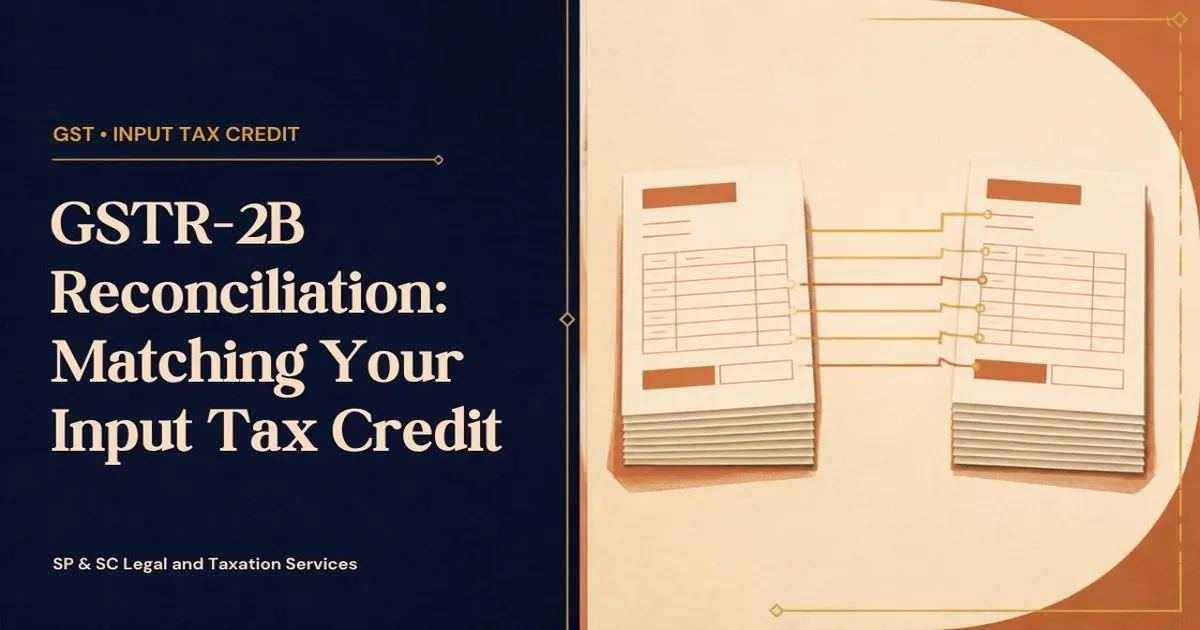
Since Rule 36(4), you can claim ITC only if it shows in GSTR-2B. A step-by-step reconciliation process, common mismatches and how to fix them.
GSTR-2B reconciliation means matching your purchase register with the GST portal’s ITC statement before filing GSTR-3B. For ordinary domestic purchases, claim credit only when supplier-reported invoice details are communicated in GSTR-2B and all eligibility conditions are satisfied under Sec. 16 CGST Act and Rule 36(4) CGST Rules. For FY 2025-26, also review Invoice Management System (IMS) actions, missing invoices, blocked credits and required reversals; a matching entry alone does not establish eligibility.
What is GSTR-2B, and when is it generated?
GSTR-2B is an auto-drafted ITC statement normally generated on the 14th after the relevant tax period, but IMS actions can require recomputation before filing GSTR-3B.
It draws information from supplier filings, including GSTR-1 and the Invoice Furnishing Facility (IFF), together with applicable GSTR-1A amendments, input service distributor records and import data. It identifies credit as available or unavailable based on system checks.
For monthly taxpayers, generation is normally monthly; under the current IMS framework, QRMP recipients receive quarterly GSTR-2B. Suppliers using QRMP can use IFF to report eligible B2B invoices during the first two months of a quarter.
Calling GSTR-2B permanently “static” is now incomplete. Unlike dynamic GSTR-2A, it is period-based, but IMS actions after initial generation can change the statement through recomputation. Always use the latest applicable version.
How does GSTR-2B differ from GSTR-2A?
GSTR-2A helps track supplier reporting, while GSTR-2B is the principal statement used to reconcile supplier-reported ITC for GSTR-3B.
| Point | GSTR-2A | GSTR-2B |
|---|---|---|
| Nature | Dynamic, updates as source filings change | Period-based, with IMS-related recomputation where applicable |
| Availability | Updates as relevant data flows in | Normally generated on the 14th after the relevant period |
| Main use | Supplier tracking and historical investigation | ITC reconciliation and GSTR-3B preparation |
| Eligibility guarantee | No | No |
Neither statement overrides the law. Sec. 16(2)(aa) CGST Act requires supplier-furnished invoice details to be communicated to the recipient for covered supplies. Rule 36(4) CGST Rules implements the corresponding GSTR-2B restriction.
You must also hold a valid document, receive the goods or services, satisfy applicable tax-payment conditions and file the return. Blocked credits under Sec. 17(5) CGST Act remain unavailable even when shown in GSTR-2B.
How should you perform GSTR-2B reconciliation?
Reconcile invoice by invoice, resolve IMS actions and prepare an eligibility-adjusted ITC schedule before filing GSTR-3B.
- Download the statement. Obtain GSTR-2B in Excel or JSON for the relevant period and review IMS records.
- Export your purchase register. Include supplier GSTIN, invoice number, invoice date, taxable value and separate IGST, CGST and SGST amounts.
- Include earlier unmatched invoices. A current statement may contain older invoices reported late.
- Match key fields. Compare GSTIN, invoice number, date and tax amounts. Normalise prefixes, spaces and leading zeros without merging distinct invoices.
- Classify differences. Separate matched entries, books-only invoices, GSTR-2B-only entries, duplicates, amount differences and credit notes.
- Resolve IMS records. Accept genuine records, reject records that do not belong to you, and use pending status where permitted. Recompute GSTR-2B when required.
- Check eligibility. Exclude blocked, personal-use and other ineligible credits; calculate required reversals.
- Prepare GSTR-3B. Separate eligible credit, deferred claims, reversals and reclaims, retaining a supporting working.
An invoice appearing only in GSTR-2B is not automatically claimable. Obtain the bill, verify receipt and business purpose, and record the purchase before claiming eligible credit.
How does IMS affect reconciliation in FY 2025-26?
IMS allows recipients to act on supplier records, and those actions influence which records feed into GSTR-2B.
Records left without action are generally treated as accepted for statement generation. That system treatment does not prove that the supply occurred or that the credit is legally available.
Review credit notes and amendments carefully: they can reduce credit already claimed. IMS functionality changed during FY 2025-26, including expanded pending options for specified records from the October 2025 tax period. Apply the portal rules relevant to that period rather than assuming every record can remain pending indefinitely.
Retain the final GSTR-2B download and IMS action trail supporting the filed return.
What causes common mismatches, and how can you fix them?
Most mismatches arise from delayed reporting, incorrect invoice details, missing accounting entries or timing differences.
| Mismatch | Likely reason | Correct response |
|---|---|---|
| Invoice in books, not GSTR-2B | Supplier filed late or omitted it | Seek reporting or correction; defer covered credit until communicated |
| Wrong recipient GSTIN | Supplier entered another GSTIN | Request amendment in the supplier’s outward-supply reporting |
| Tax amount differs | Data-entry, valuation or rate error | Establish the correct amount; obtain an amendment or valid credit/debit note as appropriate |
| In GSTR-2B, not books | Unrecorded bill or unrelated purchase | Verify ownership and receipt; record genuine purchases, reject unrelated records |
| Invoice number differs | Prefixes, punctuation or leading zeros | Normalise for matching while retaining original document references |
| Duplicate entry | Repeated booking or reporting | Investigate and ensure credit is claimed only once |
A data-entry mistake does not always require a credit or debit note. The correction must reflect the actual transaction.
What does a worked reconciliation example look like?
A Bengaluru trader with ₹4,20,000 of recorded ITC and ₹3,85,000 in GSTR-2B must investigate the ₹35,000 difference before claiming it.
Assume the July 2025 reconciliation establishes:
| Particulars | ITC |
|---|---|
| Purchase-register total | ₹4,20,000 |
| Supported, eligible credit appearing in GSTR-2B | ₹3,85,000 |
| Supplier invoice not yet reported | ₹30,000 |
| Unresolved typing difference | ₹5,000 |
The trader claims ₹3,85,000, assuming all other conditions are satisfied, and follows up with both suppliers. The ₹30,000 is claimed in September 2025 once it appears and remains eligible. The ₹5,000 is claimed only if verified as genuine additional eligible tax; otherwise, the books are corrected.
An excess claim does not automatically trigger an ASMT-10 notice. Depending on the facts, scrutiny under Sec. 61 CGST Act or a discrepancy intimation in Form GST DRC-01C under Rule 88D CGST Rules may arise.
If the entire ₹35,000 were wrongly availed and utilised for 60 days, illustrative interest at 18% would be:
₹35,000 × 18% × 60 ÷ 365 = approximately ₹1,036.
Sec. 50(3) CGST Act and Rule 88B CGST Rules govern this interest; mere availment without utilisation does not attract that provision.
What deadlines and reversals must you monitor?
For FY 2025-26 invoices, the ordinary ITC deadline is 30 November 2026 or the date of furnishing the relevant annual return, whichever is earlier.
This follows Sec. 16(4) CGST Act. Supplier reporting alone does not complete your claim: eligible credit must actually be availed within the deadline.
Also monitor:
- Unpaid suppliers: Rule 37 CGST Rules generally requires proportionate reversal where payment is not made within 180 days, with applicable interest and reclaim provisions.
- Supplier return defaults: Rule 37A CGST Rules can require reversal where the supplier reports the invoice but does not furnish the corresponding GSTR-3B within the prescribed timeline.
- Other restrictions: Apply Sec. 17(5) CGST Act and common-credit reversals where relevant.
How SP & SC helps
SP & SC Legal and Taxation Services, Bengaluru, reconciles purchase records, reviews IMS actions and prepares supported ITC workings for GSTR-3B.
Our GST return filing service and reconciliation service cover mismatch tracking, supplier follow-up support and reversal schedules.
Fees are a fixed quote after reviewing the case, confirmed in writing before work begins. Contact SP & SC or WhatsApp +91 90356 74566 with your records.
Frequently asked questions
Can I claim ITC not shown in GSTR-2B?
Generally not for covered domestic supplier invoices. Imports and reverse-charge credits require separate analysis; the supplier-upload restriction is not universal.
When is GSTR-2B generated?
Normally on the 14th after the relevant period, subject to portal prerequisites and IMS-related recomputation.
What if my supplier never reports the invoice?
Covered credit cannot be claimed without the required reporting and communication. Pursue correction and contractual remedies; avoid unilaterally withholding GST without reviewing payment obligations.
How often should I reconcile?
Monthly is advisable, including for QRMP businesses, with a final reconciliation before each GSTR-3B filing.
Does a matched invoice guarantee ITC?
No. Receipt, documentation, business use, payment-related conditions, deadlines and blocked-credit restrictions must also be checked.
Written by
SP & SC Editorial
Editorial team at SP & SC Legal and Taxation Services — practising advocates, chartered accountants, and company secretaries publishing hands-on guidance from live client files.
Next steps
What to do next
Guides help you decide. If you need an advocate, CA, or CS on your side, the SP & SC team files, drafts, and represents.