GST Reverse Charge on Security and Manpower Services
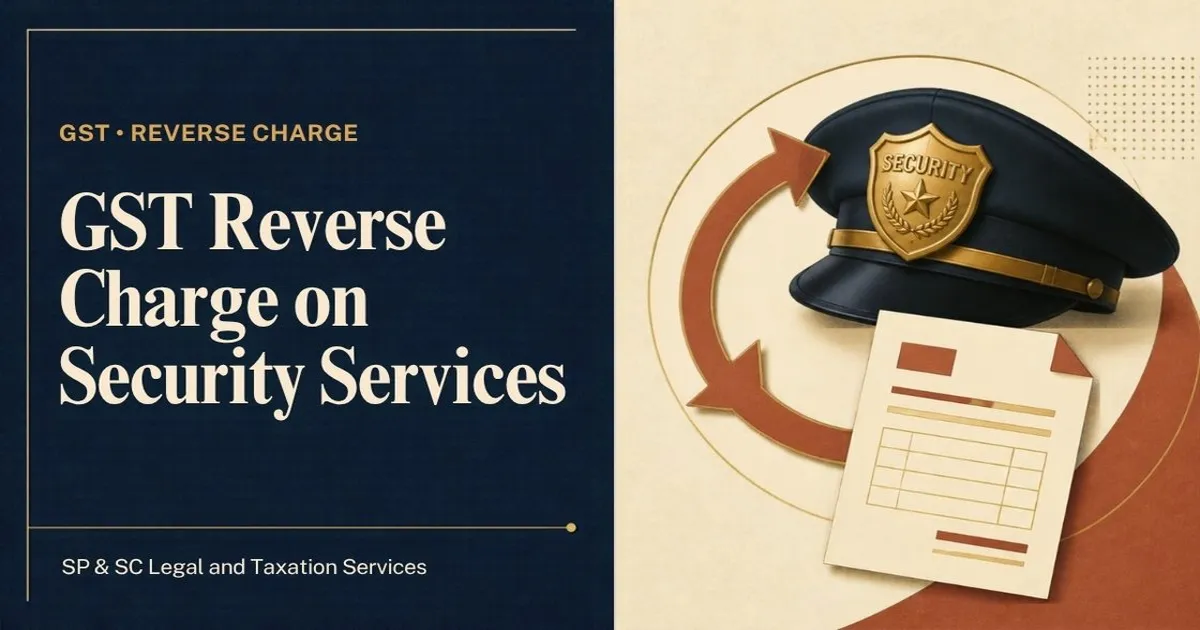
If your business hires a security agency that isn't a company, you must pay the GST under RCM. Our guide explains the rules and how to comply correctly.
GST Reverse Charge on Security and Manpower Services
Short answer: If a GST-registered business receives security services from any person other than a body corporate (e.g., a proprietorship or partnership firm), the business receiving the service must pay the GST directly to the government. This is called the Reverse Charge Mechanism (RCM). The service provider will not charge GST on their invoice, but the recipient must self-invoice and pay the tax while filing their GST returns.
What is the Reverse Charge Mechanism (RCM) for security services?
The Reverse Charge Mechanism is a provision under GST where the liability to pay tax is on the recipient of goods or services instead of the supplier. For security services, this rule is specifically defined by Notification No. 13/2017-Central Tax (Rate), as amended. It mandates that when a registered person receives security personnel services from any person other than a body corporate, the recipient is responsible for discharging the GST liability.
Who is liable to pay GST under RCM for security services?
A GST-registered person is liable to pay tax under RCM for security services if two conditions are met:
- The Service Recipient: You are a person or entity registered under the GST Act.
- The Service Provider: The entity providing the security service is not a 'body corporate'. This means if your security agency is a sole proprietorship, a partnership firm, a Limited Liability Partnership (LLP), or an Association of Persons (AOP), you (the recipient) must pay the GST under RCM.
A 'body corporate' typically includes a private limited company, a public limited company, or a foreign company.
Does RCM apply if the security agency is a company?
No, RCM does not apply if the security service provider is a body corporate, such as a private limited company or a public limited company. In this scenario, the standard 'forward charge' mechanism is applicable. The security company will issue a tax invoice including GST at the applicable rate (currently 18%), and you, the recipient, will pay the gross amount (service fee + GST) to the company. The company is then responsible for remitting the collected GST to the government.
What is the rule for manpower supply services?
The RCM provision that previously applied to general manpower supply services was withdrawn in 2018. Currently, GST on manpower supply is paid by the service provider under the forward charge mechanism. However, 'security services' were specifically retained under the RCM net. Therefore, it is crucial to distinguish between general manpower supply and security services. The RCM rules discussed in this article apply exclusively to security services and not to other forms of manpower supply.
Are there any exemptions to RCM on security services?
Yes, the RCM liability on security services does not apply to certain specified recipients. The key exemptions are:
- If the service provider is a body corporate (e.g., a Pvt Ltd company).
- If the service recipient is not registered under GST.
- If the recipient is a business registered under the GST Composition Scheme.
- If the recipient is a government department, establishment of Central/State/UT government, local authority, or governmental agency that has taken GST registration solely for the purpose of deducting tax at source (TDS) under Section 51 of the CGST Act.
| Aspect | Forward Charge (Security Agency is a Company) | Reverse Charge (Security Agency is a Proprietorship/Partnership) |
|---|---|---|
| Who Pays GST? | The security agency (service provider). | The business receiving the service (service recipient). |
| Invoice | Agency issues a Tax Invoice with GST. | Agency issues a bill of supply/invoice without GST. |
| Recipient's Action | Pay the total invoice amount (including GST) to the agency. | Pay only the service value to the agency. Pay GST directly to govt. |
| Tax Compliance | Agency files GSTR-1 and GSTR-3B to report the sale and pay tax. | Recipient reports liability in GSTR-3B, pays the tax, and issues a self-invoice. |
| Input Tax Credit (ITC) | Recipient claims ITC based on the agency's tax invoice. | Recipient claims ITC on the RCM tax they paid to the government. |
Worked example
Let's consider 'Bengaluru Innovations Pvt. Ltd.', a GST-registered software company. They hire 'Alpha Security Services', a partnership firm, to provide security for their office premises.
- Monthly Service Fee: ₹1,00,000
- GST Rate: 18%
Since Bengaluru Innovations is a registered person and Alpha Security is a partnership firm (not a body corporate), RCM applies.
Step-by-Step Compliance:
-
Invoicing by Alpha Security: Alpha Security will issue an invoice to Bengaluru Innovations for ₹1,00,000. This invoice will not include any GST amount. It may carry a declaration stating that the tax is payable by the recipient under RCM.
-
Payment by Bengaluru Innovations: The company pays ₹1,00,000 to Alpha Security.
-
GST Calculation and Payment: Bengaluru Innovations must calculate the GST liability on this service:
- GST = ₹1,00,000 × 18% = ₹18,000 This amount of ₹18,000 must be paid in cash (through the electronic cash ledger) while filing their monthly GSTR-3B return.
-
Self-Invoicing: Bengaluru Innovations must issue a 'self-invoice' for this transaction as per Section 31(3)(f) of the CGST Act.
-
Claiming Input Tax Credit (ITC): In the very same GSTR-3B, Bengaluru Innovations can claim ₹18,000 as eligible Input Tax Credit, provided the service is used for business purposes. This ITC can be used to offset their output GST liability on software services.
Effectively, for a business with output tax liability, the cash flow impact is neutral as the tax paid under RCM is immediately available as ITC.
Common mistakes
- Paying GST to the Non-Corporate Agency: Many businesses mistakenly pay the 18% GST to their security agency (which is a proprietorship or partnership), assuming it's a normal transaction. The agency cannot deposit this tax, and the recipient loses the ITC.
- Forgetting to Pay Tax under RCM: The recipient business fails to identify the RCM applicability and neither pays the tax nor reports it. This leads to non-compliance, interest, and penalties during departmental audits.
- Corporate Agency Not Charging GST: A security agency that is a private limited company incorrectly believes RCM applies to them and issues an invoice without GST. This is incorrect; they must charge GST under the forward charge.
- Failing to Claim ITC: After correctly paying tax under RCM, the business forgets to claim the corresponding Input Tax Credit in their GSTR-3B, leading to a direct loss of funds.
- Applying RCM to General Manpower Supply: Confusing security services with other manpower services and incorrectly applying RCM where it is not required.
How SP & SC helps
Navigating the complexities of GST, especially provisions like RCM, requires careful attention to detail. At SP & SC, our GST experts help businesses stay compliant and optimize their tax positions. We meticulously review your vendor agreements and profiles to determine the correct GST treatment, ensure accurate reporting of RCM transactions in your GST returns, and manage your ITC ledger effectively. Our end-to-end service protects you from notices and penalties arising from non-compliance.
Frequently asked questions
What is the GST rate for security services under RCM?
The applicable GST rate for security services, whether under forward charge or reverse charge, is 18%.
Do I need to pay RCM if my business is under the Composition Scheme?
No. As per Notification No. 15/2018-Central Tax (Rate), businesses registered under the composition scheme are exempt from paying GST under RCM for security services.
What form is used to report RCM liability?
The tax liability on account of reverse charge is declared and paid through Form GSTR-3B. The details of the inward supply are reported in GSTR-1 by the recipient.
Does this RCM apply to security services for a residential house?
No. The RCM provision applies only when the service recipient is a 'registered person' under GST. An individual hiring security for their personal residence is not a registered person and hence is not liable to pay tax under RCM.
Is there a threshold limit for RCM on security services?
No, there is no minimum threshold for this specific RCM provision. If the conditions are met (registered recipient, non-corporate provider), RCM is applicable from the very first rupee of service value.
Get a fixed-fee quote
Are you unsure about your RCM obligations or need assistance with your GST filings? Contact SP & SC or message us on WhatsApp at +91 90356 74566. Share your documents, and we will provide a written, fixed-fee quote for our services. We handle all aspects of GST compliance, from registration and filing to responding to departmental queries, ensuring your business remains compliant end-to-end.
Written by
SP & SC Editorial
Editorial team at SP & SC Legal and Taxation Services — practising advocates, chartered accountants, and company secretaries publishing hands-on guidance from live client files.
Next steps
What to do next
Guides help you decide. If you need an advocate, CA, or CS on your side, the SP & SC team files, drafts, and represents.