GST on Education, Coaching and Online Courses
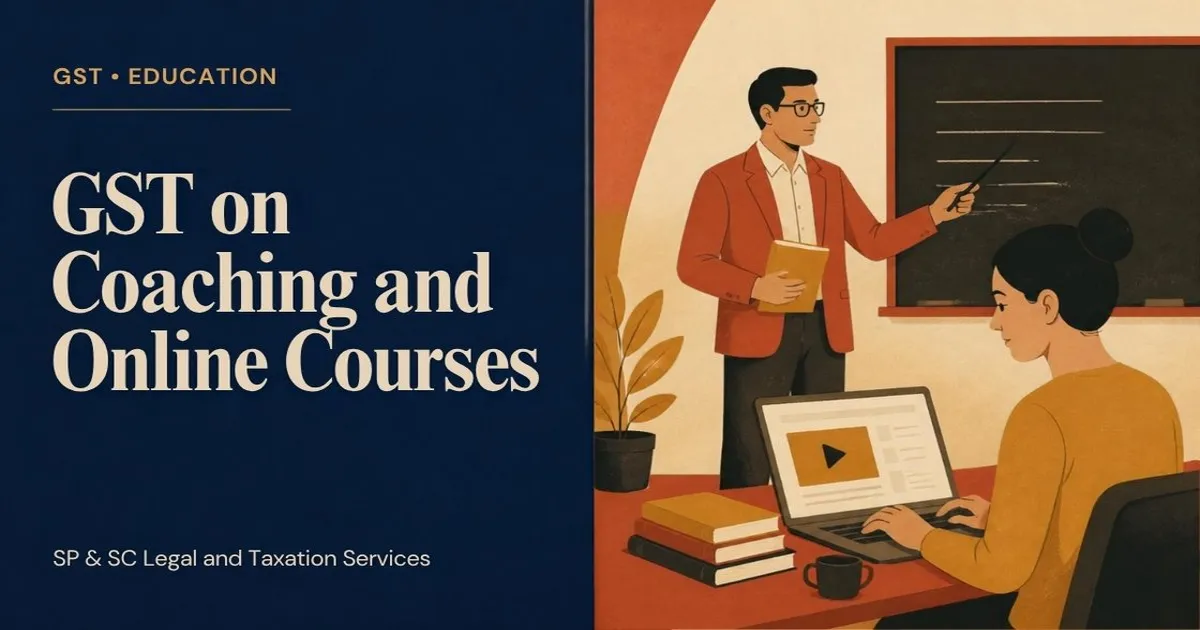
Most educational services from schools are GST-exempt. However, private coaching, professional training, and most online courses attract 18% GST. Know the rules.
GST on Education, Coaching and Online Courses
Short answer: While formal education from pre-school to higher secondary and certain recognised degree courses are exempt from GST, most other educational services are not. Private coaching centres, professional training institutes, and online courses are taxable services, attracting a GST rate of 18%. The key determining factor is whether the institution and the qualification it provides are recognised under Indian law as part of the formal education system.
What educational services are exempt from GST?
Services provided by an 'educational institution' to its students, faculty, and staff are exempt from GST. This exemption is specific and does not cover all forms of education. According to GST Notification No. 12/2017-Central Tax (Rate), an 'educational institution' is defined as an institution providing services by way of:
- Pre-school education and education up to higher secondary school or equivalent.
- Education as a part of a curriculum for obtaining a qualification recognised by any law for the time being in force.
- Education as a part of an approved vocational education course.
Therefore, if a college offers a B.Com degree recognised by a university established under law, the tuition fees for that course are exempt from GST. Similarly, a CBSE or State Board school's fees are exempt.
Is GST applicable on private coaching and tuition centres?
Yes, GST is applicable on private coaching and tuition centres at a rate of 18%. These centres do not fall under the definition of an 'educational institution' as per the GST law because they do not provide qualifications recognised by law. They supplement the formal education system or prepare students for competitive exams, which is considered a commercial training and coaching service under the GST framework.
Any institute providing coaching for entrance exams like CAT, JEE, NEET, or offering private tuitions for school subjects must charge GST on its fees, provided its aggregate annual turnover exceeds the registration threshold.
What is the GST rate on online courses and e-learning?
The GST rate on online courses and e-learning platforms is 18%. The mode of delivery, whether online or in-person, does not change the taxability of the service. Unless the course leads to a qualification recognised by law and is provided by a recognised educational institution, it is treated as a taxable supply of 'online information and database access or retrieval' (OIDAR) services or a general coaching service. This applies to most courses on platforms like Coursera, Udemy, or independent courses created by Indian entrepreneurs.
For more details on how GST applies to digital services, you may refer to our guide on GST for freelancers.
Do I need a GST registration for my coaching business?
You must obtain a GST registration if your aggregate annual turnover from your coaching or online course business exceeds ₹20 lakhs (or ₹10 lakhs for special category states). Aggregate turnover includes the value of all taxable supplies made across India under the same PAN. Once you are registered, you must collect GST from your students and file regular GST returns.
| Service Provider | Aggregate Annual Turnover | GST Registration Required? | Note |
|---|---|---|---|
| Private Tutor in Bengaluru | ₹18 Lakhs | No | Turnover is below the ₹20 Lakhs threshold. |
| Online Course Creator in Delhi | ₹25 Lakhs | Yes | Turnover exceeds the ₹20 Lakhs threshold. |
| Coaching Centre in Mumbai | ₹1.6 Crores | Yes | Must also comply with e-invoicing rules. |
Can I claim Input Tax Credit (ITC) on my coaching centre's expenses?
Yes, a GST-registered coaching centre or online course provider can claim Input Tax Credit (ITC) on the GST paid on its business expenses. This is a significant benefit as it reduces your final GST liability. Common expenses on which you can claim ITC include:
- Rent for the commercial premises.
- Internet and telephone bills.
- Purchase of laptops, projectors, and other office equipment.
- Software subscriptions (e.g., video conferencing, CRM).
- Marketing and advertising expenses.
- Professional fees paid to accountants and lawyers.
To understand the rules better, see our guide on Input Tax Credit (ITC) rules.
Are study materials and books sold by coaching centres taxed?
This depends on how they are supplied. If the study materials are provided as part of a single, indivisible course package (a composite supply), the entire course fee, including the value of the materials, is taxed at 18%. The principal supply is coaching, so its rate applies to everything.
However, if the coaching centre sells printed books separately, that transaction is GST-exempt, as the sale of printed books (which have an ISBN) is exempt. If they sell digital materials like PDFs or pen drives separately, these would be taxable at 18% as e-content.
Worked example
Ms. Priya runs an online platform, 'FinGrowth Academy', from Bengaluru, offering courses on financial modelling. In FY 2025-26, her business operations were as follows:
- Total revenue from course fees (exclusive of GST): ₹35,00,000
- Business expenses incurred (exclusive of GST):
- Office Rent: ₹3,60,000
- Cloud Hosting & Software: ₹2,00,000
- Digital Marketing: ₹1,50,000
- Professional Fees: ₹50,000
Step 1: GST Registration Since Priya's turnover of ₹35 lakhs exceeds the ₹20 lakhs threshold for services in Karnataka, she must register for GST.
Step 2: Calculate Output GST (GST Collected) This is the GST Priya collects from her students.
- Output GST = 18% of ₹35,00,000 = ₹6,30,000
Step 3: Calculate Input Tax Credit (ITC) This is the GST Priya paid on her business expenses.
- GST on Rent (18% of ₹3,60,000) = ₹64,800
- GST on Software (18% of ₹2,00,000) = ₹36,000
- GST on Marketing (18% of ₹1,50,000) = ₹27,000
- GST on Professional Fees (18% of ₹50,000) = ₹9,000
- Total ITC available = ₹64,800 + ₹36,000 + ₹27,000 + ₹9,000 = ₹1,36,800
Step 4: Calculate Net GST Payable This is the amount Priya must pay to the government.
- Net GST Payable = Output GST - Total ITC
- Net GST Payable = ₹6,30,000 - ₹1,36,800 = ₹4,93,200
Priya will collect ₹6,30,000 in GST, use ₹1,36,800 of it to offset the GST she already paid on her expenses, and remit the balance of ₹4,93,200 to the government through her periodic GSTR-3B filings.
Common mistakes
- Assuming all education is GST-exempt: Many new entrepreneurs in the ed-tech space wrongly assume their services are exempt. Only formal, recognised education is exempt; coaching and skill development are generally taxable.
- Failure to register for GST: Businesses often miss tracking their aggregate turnover. Once it crosses ₹20 lakhs in a financial year, GST registration becomes mandatory.
- Incorrectly classifying services: Selling course materials separately vs. as a composite supply can have different tax implications. Incorrect classification can lead to disputes with tax authorities.
- Not claiming eligible ITC: Forgetting to claim ITC on legitimate business expenses like rent, marketing, or software results in paying higher GST than necessary.
- Charging GST on exempt services: A recognised school or college must not charge GST on its tuition fees or other exempt services. Doing so is incorrect and burdens parents unnecessarily.
How SP & SC helps
Navigating the nuances of GST on educational services can be complex. SP & SC Legal and Taxation Services provides end-to-end GST solutions, from determining the taxability of your specific service to obtaining GST registration, and managing monthly and annual GST return filing. We ensure you remain compliant, maximise your Input Tax Credit, and avoid costly errors. Our team of Chartered Accountants and tax lawyers offers clear, practical advice tailored to your business model, whether you run a physical coaching centre or a global online course platform.
Frequently asked questions
Q1: Is GST applicable on hobby classes like painting, dancing or music?
Yes, services provided by way of recreational activities or hobby classes are taxable. They are not considered part of a formal curriculum for obtaining a recognised qualification, and hence attract GST at 18% if the provider's turnover exceeds the threshold.
Q2: Are services provided to an educational institution also exempt?
Certain specified services provided to an educational institution (from pre-school to higher secondary) are exempt. These include transportation of students, faculty, and staff; catering, including mid-day meal schemes; and security, cleaning, or housekeeping services. Services like online teaching software or consultancy provided to them remain taxable.
Q3: Do I have to pay GST on examination fees?
Fees for conducting examinations by an educational institution (as defined in the GST law) are exempt. However, if a private coaching centre or a professional body not recognised as an educational institution charges an exam fee, it would be taxable.
Q4: What is OIDAR and how does it affect online courses?
OIDAR stands for 'Online Information and Database Access or Retrieval'. It's a category of services provided through the internet with minimal human intervention. Many online courses fall under this definition. Under GST, foreign OIDAR providers selling to Indian customers must register in India and pay GST, ensuring a level playing field with domestic providers.
Q5: Is GST applicable on a corporate training program conducted for our employees?
Yes, corporate training and skill development programs are considered taxable services and attract 18% GST. The company receiving the training can typically claim Input Tax Credit on the GST paid, provided the training is a legitimate business expense.
Get a fixed-fee quote
Incorrect GST compliance can lead to notices, penalties, and business disruption. For clarity on your specific situation and for end-to-end handling of your GST registration and filing, share your documents with us. We provide a written fixed-fee quote after a preliminary review. Contact SP & SC or WhatsApp us at +91 90356 74566. We take on your compliance burden so you can focus on your business.
Written by
SP & SC Editorial
Editorial team at SP & SC Legal and Taxation Services — practising advocates, chartered accountants, and company secretaries publishing hands-on guidance from live client files.
Next steps
What to do next
Guides help you decide. If you need an advocate, CA, or CS on your side, the SP & SC team files, drafts, and represents.