GST on Advances Received: Goods vs Services and Refunds
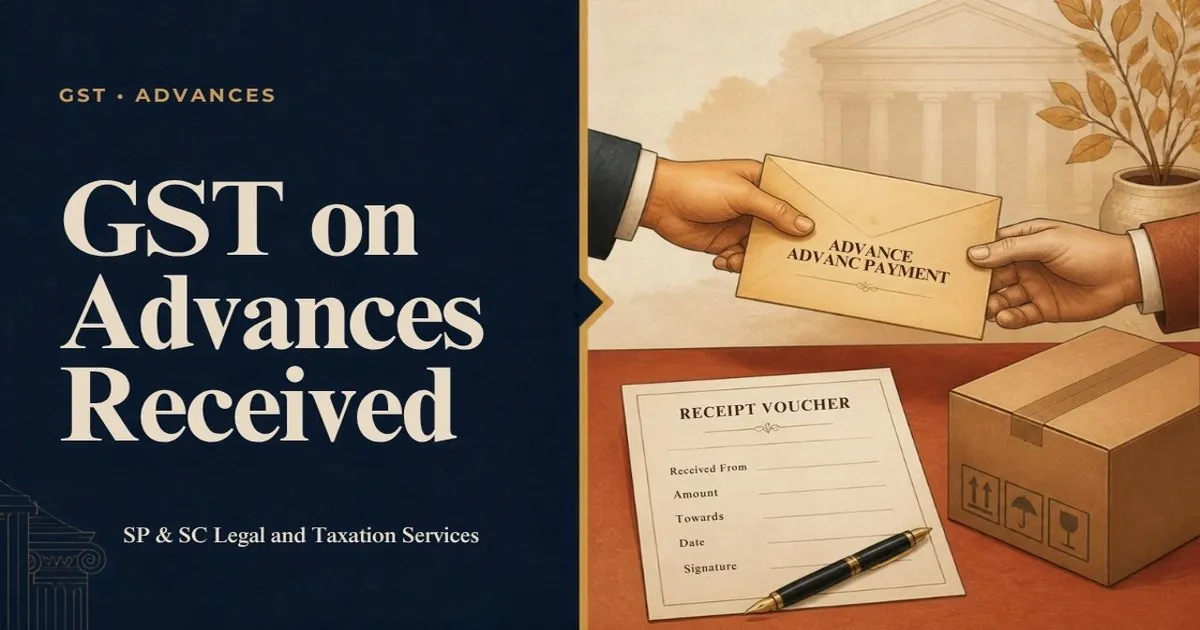
GST applies on advances for services at the time of receipt, but not on advances for goods since 2017. Receipt vouchers, adjustments and what to do if the deal is cancelled.
GST on advance received generally becomes payable on receipt for taxable services, but not for goods supplied by regular registered taxpayers covered by Notification No. 66/2017-Central Tax. For FY 2025-26, the answer depends on the supply, registration scheme and whether the money is consideration or a refundable deposit. Issue the appropriate voucher, reconcile advances when invoicing, and distinguish cancellation refunds from adjustments against completed supplies.
How does GST on advances differ for goods and services?
Regular registered suppliers generally pay GST on service advances, while goods advances receive specific relief from payment-based time-of-supply rules.
The following position applies for FY 2025-26. AY 2026-27 is an income-tax assessment-year reference, not a GST reporting period.
| Point | Goods: regular registered supplier | Taxable services: regular registered supplier |
|---|---|---|
| GST when advance arrives | Generally not payable | Generally payable |
| Governing provision | Sec. 12 CGST Act and Notification No. 66/2017-Central Tax | Sec. 13 CGST Act |
| Receipt document | Receipt voucher | Receipt voucher |
| Rate not determinable | No advance tax under the notification | 18% under Rule 50 CGST Rules |
| Inter-state/intra-state nature not determinable | No advance tax under the notification | Treat as inter-state under Rule 50 CGST Rules |
| GSTR-1 advance reporting | Generally no taxable advance entry | Table 11A for taxable advances not already invoiced |
| Subsequent invoice adjustment | No advance GST to offset | Table 11B for previously taxed advances |
Notification No. 66/2017-Central Tax, dated 15 November 2017, covers registered persons who have not opted for composition. It links goods liability to Sec. 12(2)(a) CGST Act, meaning the invoice date or the last date on which the invoice should have been issued, whichever is earlier.
Composition taxpayers are outside this notification. Their liability and reporting must follow the applicable composition provisions, rather than the regular-taxpayer table above; they cannot separately collect GST from customers.
When does a service advance become taxable?
For ordinary taxable services under forward charge, receipt of an advance normally triggers GST to the extent of that payment.
Under Sec. 13(2) CGST Act, where the invoice is issued within the prescribed period, time of supply is generally the earlier of invoice or payment. If the invoice is late, the relevant comparison is between service provision and payment.
The payment date is the earlier of entry in the supplier’s books and credit to the bank account. Calling an amount a “booking fee” or “retainer” does not postpone tax if it is consideration for a service.
However:
- Exempt services do not become taxable merely because payment is received upfront.
- Under Sec. 2(31) CGST Act, a deposit is not consideration unless the supplier applies it as consideration.
- Reverse-charge supplies, vouchers and changes in tax rate require separate analysis.
Consultants, event managers, software developers and coaching institutes should therefore check taxability before calculating GST. Not every educational service is taxable.
How should you calculate and adjust GST on a service advance?
Calculate GST at the applicable service rate, then offset the tax already discharged when reporting the subsequent invoice.
Consider a Bengaluru interior design firm receiving ₹2,36,000 in June for a project invoiced in September. Assume the supply is intra-state, attracts 18% GST, and the advance is GST-inclusive.
| Calculation | Amount |
|---|---|
| June advance received | ₹2,36,000 |
| Taxable value: ₹2,36,000 × 100 ÷ 118 | ₹2,00,000 |
| CGST at 9% | ₹18,000 |
| Karnataka SGST at 9% | ₹18,000 |
| Total GST liability on June advance | ₹36,000 |
The firm issues a receipt voucher, reports the uninvoiced advance in GSTR-1 Table 11A, and discharges ₹36,000 through June’s GSTR-3B, assuming monthly filing.
Suppose September’s full invoice is ₹5,90,000, comprising ₹5,00,000 value and ₹90,000 GST. The firm reports the complete invoice and adjusts the previously taxed advance through GSTR-1 Table 11B. The additional GST liability is ₹54,000, and the customer’s remaining payment is ₹3,54,000.
For a straightforward furniture sale covered by Notification No. 66/2017-Central Tax, the June advance would not trigger GST. An interior fit-out contract, however, may be a works contract service rather than a goods sale.
What must a receipt voucher contain?
A receipt voucher records an advance under Sec. 31(3)(d) CGST Act and must contain the particulars prescribed by Rule 50 CGST Rules.
These include:
- Supplier’s name, address and GSTIN.
- Consecutive serial number, not exceeding 16 characters and unique for the financial year, and issue date.
- Recipient’s name, address and GSTIN or UIN, if registered.
- Description and advance amount.
- Tax rate and tax amount.
- Place of supply with State name and code for inter-state supplies.
- Whether reverse charge applies.
- Signature or digital signature of the supplier or authorised representative.
Where the rate cannot be determined when the advance is received, Rule 50 CGST Rules prescribes 18%. This is not a universal rate for all service advances.
The inter-state fallback applies where the nature of supply cannot be determined. It should not replace a proper place-of-supply review simply because customer information is incomplete.
For goods covered by the advance-tax relief, retain the receipt voucher without collecting GST merely because an advance arrived.
What happens if an advance is refunded or the order is cancelled?
Cancellation before invoicing generally calls for a refund voucher, while cancellation after invoicing may require a GST credit note.
Where a receipt voucher was issued but neither supply nor tax invoice followed, issue a refund voucher under Sec. 31(3)(e) CGST Act and Rule 51 CGST Rules. Link it to the original receipt voucher and retain the cancellation agreement and bank refund proof.
Do not assume that issuing this voucher automatically recovers GST already paid. CBIC Circular No. 137/07/2020-GST clarifies the refund-voucher route and an application in FORM GST RFD-01, under “refund of excess payment of tax”, for the relevant cancelled service advance situation. Check eligibility, limitation and evidence under Sec. 54 CGST Act.
GSTR-1 Table 11B principally adjusts previously taxed advances against subsequent supplies. It is not a universal cancellation-refund mechanism.
If an invoice was already issued, examine a credit note under Sec. 34 CGST Act and Rule 53 CGST Rules. Reduction of output tax is subject to statutory conditions and the reporting deadline: generally 30 November following the relevant financial year, or filing the relevant annual return, whichever is earlier.
Any cancellation fee retained needs separate taxability analysis.
Which reporting mistakes cause avoidable costs?
The main risks are delayed service-advance tax, duplicate taxation and unsupported refund adjustments.
Missing GST on taxable service advances can attract interest, generally at 18% per annum, under Sec. 50 CGST Act, subject to the applicable calculation rules. Conversely, paying GST unnecessarily on covered goods advances creates avoidable cash-flow and reconciliation problems.
Maintain an advance register showing customer, contract, receipt date, taxable value, tax, voucher, invoice adjustment and refund status. Reconcile it with bank receipts, GSTR-1 and GSTR-3B.
If the advance and invoice fall within the same tax period, avoid reporting both as separate taxable liabilities. For quarterly filers, check the applicable payment and reporting timetable.
Builders must examine each instalment for taxable under-construction property alongside project-specific conditions. Completed-property treatment differs; see our guide on GST on under-construction flats.
How SP & SC helps
SP & SC Legal and Taxation Services, Bengaluru, reviews advance receipts, classification, vouchers, return reconciliation and cancellation documentation.
Our GST return filing service helps businesses prevent missed liabilities and double taxation. Fees are provided as a written, fixed quote after reviewing the case, before work starts. Contact SP & SC or message WhatsApp at +91 90356 74566 with your contracts, invoices and payment records.
Frequently asked questions
Is GST payable on advance received for goods?
Generally no for regular registered suppliers covered by Notification No. 66/2017-Central Tax. Composition taxpayers require separate treatment.
Is GST payable on every service advance?
It generally applies to advances for taxable services under forward charge. Exempt supplies and genuine unapplied deposits require different treatment.
What rate applies if the service rate is unknown?
Rule 50 CGST Rules prescribes 18% where the rate is not determinable when the advance is received.
Can the customer claim ITC using a receipt voucher?
A receipt voucher alone does not support input tax credit. The customer must satisfy Sec. 16 CGST Act, including applicable invoice and receipt-of-supply requirements.
What if I refund the entire advance?
Issue a refund voucher if no invoice or supply followed. Recovering tax already paid requires the applicable refund procedure, not merely repayment to the customer.
Written by
SP & SC Editorial
Editorial team at SP & SC Legal and Taxation Services — practising advocates, chartered accountants, and company secretaries publishing hands-on guidance from live client files.
Next steps
What to do next
Guides help you decide. If you need an advocate, CA, or CS on your side, the SP & SC team files, drafts, and represents.