Multiple GST Registrations: Branches, Warehouses and Additional Places
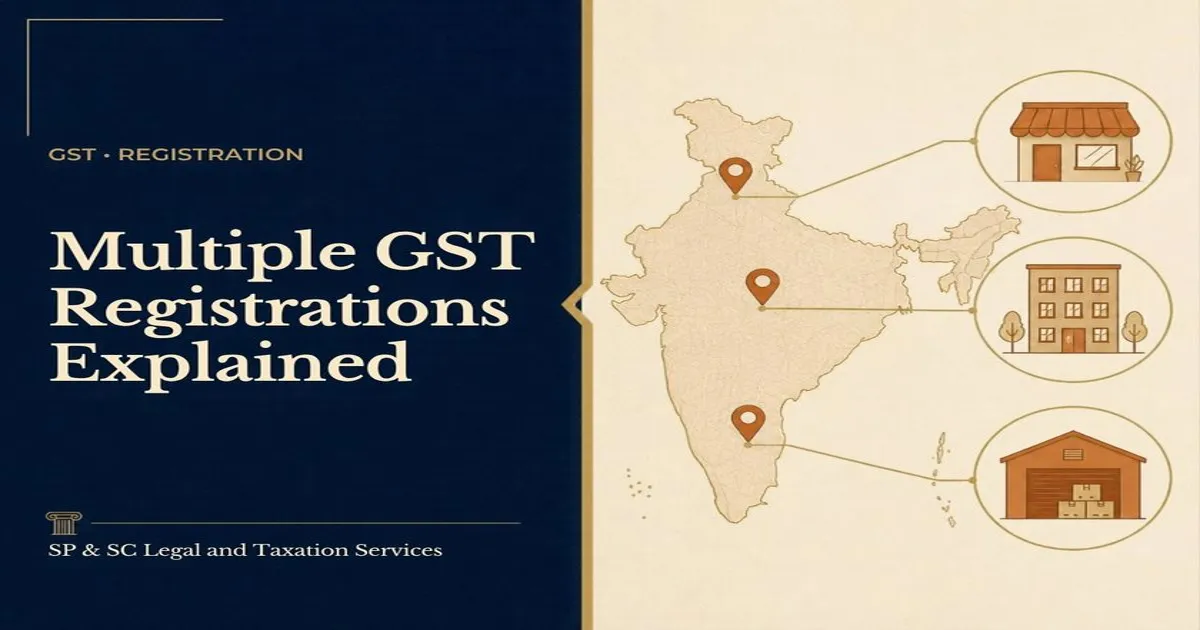
GST registration is state-wise. When a new branch needs a separate GSTIN, when to add an additional place of business, and how inter-branch supplies are taxed.
GST registration is PAN-based and state-wise, but opening another location does not always require another GSTIN. For FY 2025-26, a branch, shop or warehouse in the same state can generally be added as an additional place of business under the existing registration. A location in another state may require separate registration, depending on supplies and registration liability. Separate GSTINs bring distinct-person invoicing, tax and return obligations.
When does a new location need a separate GSTIN?
A separate GSTIN is generally required when you become liable for registration in another state or union territory from which taxable supplies are made.
Sec. 22 CGST Act governs turnover-based registration, Sec. 24 CGST Act covers compulsory registration, and Sec. 25 CGST Act governs the registration framework. Relevant thresholds, exemptions and compulsory-registration provisions must be considered together.
Aggregate turnover is calculated across India for the same PAN, not separately for each branch. However, merely selling to customers in another state does not require registration there.
| Situation | Usual GST treatment |
|---|---|
| Second shop in Bengaluru under the same PAN | Add it as an additional place under the Karnataka GSTIN |
| New warehouse in Karnataka | Normally add it to the existing Karnataka registration |
| Chennai branch making taxable supplies | Obtain Tamil Nadu registration where registration liability arises |
| Multiple business locations in one state | One GSTIN with additional places, or optional separate registrations under Rule 11 CGST Rules |
| Goods stored in another state's third-party warehouse | Examine registration there, particularly where customer supplies originate from that warehouse |
| Sales from Karnataka to customers elsewhere, without premises there | Customer location alone does not require another GSTIN |
A new state's registration cannot be created by amending the address of an existing state's GSTIN.
What qualifies as an additional place of business for GST?
An additional place is another business location covered by the same state-level registration, rather than a separately registered establishment.
Sec. 2(85) CGST Act includes places where business is ordinarily carried on, warehouses or godowns where goods are stored, locations where books are maintained, and places where business is conducted through an agent.
For an additional place of business GST amendment, common examples include:
- A second retail outlet or branch office.
- A warehouse, godown or fulfilment location.
- A factory or processing premises.
- Another operating location within the same state.
One GSTIN can cover multiple such locations. Maintain records identifying stock and transactions at each site, even though outward supplies are reported under the common GSTIN.
A third-party logistics arrangement does not automatically remove registration obligations. Review who owns the goods, where stock is held and from where customer orders are fulfilled. Temporary transit storage should not automatically be treated like an established distribution warehouse.
How do you add a shop or warehouse to an existing registration?
Add the premises through a core amendment on the GST portal, ordinarily within 15 days of the change.
Sec. 28 CGST Act and Rule 19 CGST Rules govern registration amendments. The application is made in FORM GST REG-14.
The usual process is:
- Select the amendment of registration core fields facility.
- Add the address and nature of activities.
- Upload appropriate possession and address documents.
- Submit with the applicable electronic authentication.
- Respond to any clarification request and retain the amended certificate.
Documents depend on whether the premises are owned, rented or used with consent. Typical evidence includes ownership records, a rent or lease agreement, or a consent letter supported by the owner's address or ownership evidence. Follow current portal requirements and departmental guidance.
Rule 19 CGST Rules ordinarily provides 15 working days for approval of qualifying core amendments, subject to verification and clarification procedures. Display the registration certificate and GSTIN at the relevant premises as required by Rule 18 CGST Rules.
Can one PAN have multiple GSTINs in the same state?
Yes, separate registrations are permitted for multiple places of business in the same state, subject to Rule 11 CGST Rules.
The old requirement for separate “business verticals” is outdated. Separate registrations can now be obtained for multiple places of business without proving that they constitute different verticals.
However, separate GSTINs create additional obligations. Supplies between them become taxable where covered by the distinct-person rules, each maintains its own credit ledger, and each has separate return responsibilities.
Composition eligibility also requires care. Under Rule 11 CGST Rules, one separately registered place cannot pay composition tax while another place under the same PAN pays normal tax. Separate registration should therefore follow an operational and cash-flow assessment, not just an accounting preference.
How are stock transfers and branch services taxed?
Transfers between distinct GST registrations can be taxable even without payment, while movements within one GSTIN are generally not supplies merely because goods change location.
Separately registered establishments are distinct persons under Sec. 25(4) CGST Act; Sec. 25(5) CGST Act also addresses establishments across states or union territories. Schedule I CGST Act brings business supplies between distinct persons into tax even without consideration.
For taxable inter-state stock transfers, issue a tax invoice and charge IGST at the applicable rate. For transfers between separate GSTINs within one state, CGST and SGST generally apply.
Valuation follows Rule 28 CGST Rules. Open-market value is the starting point, with prescribed alternatives and special options. Where the recipient is eligible for full input tax credit, the declared invoice value is deemed to be the open-market value. See our related party valuation guide.
Movements between locations under one GSTIN generally use a delivery challan under Rule 55 CGST Rules where applicable. Check e-way bill requirements under Rule 138 CGST Rules, including the general ₹50,000 consignment-value threshold and relevant exceptions.
What does an inter-state stock transfer cost in practice?
The sending branch incurs output GST, while the receiving branch can claim eligible ITC, creating a possible working-capital gap rather than an automatic permanent tax cost.
Assume a Bengaluru retailer opens a separately registered Chennai store. Both registrations follow normal taxation, and the goods attract 18% GST.
| Transaction | Amount |
|---|---|
| Accepted taxable value of stock transferred to Chennai | ₹20,00,000 |
| IGST charged at 18% | ₹3,60,000 |
| Transfer invoice total | ₹23,60,000 |
| Chennai's subsequent local sales, excluding GST | ₹25,00,000 |
| Output GST on those sales at 18% | ₹4,50,000 |
| Eligible transfer-related IGST credit | ₹3,60,000 |
| Remaining output tax after credit utilisation | ₹90,000 |
This assumes full ITC eligibility, compliance with Sec. 16 CGST Act and applicable utilisation rules, and no other credits.
The Bengaluru GSTIN may discharge its liability using eligible credit, cash or both. Chennai's ITC availability depends on statutory conditions and reporting. Consequently, the cash-flow gap is not necessarily brief.
When is ISD mandatory for shared branch expenses?
From 1 April 2025, covered third-party input-service credits received for distinct persons must be distributed through the ISD mechanism.
Sec. 2(61) CGST Act and Sec. 20 CGST Act, read with Rule 39 CGST Rules, govern the revised Input Service Distributor framework, including covered reverse-charge input services.
Head-office invoices for software subscriptions, audit or marketing may require ISD treatment where the services benefit other GST registrations. Allocation must follow the prescribed attribution and distribution rules.
Not every head-office cost belongs in ISD. Internally generated services between registrations require a separate cross-charge analysis. ISD distributes eligible input-service credit, not credit on goods or capital goods. Our ISD guide explains the distinction.
What compliance mistakes should businesses avoid?
The main risks are unregistered operating locations, missing branch invoices, incorrect credit allocation and missed GSTIN-level filings.
Each normal GSTIN generally files GSTR-1 and GSTR-3B. Eligible businesses using QRMP file these quarterly, with applicable monthly tax-payment requirements, so monthly returns are not universal.
Annual GSTR-9 requirements are subject to exemptions, including the applicable exemption for aggregate turnover up to ₹2 crore. Self-certified GSTR-9C generally applies where aggregate turnover exceeds ₹5 crore, under Rule 80 CGST Rules.
Avoid:
- Operating taxable supply locations without checking registration liability.
- Leaving warehouses off registration records.
- Moving goods between distinct GSTINs without required invoices.
- Ignoring mandatory ISD arrangements.
- Assuming one branch's filing covers every registration.
Defaults can attract interest, late fees, penalties, e-way bill restrictions and customer ITC difficulties.
How SP & SC helps
SP & SC reviews your locations, supply flows and shared expenses before recommending a registration structure.
We handle new-state registrations, additional-place amendments, inter-branch invoicing, ISD implementation and GSTIN-wise filings. Explore our GST registration service.
Our fees are a fixed quote after reviewing the case, confirmed in writing before work begins. Contact SP & SC or WhatsApp +91 90356 74566.
Frequently asked questions
Does a second Bengaluru shop need another GSTIN?
Usually not. Add it to the existing Karnataka GSTIN as an additional place.
Are inter-state branch stock transfers taxable without payment?
Yes, where they are supplies between distinct persons covered by Schedule I CGST Act.
Are separate business verticals required for same-state registrations?
No. Rule 11 CGST Rules permits separate registration for multiple places of business, subject to its conditions.
Does an out-of-state warehouse always require registration?
Not automatically. Storage arrangements, supply origins and registration liability must be examined.
Can all branches use one GSTIN's input tax credit?
No. Credit belongs to the relevant registration and must reach other GSTINs through legally permitted mechanisms.
Written by
SP & SC Editorial
Editorial team at SP & SC Legal and Taxation Services — practising advocates, chartered accountants, and company secretaries publishing hands-on guidance from live client files.
Next steps
What to do next
Guides help you decide. If you need an advocate, CA, or CS on your side, the SP & SC team files, drafts, and represents.