Blocked Input Tax Credit under Section 17(5): Cars, Food, Construction and More
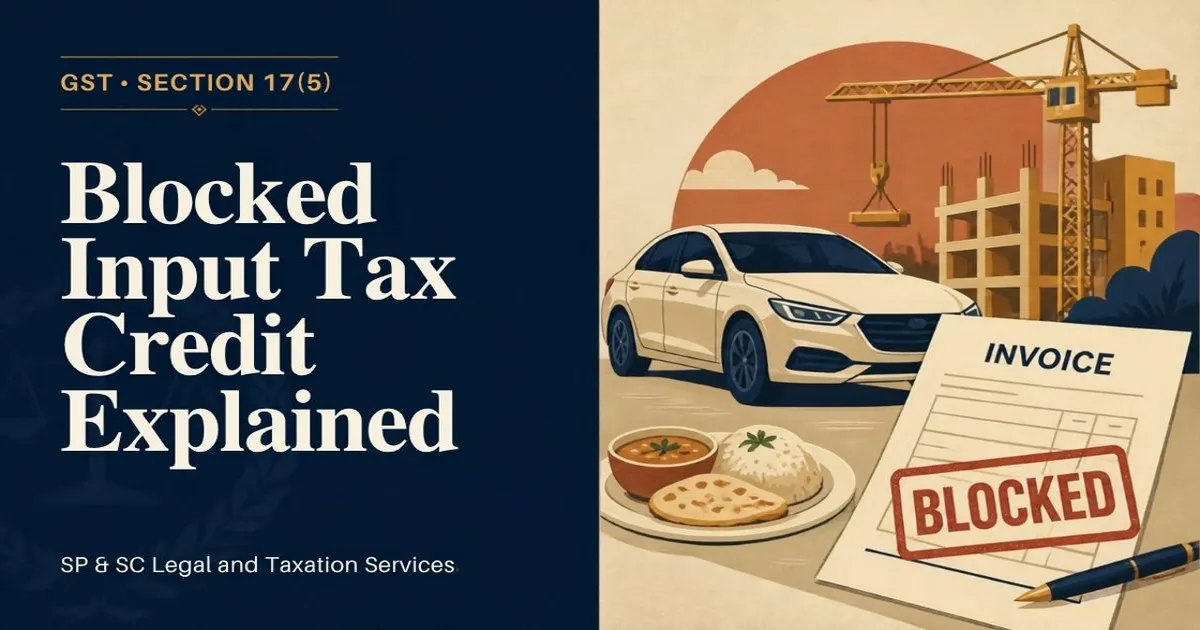
The GST credits you can never claim — motor vehicles, food and beverages, club memberships, construction of immovable property — with the exceptions that matter.
Blocked ITC under Sec. 17(5) CGST Act is GST credit you cannot claim even when an expense serves your business and appears in GSTR-2B. Common exclusions cover certain cars, employee benefits, construction, gifts and personal consumption. For FY 2025-26, check the statutory exceptions, retrospective construction amendment and corrected interest rules before claiming or reversing credit. Business use alone does not establish eligibility.
Which expenses attract blocked ITC under Section 17(5)?
Sec. 17(5) CGST Act blocks specified credits despite general eligibility, although several categories have narrowly defined exceptions.
| Expense or inward supply | Position and principal exceptions |
|---|---|
| Passenger motor vehicles with approved seating capacity of 13 or fewer, including the driver | Blocked unless used for further supply of such vehicles, passenger transportation or driving training. |
| Vessels and aircraft | Blocked unless used for further supply, passenger transportation, navigation or flying training, or transportation of goods. |
| General insurance, servicing, repairs and maintenance relating to the above | Blocked for specified vehicles, vessels and aircraft, subject to permitted-use exceptions and specified manufacturer/general-insurer exceptions. |
| Food, beverages, outdoor catering, beauty treatment, health services and cosmetic/plastic surgery | Generally blocked; exceptions include qualifying same-category outward supplies, elements of taxable composite/mixed supplies, and provision obligatory for employers under law. |
| Leasing, renting or hiring specified vehicles, vessels or aircraft; life and health insurance | Generally blocked, subject to statutory permitted-use, onward-supply and employer-obligation exceptions. |
| Club, health and fitness-centre membership; employee vacation travel benefits such as LTC | Generally blocked; the statutory employer-obligation exception can apply. |
| Works-contract services for construction of immovable property | Blocked except for plant and machinery or input services used for further supply of works-contract services. |
| Goods/services for own-account construction of immovable property | Blocked except for plant and machinery, including where construction is for business. |
| Composition-scheme tax | No ITC; composition suppliers cannot separately collect GST as normal tax. |
| Supplies received by a non-resident taxable person | Blocked except for goods imported by that person. |
| Statutory corporate social responsibility expenditure | Blocked under Sec. 17(5)(fa) CGST Act for obligations under Sec. 135 Companies Act, 2013. |
| Personal consumption; goods lost, stolen, destroyed, written off, gifted or supplied as free samples | Blocked. |
| Tax paid under Sec. 74 CGST Act for periods up to FY 2023-24 | Specifically blocked under the current Sec. 17(5)(i) CGST Act. |
An exception removes only the Section 17(5) restriction. Invoice, receipt, return and other conditions under Sec. 16 CGST Act still apply.
Can businesses claim ITC on cars, hired vehicles and goods carriages?
Ordinary business use does not unlock credit on a passenger car with approved seating capacity of 13 or fewer.
A seven-seater SUV used by a director for office travel remains blocked. Client visits, business registration and recording the vehicle as a fixed asset do not change that result. Related insurance, servicing and repair credits are generally blocked too.
A travel agency buying a 12-seater tempo traveller for taxable passenger transportation falls within the vehicle exception. However, its applicable GST rate entry must also permit ITC: some passenger-transport options impose credit restrictions.
Trucks and genuine goods-delivery vans are outside this passenger-vehicle block. Passenger vehicles with seating capacity above 13 are also outside Sec. 17(5)(a) CGST Act, although other restrictions remain relevant.
Hiring a small passenger vehicle for business trips can likewise be blocked. Check whether the supplier provides vehicle rental or passenger transportation rather than relying on the label “cab expense”.
How much does blocked credit add to a company SUV’s cost?
Blocked GST and compensation cess generally become part of the asset’s capitalised acquisition cost.
Consider a Bengaluru IT firm purchasing a seven-seater SUV on 1 June 2025 for its director’s office travel. Assume it meets the then-applicable specifications attracting 28% GST and 22% compensation cess.
| Component | Amount |
|---|---|
| Vehicle price before tax | ₹25,00,000 |
| GST at 28% | ₹7,00,000 |
| Compensation cess at 22% | ₹5,50,000 |
| Total acquisition cost, excluding registration and insurance | ₹37,50,000 |
| Available GST and cess credit | Nil |
The ₹12,50,000 tax burden cannot offset the firm’s output GST.
The purchase date matters: these are historical rates applicable to the assumed June transaction. From 22 September 2025, qualifying large cars/SUVs generally moved to 40% GST without compensation cess; classification must be checked.
For FY 2025-26 / AY 2026-27, depreciation remains governed by the Income-tax Act, 1961. Subject to ownership, business use and other conditions, depreciation may be claimed on the capitalised cost including blocked taxes. It is not recovery of GST credit.
Why is ITC blocked on constructing an office or factory building?
Own-account construction of an immovable office or factory building generally blocks credit even when the premises support taxable business activity.
Cement, steel, contractor charges and architect fees attributable to such construction can all fall within the restriction.
Sec. 17(5)(c) CGST Act addresses works-contract services, while Sec. 17(5)(d) CGST Act addresses own-account construction. Construction includes reconstruction, renovation, additions, alterations and repairs to the extent capitalised to the immovable property.
Plant and machinery remains an exception. Its statutory definition includes qualifying machinery foundations and structural supports, but excludes land, buildings, other civil structures, telecommunications towers and pipelines outside factory premises.
The Finance Act, 2025 retrospectively replaced “plant or machinery” with “plant and machinery” in Sec. 17(5)(d) CGST Act from 1 July 2017. Businesses should not assume earlier litigation permits building credit merely because a property performs an essential business function.
When are employee food, benefits and gifts eligible for credit?
Employee-benefit credit depends on the precise statutory exception, while genuine gifts of goods generally remain blocked.
For example, a canteen required under applicable factories legislation may qualify under the employer-obligation proviso to Sec. 17(5)(b) CGST Act. Retain evidence that the legal requirement actually applies to the establishment.
That proviso applies across clause (b), so describing club membership or vacation travel benefits as having “no exceptions” is inaccurate. An employment policy alone is not an obligation imposed by law.
Employer gifts not exceeding ₹50,000 per employee per financial year are outside supply under Schedule I CGST Act. Nevertheless, ITC on gifted goods is blocked under Sec. 17(5)(h) CGST Act. The threshold is not an ITC allowance.
What should you do if blocked ITC has already been claimed?
Reverse ineligible credit, check whether it was utilised, and determine interest and penalty exposure under the applicable demand provisions.
- Identify the credit: Reconcile purchase records, GSTR-2B, asset registers and expense ledgers.
- Reverse permanent blocks: Report Section 17(5) reversals in GSTR-3B Table 4(B)(1), avoiding duplicate reversal or payment.
- Calculate interest correctly: Under Sec. 50(3) CGST Act, interest on ITC wrongly availed and utilised is 24% per annum, calculated under Rule 88B CGST Rules. The original 18% statement is incorrect for this situation. Mere availment without utilisation does not trigger this interest.
- Review the relevant period: Sec. 73 CGST Act covers non-fraud demands through FY 2023-24; Sec. 74A CGST Act governs FY 2024-25 onward.
Qualifying voluntary correction and payment before notice can avoid non-fraud penalties, subject to statutory conditions. Fraud cases differ.
The current Sec. 17(5)(i) CGST Act no longer lists Sec. 129 CGST Act or Sec. 130 CGST Act. Sec. 74A CGST Act is not expressly listed either, but underlying blocked expenditure remains ineligible.
How SP & SC helps
SP & SC Legal and Taxation Services, Bengaluru, reviews blocked credits and supports practical, documented corrections.
We reconcile GSTR-2B with books, examine vehicle use, construction costs and employee benefits, and assess reversal, interest and notice exposure. Fees are a fixed quote after reviewing the case. Explore our compliance services or read our input tax credit rules.
Frequently asked questions
Can I claim ITC on a car hired for business trips?
Not automatically. Vehicle-rental credit can be blocked unless a statutory exception applies; passenger-transport services require separate classification and rate-condition checks.
Are employee laptops and phones blocked?
Not merely because employees use them. Credit is generally available for documented business use, subject to normal conditions and personal-use restrictions.
Is ITC on office repairs blocked?
Revenue repairs are generally eligible, subject to other conditions. Capitalised renovation or repairs to immovable property generally attract the construction block.
Does GSTR-2B appearance establish eligibility?
No. GSTR-2B matching does not override Sec. 17(5) CGST Act or other eligibility requirements.
Is interest payable if blocked credit was never used?
Generally not under Sec. 50(3) CGST Act, but the credit must still be reversed and non-utilisation verified under Rule 88B CGST Rules.
Written by
SP & SC Editorial
Editorial team at SP & SC Legal and Taxation Services — practising advocates, chartered accountants, and company secretaries publishing hands-on guidance from live client files.
Next steps
What to do next
Guides help you decide. If you need an advocate, CA, or CS on your side, the SP & SC team files, drafts, and represents.