Trademark Registration in India: Process, Fees and Timeline
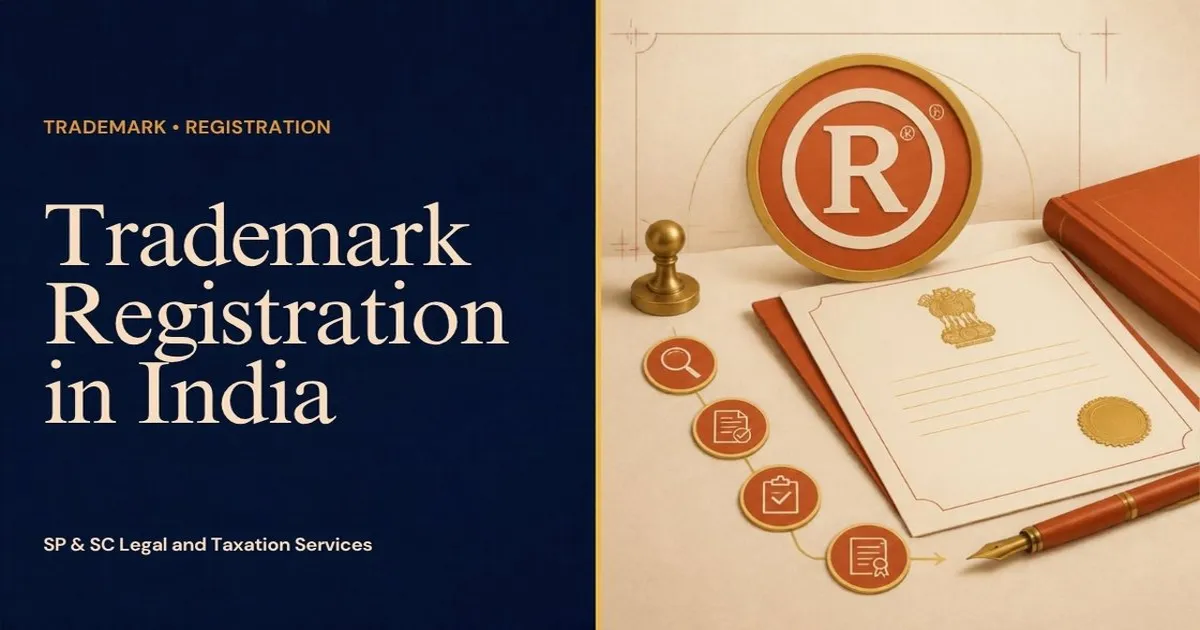
Step-by-step trademark registration in India: search, class selection, TM-A filing, examination, publication and the real timeline.
The trademark registration process in India involves searching for conflicting marks, selecting the correct classes, filing Form TM-A, responding to examination objections, and completing publication and registration. For FY 2025-26, government e-filing fees are ₹4,500 or ₹9,000 per mark, per class, depending on applicant eligibility. Registration protects the mark for ten years from the application date, with further ten-year renewals available. Approval is not automatic, and objections or opposition can substantially extend the timeline.
What should you check before filing a trademark?
Check whether your proposed mark is distinctive, available for your goods or services, and owned by the correct applicant.
A trademark may protect a business name, product name, logo, slogan or another legally recognised identifier. Registration of a company, LLP, domain name or GST account does not itself establish trademark availability.
Search the Trade Marks Registry for identical and similar marks, including phonetic similarities, spelling variations and relevant logos. Check related goods and services, not just exact matches within your preferred class. Earlier unregistered use can also matter, so supplement registry searches with market and online checks. See our trademark search guide.
Two important refusal provisions are:
- Sec. 9 Trade Marks Act, 1999: Covers absolute grounds, including lack of distinctiveness and marks describing the goods or services.
- Sec. 11 Trade Marks Act, 1999: Covers relative grounds, including conflicts with earlier marks and likelihood of confusion.
“Best Tax Services”, for example, is likely to attract a descriptiveness or distinctiveness objection. A search reduces risk but cannot guarantee approval.
How does the trademark registration process work?
The process moves through classification, application, examination, publication and registration, with additional steps if objections or opposition arise.
1. Select the classes and specification
The Nice Classification has 45 classes: 34 for goods and 11 for services. Select classes covering your actual or genuinely intended business activities.
A software business may need different coverage for downloadable software and software-as-a-service. Class selection alone is insufficient: the goods or services specification determines the scope sought.
2. Identify the owner and prepare documents
File in the name of the actual proprietor, whether an individual, partnership, LLP or company. For a sole proprietorship, the proprietor is the individual, not a separate incorporated entity.
Typically, prepare:
- Applicant details and the mark representation.
- The goods or services description.
- Agent authorisation, where applicable.
- Documents supporting reduced-fee eligibility.
- Prior-use evidence, if claiming use before filing.
Under Rule 25 Trade Marks Rules, 2017, a claim of use before the application date requires an affidavit and supporting documents. Otherwise, an application may be filed on a “proposed to be used” basis. Do not invent an earlier use date.
3. File Form TM-A
Submit Form TM-A, usually through the Registry’s e-filing system, and pay the applicable fee for each mark and class.
The application number enables status tracking. Filing does not mean that the Registry has accepted or registered the mark.
4. Respond to examination
The Registry examines the application and may raise procedural or substantive objections. A response should address each objection with legal submissions and relevant evidence. A hearing may follow.
Under Rule 33(4) Trade Marks Rules, 2017, the response period is one month from receipt of the examination report, not invariably 30 days. Non-response can result in abandonment.
5. Complete publication and registration
An accepted application is ordinarily advertised in the Trade Marks Journal. Under Sec. 21 Trade Marks Act, 1999, opposition may be filed within four months from advertisement or re-advertisement.
If no opposition is filed, or opposition is resolved in the applicant’s favour, the application can proceed to registration.
What are the government trademark filing fees?
Ordinary Form TM-A e-filing costs ₹4,500 for eligible individuals, startups and small enterprises, and ₹9,000 for other applicants, per mark and class.
The applicable schedule is in the First Schedule, Trade Marks Rules, 2017.
| Applicant category | E-filing fee per mark, per class | Physical filing fee per mark, per class |
|---|---|---|
| Individual, eligible startup or small enterprise | ₹4,500 | ₹5,000 |
| Other applicants | ₹9,000 | ₹10,000 |
An individual does not need an MSME or DPIIT certificate merely to claim the individual fee category.
Startup or small-enterprise status requires appropriate eligibility evidence, such as applicable DPIIT recognition or qualifying enterprise documentation. Do not assume that every MSME certificate automatically establishes eligibility: the trademark rules’ definition and supporting documents must be checked.
A company or LLP can qualify for the lower fee if it meets the relevant criteria. Incorporation alone does not determine the fee.
These amounts exclude professional charges, applicable taxes on professional services, and charges for separately chargeable proceedings or requests.
How much would a two-class application cost?
An eligible individual filing one mark electronically in two classes pays ₹9,000 in government application fees.
Consider a Bengaluru founder filing a brand for:
| Item | Calculation | Government fee |
|---|---|---|
| Downloadable software in Class 9 | 1 mark × 1 class × ₹4,500 | ₹4,500 |
| Software-as-a-service in Class 42 | 1 mark × 1 class × ₹4,500 | ₹4,500 |
| Total | 1 mark across 2 classes | ₹9,000 |
An applicant outside the reduced-fee categories would pay ₹18,000 for the same coverage: ₹9,000 × two classes.
If the eligible founder separately files both a word mark and a logo in both classes, the government filing total becomes ₹18,000: two marks × two classes × ₹4,500.
Professional work and any later contested proceedings must be budgeted separately.
How long does registration take, and which deadlines matter?
An uncomplicated application may register in approximately 8–14 months, but this is an indicative estimate rather than a guaranteed or statutory turnaround.
Examination may occur within a few months, although Registry workloads, procedural issues and individual case circumstances can cause longer waits. Objections, hearings and opposition can substantially extend the process, sometimes by years.
| Event | Relevant deadline or period | Practical consequence |
|---|---|---|
| Examination report | One month from receipt under Rule 33(4) | Non-response can lead to abandonment |
| Journal advertisement | Four-month opposition window under Sec. 21 | Third parties may oppose registration |
| Receipt of opposition notice | Counterstatement within two months under Sec. 21(2) | Failure results in deemed abandonment |
Track both the online record and communications sent to the address for service. Do not assume that delay by the Registry extends your response deadline.
When can you use ™ and ®, and how long does protection last?
You may use ™ to indicate a trademark claim before filing, but ® should be used only after registration and within its registered scope.
The original suggestion that ™ becomes available only on filing is incorrect. The symbol does not itself confer registration or guarantee exclusive rights.
Under Sec. 23 Trade Marks Act, 1999, registration ordinarily takes effect from the application date. Under Sec. 25 Trade Marks Act, 1999, registration lasts ten years and may be renewed for successive ten-year periods.
Maintain renewal reminders and evidence of genuine use. Registration is not immunity from challenge: cancellation, invalidity and non-use proceedings may arise, including under Sec. 47 Trade Marks Act, 1999.
Protection is territorial. An Indian registration does not automatically provide worldwide rights.
How SP & SC helps
SP & SC Legal and Taxation Services helps applicants assess availability, choose appropriate coverage and manage filing and subsequent proceedings.
We review ownership, proposed use, eligibility documents and search results before recommending a filing strategy. Our fees are a fixed quote after reviewing the case, with government charges and the agreed scope clearly identified.
For Bengaluru businesses, see Trademark Registration in Bangalore, or contact us for a case review.
Frequently asked questions
Is trademark registration compulsory?
Generally, no. However, registration provides statutory rights and access to infringement remedies, subject to the Act. Unregistered marks may still receive passing-off protection.
Can I apply before launching my business?
Yes. You may file on a proposed-to-be-used basis where you genuinely intend to use the mark for the specified goods or services.
Does one application protect every business activity?
No. Protection depends on the mark and registered goods or services. Additional classes or separate mark applications may be necessary.
Is an examination objection the same as opposition?
No. An objection comes from the Registry during examination. Opposition is a third-party challenge following advertisement in the Trade Marks Journal.
Can a descriptive name ever be registered?
Sometimes, including where the statutory requirements for acquired distinctiveness are met. That requires appropriate evidence; ordinary descriptive wording remains difficult to protect.
Written by
SP & SC Editorial
Editorial team at SP & SC Legal and Taxation Services — practising advocates, chartered accountants, and company secretaries publishing hands-on guidance from live client files.
Next steps
What to do next
Guides help you decide. If you need an advocate, CA, or CS on your side, the SP & SC team files, drafts, and represents.