Revised MSME Classification Limits 2025
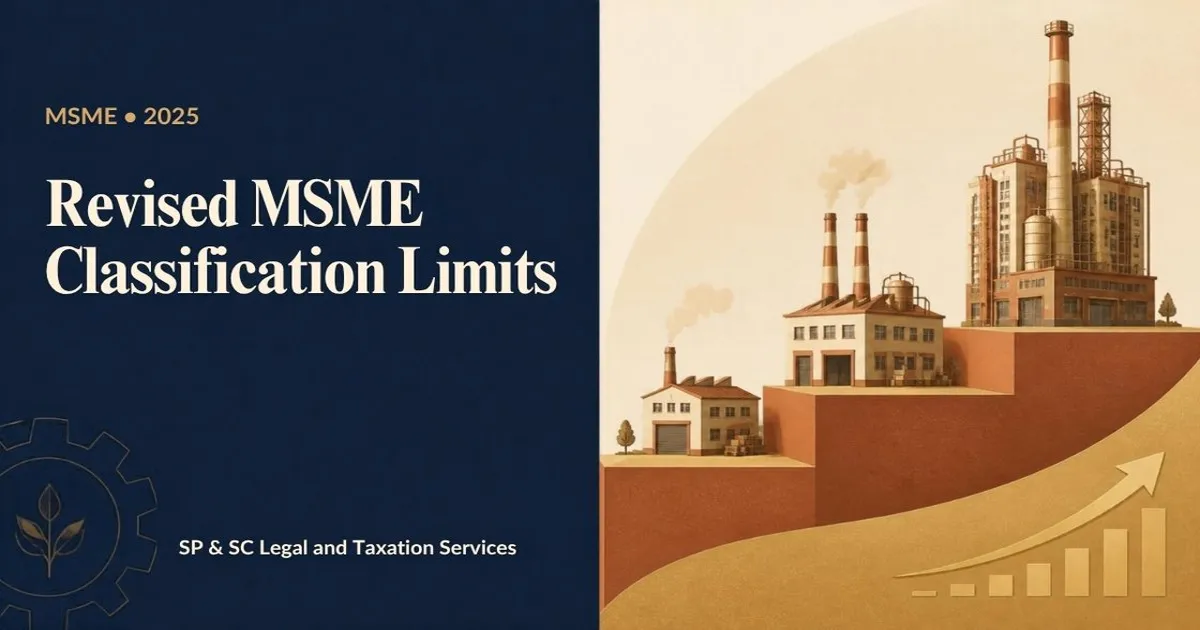
Learn the current MSME classification criteria effective from 2020. Understand the investment and turnover limits for Micro, Small, and Medium Enterprises in India.
Revised MSME Classification Limits 2025
Short answer: As of September 2026, an enterprise is classified as a Micro, Small, or Medium Enterprise (MSME) based on a composite criteria of investment in plant & machinery and annual turnover. The limits, effective since July 1, 2020, are: Micro (Investment < ₹1 Cr & Turnover < ₹5 Cr), Small (Investment < ₹10 Cr & Turnover < ₹50 Cr), and Medium (Investment < ₹50 Cr & Turnover < ₹250 Cr).
What are the current MSME classification limits?
The current classification is based on a composite criteria introduced by the Ministry of MSME notification on June 26, 2020. For an enterprise to be classified in a certain category, it must satisfy both the investment and turnover conditions for that category. If an enterprise crosses the ceiling of either investment or turnover for its current category, it is promoted to the next higher category.
Here are the limits currently in force:
| Enterprise Type | Investment in Plant & Machinery or Equipment | Annual Turnover |
|---|---|---|
| Micro | Does not exceed ₹1 crore | Does not exceed ₹5 crore |
| Small | Does not exceed ₹10 crore | Does not exceed ₹50 crore |
| Medium | Does not exceed ₹50 crore | Does not exceed ₹250 crore |
This single, composite definition applies to both manufacturing and service sector enterprises.
How is investment in plant and machinery calculated?
Investment is calculated based on the written down value (WDV) of plant and machinery or equipment as shown in the Income Tax Return (ITR) for the previous financial year. Key points to remember are:
- Source of Value: The value is linked to your filed ITRs. For new enterprises without a prior ITR, the investment is based on the promoter's self-declaration.
- Exclusions: The cost of pollution control equipment, research and development assets, and industrial safety devices are excluded from the calculation.
- GST: Input Tax Credit (ITC) on GST paid on the purchase of plant and machinery is not included in the investment value.
- Inclusions: All tangible assets (other than land, building, furniture and fittings) as defined in the Income Tax Act, 1961.
How is turnover calculated for MSME classification?
Turnover for classification purposes is your net turnover, which has a specific meaning here. The total turnover figure is taken from your GST returns or other reliable data sources if you are not under GST. Crucially, the turnover from the export of goods or services is excluded when determining your MSME category. This is a significant incentive for export-oriented businesses, as it allows them to remain in a lower MSME category and continue enjoying the associated benefits even if their export revenue is high.
Do I need to re-register if my business grows?
No, you do not need to re-register, but your classification can change automatically. The Udyam Registration portal is dynamically linked with the Income Tax and GST networks. After you file your ITR and GST returns for a financial year, the government's systems will automatically assess your investment and turnover figures. If these figures cross the threshold of your current category, your enterprise will be re-classified upwards. An enterprise graduates to the next higher category if it breaches either the investment or the turnover ceiling. However, an enterprise will only be re-classified to a lower category if it remains below the category's limits for a full year after registration.
What are the benefits of MSME registration (Udyam)?
Registering your business on the Udyam portal provides access to a wide range of government schemes and benefits. These include:
- Protection Against Delayed Payments: Under the MSMED Act, 2006, buyers must pay MSMEs within 45 days. Delays attract compound interest at three times the bank rate. Disputes can be filed on the MSME Samadhaan portal.
- Priority Sector Lending: Banks are mandated to provide a certain portion of their lending to MSMEs, making it easier to secure business loans at competitive rates.
- Government Tenders: Many government tenders are exclusively reserved for MSMEs. Registered enterprises may also get exemptions from paying earnest money deposits (EMD).
- Subsidies and Concessions: You can avail subsidies on patent registration, trademark fees, and electricity bills, along with various tax exemptions.
- Credit Guarantee Schemes: Access to collateral-free loans under the Credit Guarantee Fund Trust for Micro and Small Enterprises (CGTMSE).
For a detailed guide on the process, see our article on Udyam MSME Registration.
Worked example
Let's consider 'Bengaluru Tech Solutions Pvt. Ltd.', a software development company, for the Financial Year 2025-26.
- Business: Software services
- Investment (WDV) in computers, servers, and networking equipment: ₹1.2 crores
- Annual Turnover for FY 2025-26: ₹8 crores (including ₹1 crore of export turnover)
Step 1: Calculate Investment The investment in equipment is ₹1.2 crores. This is more than the ₹1 crore limit for a Micro enterprise but less than the ₹10 crore limit for a Small enterprise.
Step 2: Calculate Turnover for Classification Total Turnover = ₹8 crores Export Turnover = ₹1 crore Turnover for MSME classification = Total Turnover - Export Turnover = ₹8 Cr - ₹1 Cr = ₹7 crores.
This turnover of ₹7 crores is more than the ₹5 crore limit for a Micro enterprise but less than the ₹50 crore limit for a Small enterprise.
Step 3: Determine the Classification
- Investment criteria met: Small (since ₹1.2 Cr is > ₹1 Cr but < ₹10 Cr)
- Turnover criteria met: Small (since ₹7 Cr is > ₹5 Cr but < ₹50 Cr)
Since the company satisfies both conditions for the 'Small' enterprise category, Bengaluru Tech Solutions Pvt. Ltd. will be classified as a Small Enterprise.
If their investment had been only ₹90 lakhs, but turnover was still ₹7 crores, they would still be classified as 'Small' because they crossed the turnover limit for the 'Micro' category.
Common mistakes
- Including Land and Building in Investment: The cost of land, buildings, and furniture/fittings should not be included when calculating the 'Investment in Plant & Machinery or Equipment'.
- Using Gross Turnover: Forgetting to exclude export turnover from the calculation. This can lead to an incorrect (higher) classification, causing you to miss out on benefits.
- Paying for Registration: The official Udyam Registration portal (udyamregistration.gov.in) provides free registration. Many third-party websites charge a fee for this service, which is unnecessary.
- Ignoring ITR and GST Linkage: Assuming your initial self-declared classification is permanent. The government will automatically re-classify your business based on data from your tax filings.
- Creating Multiple Registrations: An enterprise (identified by a single PAN) can only have one Udyam Registration. All business activities, branches, or plants under that PAN must be consolidated for classification.
How SP & SC helps
Navigating MSME classification and compliance is crucial for leveraging government benefits. SP & SC's team of Chartered Accountants and corporate lawyers provides end-to-end assistance for startups and small businesses. We help you with accurate MSME classification, handle the Udyam Registration process, and advise on compliance with laws like the MSME 45-day payment rule. We ensure your business is correctly structured to maximize benefits from day one. For complete business setup and compliance services, explore our offerings on our Start Your Business page.
Frequently asked questions
Can a trading company register as an MSME?
Yes. Since July 2021, wholesale and retail traders are permitted to register on the Udyam portal. However, their benefits are currently limited to Priority Sector Lending by financial institutions and banks.
What documents are required for Udyam Registration?
The only mandatory document for the proprietor, managing partner, or director is their Aadhaar number. The Udyam portal is fully online and paperless. It auto-populates PAN and GSTIN details from government databases.
How long is the Udyam Registration certificate valid?
The Udyam Registration Number is a permanent identification number, and the certificate has perpetual validity. There is no need for renewal as long as the enterprise is operational.
Is Udyam Registration mandatory?
No, Udyam registration is not mandatory. However, it is highly recommended as it is the only way to avail the various benefits, schemes, and protections offered by the government under the MSMED Act.
What if my company has multiple branches or plants?
An enterprise with a single PAN can have only one Udyam Registration. You must add all your branches or plants under that single registration. The total investment and turnover of all such units will be clubbed together to determine the MSME category.
Get a fixed-fee quote
Ready to register your business or need clarity on your MSME status? Share your business documents with us for a confidential review, and we will provide a written fixed-fee quote for our services. We handle everything from registration and compliance to legal and tax advisory, end to end. Contact SP & SC or WhatsApp us at +91 90356 74566.
Written by
SP & SC Editorial
Editorial team at SP & SC Legal and Taxation Services — practising advocates, chartered accountants, and company secretaries publishing hands-on guidance from live client files.
Next steps
What to do next
Guides help you decide. If you need an advocate, CA, or CS on your side, the SP & SC team files, drafts, and represents.