Minimum Wages in Karnataka: How Employers Stay Compliant
Employers in Karnataka must pay minimum wages as set by the state. This guide explains how to classify employees, calculate wages, and maintain records to ensure compliance.
Minimum Wages in Karnataka: How Employers Stay Compliant
Short answer: Employers in Karnataka must pay minimum wages specified in government notifications, which vary by industry, employee skill level (unskilled, semi-skilled, skilled, highly skilled), and geographical zone. These wages consist of a basic rate and a Variable Dearness Allowance (VDA) revised periodically. Compliance involves correct calculation, timely payment through approved methods, maintaining statutory registers, and issuing wage slips to avoid significant penalties under the Code on Wages, 2019.
What are the components of minimum wages in Karnataka?
Minimum wages in Karnataka are comprised of two main parts: a Basic Wage and a Variable Dearness Allowance (VDA). The Basic Wage is a fixed amount determined for a specific job role, skill level, and zone. The VDA is an adjustment component linked to the Consumer Price Index (CPI) that is revised periodically, typically twice a year (effective from 1st April and 1st October), to protect employees' real wages from the effects of inflation. Employers must pay the sum of the Basic Wage and the latest applicable VDA.
How are minimum wages determined in Karnataka?
The government determines minimum wages based on a combination of three factors to ensure fair compensation.
- Scheduled Employments: The Minimum Wages Act, 1948, and now the Code on Wages, 2019, empower the government to fix minimum wages for specific industries or 'scheduled employments'. Karnataka has a long list of such employments, from security services and shops & commercial establishments to engineering and automobile workshops.
- Skill Categories: Within each employment, workers are classified based on their skill level. This classification directly impacts the wage rate.
- Zones: To account for varying costs of living, Karnataka is divided into different zones. For instance, Zone 1 typically covers the Bengaluru metropolitan area (BBMP), while other zones cover different city corporations, municipal councils, and rural areas. Wages are highest in Zone 1.
Where can I find the latest minimum wage notification for Karnataka?
You can find the latest official notifications on the website of the Karnataka Labour Department. The government gazettes these notifications, which are then published online. To find the applicable rate, you need to identify the correct notification for your industry (scheduled employment), locate the zone your business operates in, and then find the wage listed for the specific skill category of your employee. Since the VDA changes, it is critical to check for new notifications every six months, usually around April and October.
What records must an employer maintain for minimum wage compliance?
Under the rules supplementing the Code on Wages, 2019, employers must maintain specific records to ensure transparency and prove compliance during inspections.
Key records include:
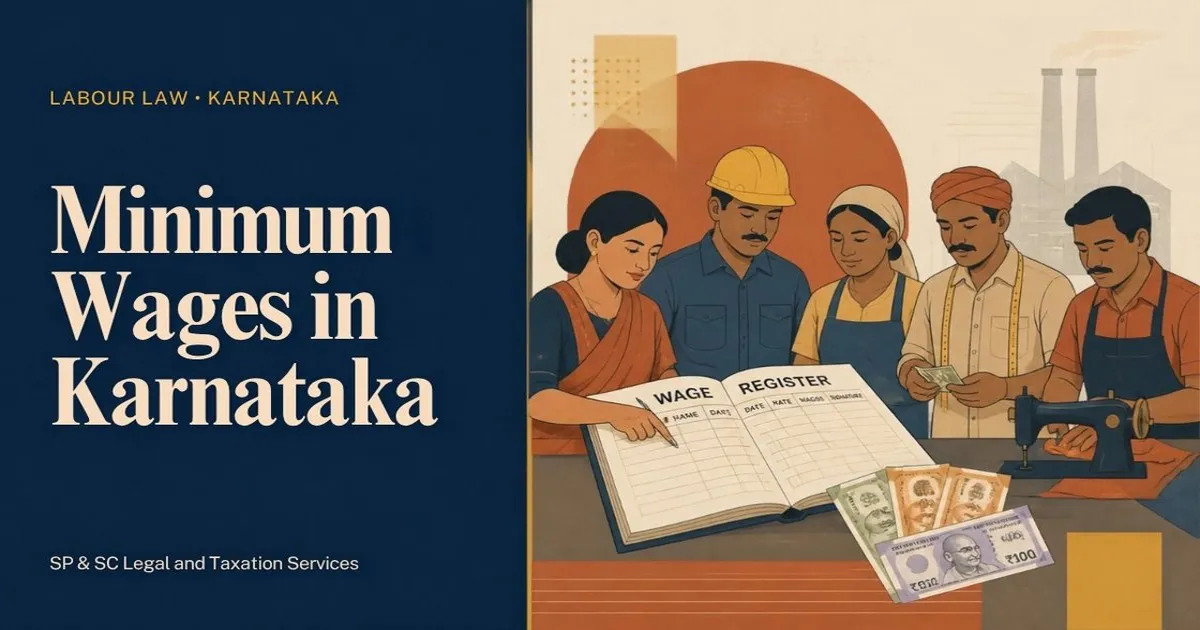
- Register of Wages: This is a detailed record of wages paid to every employee, including calculations, deductions, and the actual amount disbursed.
- Muster Roll: A record of attendance for all employees.
- Wage Slips: Employers are required to provide a wage slip to every employee for each pay period. The slip must detail all components of the wage, deductions made, and the final net pay.
These records must be preserved for a prescribed period and be made available for inspection by a Labour Inspector. Maintaining digital records is generally permitted, provided they are in the prescribed format.
Employee Skill Classification Guide
Correctly classifying your employees is the first step to paying the right minimum wage. Misclassification is a common compliance error.
| Skill Category | Description | Example Roles |
|---|---|---|
| Unskilled | Work involving simple manual duties requiring little to no prior experience, judgment, or training. | Cleaner, Peon, Watchman, Office Boy, General Helper |
| Semi-skilled | Work requiring some experience or partial skill, often acquired through on-the-job training. | Assistant Cook, Pump Operator, Driver (Light Motor Vehicle), Assistant Plumber |
| Skilled | Work requiring specific skills, technical knowledge, and experience, usually acquired through formal training or apprenticeship. | Electrician, Plumber, Carpenter, Cook, Office Assistant/Clerk, Cashier, Receptionist |
| Highly Skilled | Work requiring a high degree of technical expertise, judgment, adaptability, and supervisory capabilities. | Office Supervisor, Senior Technician, IT Support Specialist, Machine Foreman |
What are the penalties for not paying minimum wages?
The Code on Wages, 2019, which consolidates laws related to wages, imposes strict penalties for non-compliance. Paying employees less than the notified minimum wage is a serious offence. For a first-time offence, the penalty can be a fine of up to ₹50,000. If an employer commits a similar offence again within five years, the penalty can include imprisonment for up to three months, a fine of up to ₹1,00,000, or both. Aggrieved employees can also file claims for the unpaid amount, potentially with compensation up to ten times the amount of the claim.
Worked example
Let's consider a scenario for a technology startup, 'Innovate Labs Pvt. Ltd.', operating from an office in Indiranagar, Bengaluru, in September 2026.
- Location: Indiranagar, Bengaluru (falls under Zone 1 - BBMP area, the highest wage zone).
- Employees: An Office Assistant and a Cleaner.
- Classification: The Office Assistant is a 'Skilled' employee, and the Cleaner is an 'Unskilled' employee under the 'Shops and Commercial Establishments' schedule.
Let's assume the following hypothetical minimum monthly wages for Zone 1 as of September 2026 (these are for illustration only; always check the latest notification):
- Unskilled: ₹15,200 (Basic + VDA)
- Skilled: ₹18,600 (Basic + VDA)
Calculation for Innovate Labs:
- Minimum Wage for Cleaner (Unskilled): ₹15,200 per month.
- Minimum Wage for Office Assistant (Skilled): ₹18,600 per month.
- Statutory Deductions:
- Employee PF Contribution (12%): Deducted from the employee's wage. The employer makes a matching contribution.
- Employee ESI Contribution (0.75%): Deducted if gross wage is up to ₹21,000/month. The employer contributes 3.25%.
- Professional Tax (PT): In Karnataka, PT is ₹200 per month for employees earning ₹25,000 or more. Since both employees earn less than ₹25,000, no PT is deducted. See our guide on Professional Tax in Karnataka.
Compliance Steps:
- Innovate Labs must ensure the net pay credited to the bank accounts of the cleaner and office assistant is their respective minimum wage minus applicable PF and ESI deductions.
- The company must issue a detailed monthly wage slip (payslip) to both.
- It must maintain a Register of Wages and a Muster Roll.
- The employer's contributions to PF and ESI must be deposited on time.
Common mistakes
- Using Outdated Wage Rates: Failing to check for and apply the revised VDA, which is typically updated twice a year.
- Incorrect Employee Classification: Classifying a skilled employee (like a clerk) as unskilled to pay a lower wage.
- Ignoring Zone Differences: Applying the wage rate of a lower zone (e.g., a rural area) to employees working in a city like Bengaluru.
- Making Unlawful Deductions: Deducting amounts from wages that are not authorized by law, such as fines for damages or performance issues, without following due process.
- Poor Record-Keeping: Not maintaining the mandatory registers (Wages, Muster Roll) or failing to issue wage slips, making it difficult to prove compliance during an inspection.
How SP & SC helps
Navigating Karnataka's labour laws can be complex. At SP & SC, we provide end-to-end labour compliance solutions for businesses. We assist with the correct classification of your workforce, conduct comprehensive audits to identify compliance gaps, and help establish robust payroll processes. Our team ensures you maintain accurate statutory records and represents you during departmental inspections. We help you stay compliant so you can focus on growing your business. For a full scope of our services, please see our Labour Compliance page.
Frequently asked questions
H3: Is the minimum wage the same across all of Karnataka?
No, it is not. Karnataka is divided into several zones (e.g., Zone 1 for BBMP, Zone 2 for other City Corporations) to reflect the different costs of living. Minimum wages are highest in Zone 1 and progressively lower in other zones.
H3: How often are minimum wages revised?
The basic rates for minimum wages are fixed for a longer duration. However, the Variable Dearness Allowance (VDA) component is revised periodically, usually twice a year, effective from April 1st and October 1st, to account for inflation.
H3: Are minimum wages applicable to part-time employees?
Yes. Part-time employees are also covered. Their minimum wages are calculated on a pro-rata basis. For example, if an employee works for four hours a day in an eight-hour-a-day job, they are entitled to at least half of the daily minimum wage.
H3: Can I pay in kind instead of cash?
No. The Code on Wages, 2019 mandates that wages must be paid in current coin or currency notes, or by cheque, or by crediting the wages to the employee's bank account. Payment in kind is not permitted, although deductions authorised by law (like for PF, ESI, or accommodation provided by the employer under specific rules) are allowed from the wage.
H3: Do I have to pay minimum wages to interns or apprentices?
It depends. Apprentices engaged under the Apprentices Act, 1961, are paid a stipend as prescribed under that Act, not the minimum wage. However, if an individual is labelled an 'intern' or 'trainee' but is performing the duties of a regular employee, the provisions of minimum wages will likely apply. It is crucial to structure internships correctly to avoid being misconstrued as employment. Read our guide on drafting employment agreements.
Get a fixed-fee quote
Ensuring full compliance with minimum wage laws requires careful documentation and process management. To get a written fixed-fee quote for a labour compliance audit or ongoing advisory, please Contact SP & SC. You can also reach us via WhatsApp at +91 90356 74566. Our team of CAs and advocates handles all aspects of labour and statutory compliance, allowing you to run your business with peace of mind.
Written by
SP & SC Editorial
Editorial team at SP & SC Legal and Taxation Services — practising advocates, chartered accountants, and company secretaries publishing hands-on guidance from live client files.
Next steps
What to do next
Guides help you decide. If you need an advocate, CA, or CS on your side, the SP & SC team files, drafts, and represents.