
A Khata vs B Khata in Bengaluru: What You Can and Cannot Do
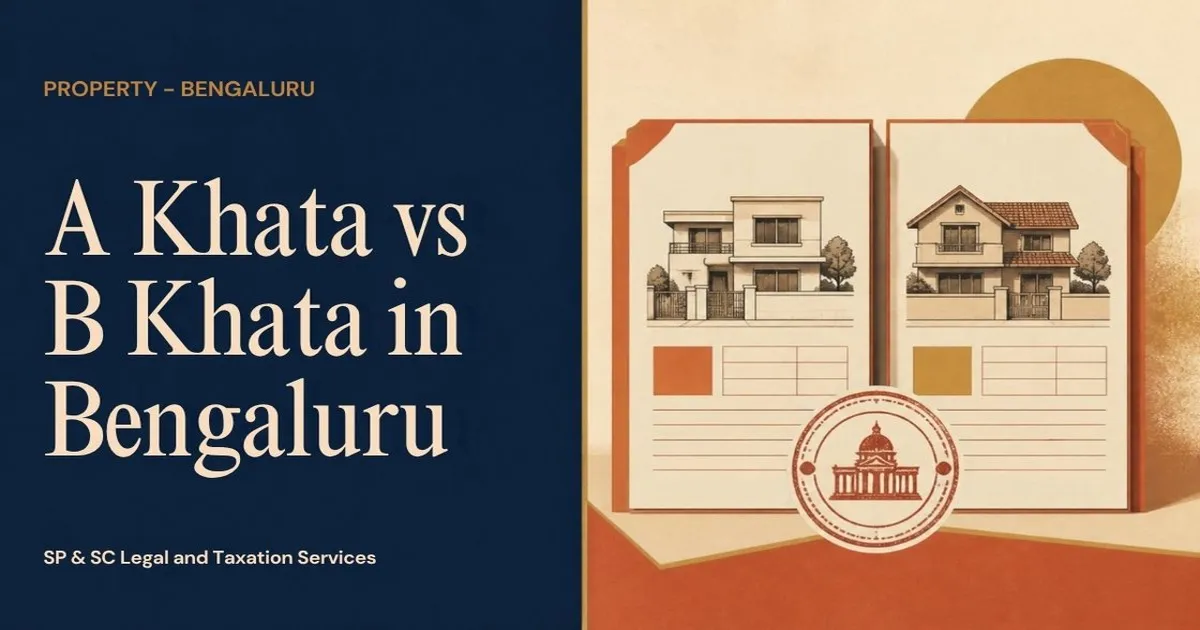
BBMP classification, loan and building-plan implications, and A-khata regularisation.
A Khata vs B Khata in Bengaluru: What You Can and Cannot Do
In Bengaluru, property classification as 'A Khata' or 'B Khata' significantly impacts its legal standing, loan eligibility, and development potential. An 'A Khata' property is fully compliant with municipal regulations, whereas a 'B Khata' property has some deviations or pending compliance. Understanding this distinction is crucial for property owners, buyers, and developers to navigate the city's real estate landscape effectively and avoid future complications.
What is the BBMP A vs B Khata classification?
The Bruhat Bengaluru Mahanagara Palike (BBMP) classifies properties into 'A Khata' and 'B Khata' based on their compliance with municipal laws, primarily for property tax collection and record-keeping. An 'A Khata' property is one that is legally constructed on approved land, has all necessary approvals, and pays property taxes regularly, making it fully compliant with the Karnataka Municipal Corporation Act, 1976. Conversely, a 'B Khata' property, while also paying property taxes, typically has some form of deviation from sanctioned plans, is built on unapproved land, or lacks certain compliance certificates, as per the Karnataka Municipal Corporations Act, 1976, Section 108A.
The Khata document itself is an account of property assessment, detailing the property owner's name, property size, location, and tax payable. It is not a document of ownership but rather a record for property tax assessment. The BBMP introduced the 'B Khata' register in 2007 to bring properties with minor deviations or those built on revenue land into the tax net, thereby increasing municipal revenue. However, this classification also creates a clear distinction in the legal standing and usability of the properties.
Does Khata classification affect home loan eligibility?
Yes, Khata classification significantly impacts home loan eligibility, with 'A Khata' properties generally being eligible for home loans from banks and financial institutions, while 'B Khata' properties face considerable challenges. Banks typically require properties to have clear titles and be fully compliant with municipal regulations to sanction loans, which 'A Khata' properties fulfil. For 'B Khata' properties, banks are often hesitant to provide loans due to the inherent legal risks, such as potential demolition, lack of clear title, or difficulties in resale.
Some financial institutions might consider providing loans for 'B Khata' properties under specific conditions, such as if the property owner has initiated the regularisation process or if the deviations are minor and can be easily rectified. However, these loans usually come with higher interest rates and stricter terms. It is always advisable to consult with multiple lenders and seek legal opinion before proceeding with a loan application for a 'B Khata' property.
How does Khata classification impact building plan sanction?
Khata classification directly impacts the ability to obtain building plan sanctions, with only 'A Khata' properties being eligible for new construction or significant modifications requiring BBMP approval. The BBMP will not sanction building plans for 'B Khata' properties because they inherently possess legal or regulatory non-compliance issues. This means that owners of 'B Khata' properties cannot legally undertake new construction, add floors, or make substantial alterations to their existing structures.
Any construction or modification on a 'B Khata' property without a sanctioned plan is considered illegal and can lead to penalties, demolition orders, or other legal consequences from the BBMP. To obtain a building plan sanction, a 'B Khata' property must first be converted to an 'A Khata' by regularising all existing deviations and obtaining the necessary clearances.
What is the regularisation route for B Khata properties?
The regularisation route for 'B Khata' properties involves a process to convert them into 'A Khata' by addressing and rectifying the existing legal and regulatory non-compliances. This process is often facilitated through schemes introduced by the Karnataka government, such as the Akrama Sakrama scheme, though such schemes have faced legal challenges and are subject to specific rules and deadlines.
To regularise a 'B Khata' property, owners typically need to:
- Pay all outstanding property taxes and penalties: Ensure all dues to the BBMP are cleared.
- Rectify deviations: Address any structural or plan deviations as per municipal bye-laws.
- Obtain necessary NOCs: Secure No Objection Certificates from various departments, such as fire safety, environmental, and urban development.
- Submit an application for Khata conversion: File a formal application with the BBMP along with all supporting documents, including property deeds, tax receipts, and rectified building plans.
- Pay betterment charges: These are fees levied by the BBMP for providing civic amenities and services to properties that were previously non-compliant.
The exact process and eligibility criteria can vary based on government notifications and the nature of the non-compliance. It is crucial to stay updated on the latest regulations and seek professional guidance for a smooth conversion process.
What are the recent B-Khata Bill developments?
Recent developments concerning 'B Khata' properties in Bengaluru include the Karnataka Land Revenue (Amendment) Bill, 2024, which aims to provide a pathway for regularisation of certain 'B Khata' properties. This Bill, if enacted, could potentially allow for the conversion of 'B Khata' properties built on revenue land (agricultural land converted to non-agricultural use without proper approval) to 'A Khata' status, provided certain conditions are met and betterment charges are paid.
The proposed legislation seeks to address the long-standing issue of properties built on unapproved layouts or revenue sites, which currently fall under the 'B Khata' category. The objective is to bring these properties into the mainstream, regularise their status, and enable owners to access civic amenities and financial services more easily. However, the Bill's specifics, including eligibility criteria, betterment charges, and the application process, are subject to finalisation and notification by the government. Property owners should monitor these developments closely as they could significantly impact the value and legal standing of their 'B Khata' properties.
| Feature | A Khata Property | B Khata Property |
|---|---|---|
| Legal Status | Fully compliant with BBMP and municipal regulations. | Non-compliant due to deviations, built on unapproved land, or lacking clearances. |
| Home Loan Eligibility | Generally eligible for home loans from all major banks and financial institutions. | Difficult to obtain home loans; limited options, often with higher interest rates. |
| Building Plan Sanction | Eligible for obtaining building plan sanctions for new construction or modifications. | Not eligible for building plan sanctions; any new construction is considered illegal. |
| Resale Value | Higher resale value due to clear title and legal compliance. | Lower resale value due to legal ambiguities and potential risks. |
| Property Tax | Pays property tax to BBMP. | Pays property tax to BBMP (often introduced to the tax net via the 'B Khata' register). |
| Conversion | No conversion needed, as it is already compliant. | Can potentially be converted to 'A Khata' through regularisation schemes. |
| Ownership Proof | Stronger proof of legal ownership and compliance. | Weaker legal standing, indicating underlying issues. |
How SP & SC helps
Navigating the complexities of property classification, especially concerning 'A Khata' and 'B Khata' properties, requires expert legal guidance. SP & SC Legal and Taxation Services provides comprehensive property legal opinions, helping you understand the legal standing of your property, identify potential risks, and guide you through regularisation processes. Our team ensures you make informed decisions, whether you are buying, selling, or developing property in Bengaluru. Visit our service page for more details: /services/legal-contracts/property-legal-opinion
Frequently asked questions
Is Khata a title document?
No, Khata is not a title document. It is an extract from the municipal records that identifies the person liable to pay property tax. It contains details like the owner's name, property size, and location, primarily for property tax assessment purposes, but it does not confer ownership.
Can I sell a B Khata property?
Yes, you can sell a 'B Khata' property, but it often comes with challenges. Buyers may be hesitant due to the legal ambiguities, difficulty in obtaining home loans, and potential risks associated with non-compliance. The resale value is generally lower compared to an 'A Khata' property.
What are betterment charges?
Betterment charges are fees levied by the BBMP on properties that are being regularised or converted from 'B Khata' to 'A Khata'. These charges are meant to compensate the municipal corporation for providing civic amenities and infrastructure to properties that were previously outside the fully compliant tax net.
Can I get an 'A Khata' for a property built on revenue land?
Historically, properties on revenue land without proper conversion to non-agricultural use were typically 'B Khata'. However, recent legislative efforts, such as the proposed Karnataka Land Revenue (Amendment) Bill, 2024, aim to provide a mechanism for regularising such properties and converting them to 'A Khata' status, subject to specific conditions and payment of betterment charges.
What is the Akrama Sakrama scheme?
Akrama Sakrama was a scheme introduced by the Karnataka government to regularise unauthorised constructions and deviations in properties by levying penalties. The scheme aimed to bring such properties into the legal framework. However, it has faced legal challenges and its implementation has been complex and intermittent.
What documents are required for Khata transfer or conversion?
For Khata transfer (e.g., upon sale or inheritance) or conversion from 'B Khata' to 'A Khata', typically required documents include the sale deed, latest property tax receipts, encumbrance certificate, identity proof, address proof, and any relevant approvals or regularisation certificates. The exact list can vary based on the specific transaction and BBMP requirements.
Written by
SP & SC Editorial
Editorial team at SP & SC Legal and Taxation Services — practising advocates, chartered accountants, and company secretaries publishing hands-on guidance from live client files.
Next steps
What to do next
Guides help you decide. If you need an advocate, CA, or CS on your side, the SP & SC team files, drafts, and represents.