FPO Benefits: Tax Holidays and Central Sector Schemes
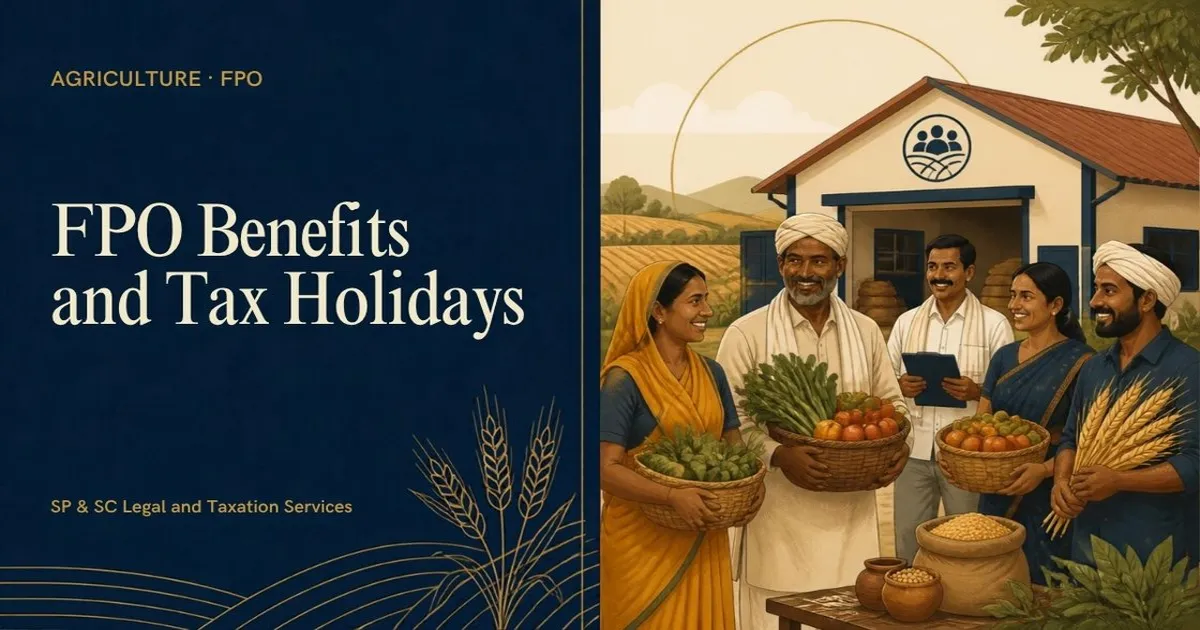
Section 10(23FF) deduction, 15% tax under 115BAD, and central sector 10,000 FPO scheme.
FPO Benefits: Tax Holidays and Central Sector Schemes
Farmer Producer Organisations (FPOs) in India enjoy significant tax benefits and government support, designed to empower farmers and boost agricultural productivity. These include income tax deductions under Section 10(23FF) and concessional tax rates under Section 115BAD. Furthermore, the "10,000 FPO" Central Sector Scheme offers crucial financial assistance through equity grants, matching grants, and other support mechanisms, alongside simplified compliance requirements.
What are the income tax benefits for FPOs?
FPOs can avail substantial income tax benefits, primarily through deductions for certain incomes and concessional tax rates, aimed at reducing their tax burden and encouraging reinvestment.
Section 10(23FF) Deduction
Section 10(23FF) of the Income Tax Act, 1961, provides a significant tax exemption for FPOs. This section states:
"10. Incomes not included in total income. ... (23FF) any income of a Farmer Producer Company, having a turnover of less than one hundred crore rupees in any previous year, from the marketing of agricultural produce grown by its members, or from the purchase of agricultural implements, seeds, livestock or other articles intended for the use of its members, or from the processing of agricultural produce of its members, shall be exempt from tax: Provided that the exemption under this clause shall not be available to a Farmer Producer Company which has opted for taxation under section 115BAA or section 115BAB or section 115BAC or section 115BAD."
This means that if your FPO, registered as a Producer Company under the Companies Act, 2013, has a turnover of less than ₹100 crore in a financial year, income derived from specific activities related to its members' agricultural produce or inputs is entirely exempt from income tax. This exemption covers:
- Marketing agricultural produce grown by its members.
- Purchasing agricultural implements, seeds, livestock, or other articles for its members' use.
- Processing agricultural produce of its members.
It's crucial to note the proviso: if an FPO opts for concessional tax regimes under Section 115BAA, 115BAB, 115BAC, or 115BAD, it cannot simultaneously claim the exemption under Section 10(23FF).
Concessional Tax Rate under Section 115BAD
For FPOs that are resident cooperative societies, Section 115BAD offers a reduced corporate tax rate, provided certain conditions are met. This section states:
"115BAD. Tax on income of certain resident co-operative societies. (1) Notwithstanding anything contained in this Act, the income-tax payable in respect of the total income of a resident co-operative society, for any previous year relevant to the assessment year beginning on or after the 1st day of April, 2021, shall, at the option of such co-operative society, be computed at the rate of fifteen per cent, if the conditions contained in sub-section (2) are satisfied. ... (2) For the purposes of sub-section (1), the following conditions shall apply, namely:— (i) the co-operative society has not availed any exemption or deduction under any of the provisions of this Act other than the deduction under section 80JJAA or section 80M; (ii) the co-operative society has not claimed any set off of any loss carried forward or depreciation brought forward from any earlier assessment year, if such loss or depreciation is attributable to any deduction referred to in clause (i); (iii) the co-operative society has not claimed any deduction for additional depreciation under section 32(1)(iia); (iv) the co-operative society has not claimed any deduction under section 33AB or section 33ABA; (v) the co-operative society has not claimed any deduction under section 35AD or section 35CCC or section 35CCD; (vi) the co-operative society has not claimed any deduction under Chapter VI-A other than the deduction under section 80JJAA or section 80M."
Under Section 115BAD, a resident cooperative society (which many FPOs are structured as) can opt to pay income tax at a concessional rate of 15% (plus surcharge and cess), provided it foregoes certain exemptions and deductions available under other provisions of the Income Tax Act. This can be highly beneficial for FPOs with higher turnovers or those not primarily engaged in activities covered by Section 10(23FF).
What is the "10,000 FPO" Central Sector Scheme?
The "Formation & Promotion of 10,000 FPOs" Central Sector Scheme, launched by the Government of India, is a flagship initiative to support the establishment and growth of FPOs across the country, providing financial, technical, and managerial assistance.
This scheme aims to create 10,000 new FPOs by 2027-28, helping farmers gain better market access, improve their bargaining power, and access modern technology and inputs. The scheme is implemented by various agencies, including Small Farmers' Agri-Business Consortium (SFAC), National Cooperative Development Corporation (NCDC), and National Bank for Agriculture and Rural Development (NABARD).
What financial support is available through Equity Grant and Matching Grant?
The scheme provides crucial financial support to FPOs through Equity Grants and Matching Grants, designed to strengthen their financial base and encourage member participation.
Equity Grant
An Equity Grant of up to ₹15 lakh per FPO is provided to eligible FPOs. This grant is aimed at enhancing the equity base of the FPO, which helps them access institutional credit and undertake business activities. The grant is provided on a matching basis, meaning the FPO needs to raise a certain amount of equity from its members to receive the grant. This encourages members to invest in their FPO, fostering a sense of ownership and commitment.
Matching Grant
A Matching Grant of up to ₹6 lakh per FPO is also available. This grant is provided to FPOs that raise equity from their members. The objective is to double the equity base of the FPO, further strengthening its financial position. This grant is particularly beneficial for nascent FPOs that may struggle to raise substantial capital initially.
These grants are critical for FPOs to invest in infrastructure, procure machinery, establish processing units, and manage working capital, thereby enhancing their operational capabilities and profitability.
What compliance simplifications are offered to FPOs?
The government has introduced several compliance simplifications for FPOs, particularly those registered as Producer Companies, to ease their administrative burden and allow them to focus more on their core agricultural activities.
These simplifications include:
- Reduced Filing Requirements: Certain annual filing requirements under the Companies Act, 2013, may be simplified for Producer Companies compared to other company structures.
- Relaxed Board Meeting Norms: There might be relaxations in the frequency or quorum requirements for board meetings, considering the operational realities of FPOs.
- Exemptions from Certain Provisions: Producer Companies may be exempt from certain provisions of the Companies Act, 2013, that are more suited for large corporations, such as specific requirements related to independent directors or audit committees, depending on their size and turnover.
These measures aim to create a more conducive regulatory environment for FPOs, enabling them to operate efficiently without being bogged down by excessive paperwork and complex legal procedures.
Comparison of Key FPO Benefits
| Feature | Section 10(23FF) Exemption | Section 115BAD Concessional Rate | 10,000 FPO Scheme (Equity/Matching Grant) |
|---|---|---|---|
| Benefit Type | Income Tax Exemption | Concessional Income Tax Rate | Financial Grant |
| Applicability | Producer Companies (turnover < ₹100 Cr) | Resident Cooperative Societies | All eligible FPOs (Producer Companies, Cooperative Societies, etc.) |
| Tax Rate | 0% on specified incomes | 15% (plus surcharge/cess) | Not applicable (direct financial support) |
| Conditions | Income from specific agricultural activities; cannot opt for 115BAD/BAA/BAB/BAC | Forego certain deductions/exemptions; cannot claim 10(23FF) | FPO formation, member equity contribution, business plan |
| Maximum Benefit | Full exemption on eligible income | Reduced tax liability | Up to ₹15 Lakh (Equity Grant) + Up to ₹6 Lakh (Matching Grant) |
| Primary Goal | Encourage agricultural marketing and processing by members | Provide lower corporate tax for cooperative FPOs | Strengthen FPO financial base, encourage member ownership |
How SP & SC helps
SP & SC Legal and Taxation Services assists founders and small business owners in India with comprehensive support for establishing and managing FPOs. From navigating the complexities of Producer Company registration to ensuring compliance with tax regulations and assisting with applications for government schemes like the 10,000 FPO scheme, our experts provide tailored guidance. We help you structure your FPO efficiently to maximise tax benefits and access available grants. Learn more about our services at /services/start-business/producer-company.
Frequently asked questions
What is a Farmer Producer Organisation (FPO)?
A Farmer Producer Organisation (FPO) is a legal entity formed by farmers, typically registered as a Producer Company under the Companies Act, 2013, or as a Cooperative Society. Its primary objective is to enable farmers to collectively procure inputs, access technology, process and market their produce, and improve their bargaining power, thereby enhancing their income and livelihoods.
Can an FPO claim both Section 10(23FF) exemption and the Section 115BAD concessional rate?
No, an FPO cannot claim both the Section 10(23FF) exemption and the Section 115BAD concessional rate simultaneously. The proviso to Section 10(23FF) explicitly states that the exemption is not available if the FPO has opted for taxation under Section 115BAD (or 115BAA, 115BAB, 115BAC). FPOs must choose the regime that offers the most beneficial tax treatment based on their income sources and financial structure.
What is the turnover limit for claiming Section 10(23FF) exemption?
To claim the exemption under Section 10(23FF), the Farmer Producer Company must have a turnover of less than ₹100 crore in the relevant previous year. If the turnover exceeds this limit, the exemption will not be applicable for that financial year.
How does the "10,000 FPO" scheme benefit individual farmers?
The "10,000 FPO" scheme benefits individual farmers by empowering them through collective action. By joining an FPO, farmers gain better access to quality inputs at lower prices, improved market linkages for their produce, technical guidance, processing facilities, and credit. This collective strength helps them overcome challenges faced by individual smallholders, leading to increased income and improved living standards.
What are the main differences between an Equity Grant and a Matching Grant under the FPO scheme?
An Equity Grant, up to ₹15 lakh, is provided to an FPO to strengthen its equity base, often requiring a matching contribution from members. A Matching Grant, up to ₹6 lakh, is specifically designed to double the equity raised by members, further enhancing the FPO's capital. Both aim to improve the FPO's financial health and ability to undertake business activities.
Are there any specific compliance requirements for FPOs to avail these benefits?
Yes, FPOs must adhere to specific compliance requirements. For tax benefits, they need to file their income tax returns correctly, maintain proper books of accounts, and meet the conditions stipulated in the respective sections of the Income Tax Act. For the 10,000 FPO scheme, they must be registered, have a minimum number of members, develop a viable business plan, and comply with the guidelines set by the implementing agencies like SFAC, NABARD, or NCDC.
Written by
SP & SC Editorial
Editorial team at SP & SC Legal and Taxation Services — practising advocates, chartered accountants, and company secretaries publishing hands-on guidance from live client files.
Next steps
What to do next
Guides help you decide. If you need an advocate, CA, or CS on your side, the SP & SC team files, drafts, and represents.